Exciting news greeted the posse of press who headed to the Marriott Denver Tech Center's Atrium Saturday October 3 for a press conference entitled "MQA and Mytek Present: From Studio to Home." Both Bob Stuart of MQA, Ltd. (above right) and Michal Jurewicz of Mytek Digital (above center) were present, as well as Pål Bråtelund, Strategic Partnership Manager for Tidal (above left), and, for MQA partner AudioQuest, AQ VP Steve Silberman.
Thanks to a lovely-sounding assemblage of components—Vandersteen's Model Seven loudspeakers, Boulder 1060 stereo amplifier, and AudioQuest cabling—we were able to take a first listen to Mytek's Brooklyn ($1995), an idiosyncratically styled, compact USB2 DAC/preamplifier/headphone all-in-one that will ship in early December. Touted as "the world's first stand-alone, high-performance DAC with MQA®technology," the 4 lb, MQA-equipped Brooklyn converts up to 32/384k PCM (including DXD), and native DSD up to DSD256 (DSDx4). It also claims a 130dB dynamic range, which should be sufficient for sending your chickens and more running for cover.
 At the conference's start, Stuart (above) laid down the bottom line: "You can take an MQA-encoded file, play it anywhere, and it will sound better than CD."
"Our hearing is much more sensitive to timing information than we thought," he continued. "Because of our ingrained sense of survival, human beings are at least five times more sensitive to timing information than to frequency. We can discern time intervals of a few microseconds.
"What works perfectly for instruments doesn't work for digital filters, which smear timing. CD smears timing for 4 milliseconds, which is the equivalent of sound traveling 4 feet. With MQA, we've redesigned the way digital sampling is done. MQA reduces ringing and smearing dramatically, over ten times more than on 24/192 recordings."
What Stuart did not address at the conference, however, was the unexpected delay in MQA implementation. After the announcement at May's Munich High End Show that MQA, Inc. had over 100 strategic partners, everything has been quiet. Rumor had it that MQA decoding was requiring more battery power than was practical for mobile phones to supply.
Asked to comment on the situation, Stuart replied by email:
MQA saw it necessary for a small delay to optimize the delivery platform in order to provide more flexible streaming. MQA has also been preparing decoders for the mobile platform, but the most important aspect to note is that the audio is still amazing and unchanged. MQA has been busy building the supply chain. By working to increase the efficiency of the delivery, with no compromise to the audio, we make MQA a better company to do business with.
We have many customers in the pipeline in addition to the following manufacturers that have recently announced including AudioQuest, Pioneer, Onkyo, Bluesound and Mytek. And you should expect more by [the 2016] CES.
At the conference's start, Stuart (above) laid down the bottom line: "You can take an MQA-encoded file, play it anywhere, and it will sound better than CD."
"Our hearing is much more sensitive to timing information than we thought," he continued. "Because of our ingrained sense of survival, human beings are at least five times more sensitive to timing information than to frequency. We can discern time intervals of a few microseconds.
"What works perfectly for instruments doesn't work for digital filters, which smear timing. CD smears timing for 4 milliseconds, which is the equivalent of sound traveling 4 feet. With MQA, we've redesigned the way digital sampling is done. MQA reduces ringing and smearing dramatically, over ten times more than on 24/192 recordings."
What Stuart did not address at the conference, however, was the unexpected delay in MQA implementation. After the announcement at May's Munich High End Show that MQA, Inc. had over 100 strategic partners, everything has been quiet. Rumor had it that MQA decoding was requiring more battery power than was practical for mobile phones to supply.
Asked to comment on the situation, Stuart replied by email:
MQA saw it necessary for a small delay to optimize the delivery platform in order to provide more flexible streaming. MQA has also been preparing decoders for the mobile platform, but the most important aspect to note is that the audio is still amazing and unchanged. MQA has been busy building the supply chain. By working to increase the efficiency of the delivery, with no compromise to the audio, we make MQA a better company to do business with.
We have many customers in the pipeline in addition to the following manufacturers that have recently announced including AudioQuest, Pioneer, Onkyo, Bluesound and Mytek. And you should expect more by [the 2016] CES.
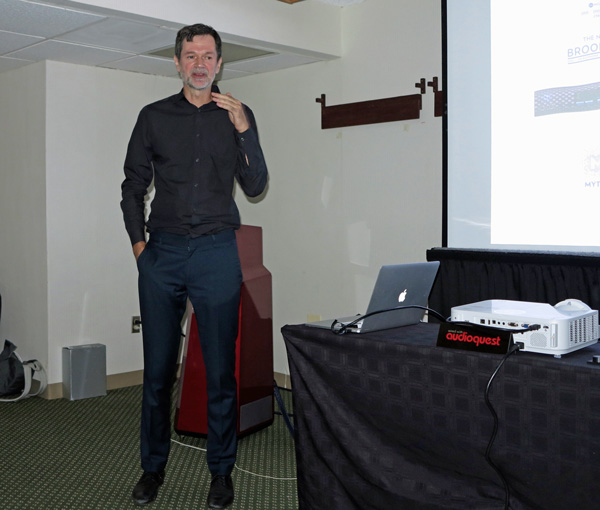 After Jurewicz (above) gave us the lowdown on the Brooklyn, the two men played snippets of several MQA-encoded selections. The first was a beautifully recorded Frank Sinatra track from 1957 whose lyrics were so soppy that they seemed destined for an entire collection of Hallmark cards. (I am not exaggerating!) Then came an equally sentimental, easy listening, DXD piano recording from Morten Lindberg's 2L label.
The icing on the first layer of the cake was part of a brand new duet by Judy Collins and Willie Nelson, entitled "When I Go." Along with it came a glowing endorsement from Alan Silverman, who has been recording Collins for 40 years. Silverman unequivocally states that encoding and decoding his master file with MQA produced a recording that was clearer than the original master.
While Silverman's endorsement is of major importance, it was difficult to listen to the part of the track that was played without conjecturing that the aging voices of both Collins and Nelson had been heavily processed. How anyone was supposed to know that this track sounded "better" than the master was beyond me.
This frustration was compounded by the fact that no one offered before/after comparisons of any tracks. I heard those comparisons at Audio High in Mountain View, CA, before John Atkinson and I filed our first reports about MQA, and was immediately convinced of MQA's efficacy. What I don't understand is why such comparisons were not conducted either here or at previous public demonstrations of MQA that have taken place at a number of venues, including both the 2015 CES and Audio High.
Be that as it may, the next exciting piece of news was that Mytek will take the Brooklyn's as yet unnamed sister A/D converter to the AES convention in New York City, October 29–November 1. The unit, which includes an MQA kernel, will be given to unnamed recording engineers to play with. What will happen after that could very well change recording history. I am certain that John Atkinson and other Stereophile East Coasters will be on hand to report everything that takes place.
At conference's end, Bråtelund served dessert. He took a huge risk by daring to stream, over the Marriott's terrible, soon-to-be redone WiFi network, an MQA-encoded hi-rez file (24/352.8k) of a recent 2L recording, Kim André Arnesen's soppy Magnificat. Actually, I don't know what was riskier, daring to trust a network that kept crashing time after time in room after room, or inundating press with so much sop that we risked drowning in ooze. Thankfully, the selection was short, and the experiment a sonic success, due to the major reduction in streaming bandwidth made possible by MQA. (The MQA process packed the 24/352.8k data into a 24-bit lossless FLAC file sampled at 44.1kHz.) I left the room excited at the prospect that MQA, Mytek, and Tidal are poised to take music playback to a whole new level.
After Jurewicz (above) gave us the lowdown on the Brooklyn, the two men played snippets of several MQA-encoded selections. The first was a beautifully recorded Frank Sinatra track from 1957 whose lyrics were so soppy that they seemed destined for an entire collection of Hallmark cards. (I am not exaggerating!) Then came an equally sentimental, easy listening, DXD piano recording from Morten Lindberg's 2L label.
The icing on the first layer of the cake was part of a brand new duet by Judy Collins and Willie Nelson, entitled "When I Go." Along with it came a glowing endorsement from Alan Silverman, who has been recording Collins for 40 years. Silverman unequivocally states that encoding and decoding his master file with MQA produced a recording that was clearer than the original master.
While Silverman's endorsement is of major importance, it was difficult to listen to the part of the track that was played without conjecturing that the aging voices of both Collins and Nelson had been heavily processed. How anyone was supposed to know that this track sounded "better" than the master was beyond me.
This frustration was compounded by the fact that no one offered before/after comparisons of any tracks. I heard those comparisons at Audio High in Mountain View, CA, before John Atkinson and I filed our first reports about MQA, and was immediately convinced of MQA's efficacy. What I don't understand is why such comparisons were not conducted either here or at previous public demonstrations of MQA that have taken place at a number of venues, including both the 2015 CES and Audio High.
Be that as it may, the next exciting piece of news was that Mytek will take the Brooklyn's as yet unnamed sister A/D converter to the AES convention in New York City, October 29–November 1. The unit, which includes an MQA kernel, will be given to unnamed recording engineers to play with. What will happen after that could very well change recording history. I am certain that John Atkinson and other Stereophile East Coasters will be on hand to report everything that takes place.
At conference's end, Bråtelund served dessert. He took a huge risk by daring to stream, over the Marriott's terrible, soon-to-be redone WiFi network, an MQA-encoded hi-rez file (24/352.8k) of a recent 2L recording, Kim André Arnesen's soppy Magnificat. Actually, I don't know what was riskier, daring to trust a network that kept crashing time after time in room after room, or inundating press with so much sop that we risked drowning in ooze. Thankfully, the selection was short, and the experiment a sonic success, due to the major reduction in streaming bandwidth made possible by MQA. (The MQA process packed the 24/352.8k data into a 24-bit lossless FLAC file sampled at 44.1kHz.) I left the room excited at the prospect that MQA, Mytek, and Tidal are poised to take music playback to a whole new level.
At the conference's start, Stuart (above) laid down the bottom line: "You can take an MQA-encoded file, play it anywhere, and it will sound better than CD."
After Jurewicz (above) gave us the lowdown on the Brooklyn, the two men played snippets of several MQA-encoded selections. The first was a beautifully recorded Frank Sinatra track from 1957 whose lyrics were so soppy that they seemed destined for an entire collection of Hallmark cards. (I am not exaggerating!) Then came an equally sentimental, easy listening, DXD piano recording from Morten Lindberg's 2L label.