

 If you're new to hi-fi, you might not be aware of the fiercely controversial and seemingly endless argument regarding the importance of blind listening in determining a component's worth. Essentially, there are those who believe that if differences in sound cannot be perceived while listening blindfolded, or under similarly exhausting, stressful, and inhumane conditions, then differences do not exist, and we're all just full of shit when we tell you that the $30,000 Musical Fidelity Titan sounds nothing at all like the $159 Sonic Impact Super T, that, in fact, they're basically the same amp, so you might as well buy the cheaper one. Of course, I'm exaggerating. You see where I stand on the subject, and I hope you get the point. Proponents for blind listening will argue that the only way to determine whether sonic differences between two components exist is to escape our many biases, is to use a carefully controlled listening environment in which the listener does not know what he or she is listening to. Imagined differences should then vanish, leaving only the "real" differences, or those that can be correlated with objective measurements.
Fascinating, right?
But, if I learned anything in school, I learned how to take a test. And I learned that some tests are just impossible to pass.
If you're new to hi-fi, you might not be aware of the fiercely controversial and seemingly endless argument regarding the importance of blind listening in determining a component's worth. Essentially, there are those who believe that if differences in sound cannot be perceived while listening blindfolded, or under similarly exhausting, stressful, and inhumane conditions, then differences do not exist, and we're all just full of shit when we tell you that the $30,000 Musical Fidelity Titan sounds nothing at all like the $159 Sonic Impact Super T, that, in fact, they're basically the same amp, so you might as well buy the cheaper one. Of course, I'm exaggerating. You see where I stand on the subject, and I hope you get the point. Proponents for blind listening will argue that the only way to determine whether sonic differences between two components exist is to escape our many biases, is to use a carefully controlled listening environment in which the listener does not know what he or she is listening to. Imagined differences should then vanish, leaving only the "real" differences, or those that can be correlated with objective measurements.
Fascinating, right?
But, if I learned anything in school, I learned how to take a test. And I learned that some tests are just impossible to pass.
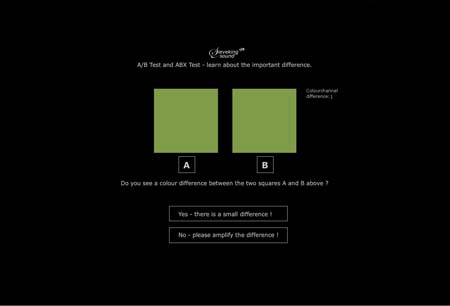
In short, the data from the Stereophile blind listening test are most likely to be due to biased guessing rather than audible differences between amplifiers.Aww, bummer! Anyhoo, this came in today: A New Angle to an Old Discussion: AB and ABX Tests Dear International Colleagues, I believe you all are aware of the long standing dispute between the subjectivists and objectivists in Audio. I believe nothing new has been learned in these discussions for the last 30 years or so and they basically come down to the inability of people who hear sonic differences to prove this in an ABX-Test which is then often considered to be proof of the non-existence of sonic differences.
Jan Sieveking Nice, right? I am all for bonding with my brothers in the enjoyment of great sound, so I took the test. It was fun! But let me tell you: I was pretty much clueless, feeling around in the dark. I could barely see the difference between the two colors in the first place. In fact, I'm not sure that there even was a difference. I was just playing along. At one point, I clicked entirely by accident when the banana I was eating fell on my mouse. I wonder if my banana got that one right. I would have to guess that my banana had about as good a chance as I had. I scored a 9 out of 20, which the computer tells me is worse than what I would have scored had I simply guessed. Well, there you go. Give it a shot, and post your score, if you dare!















