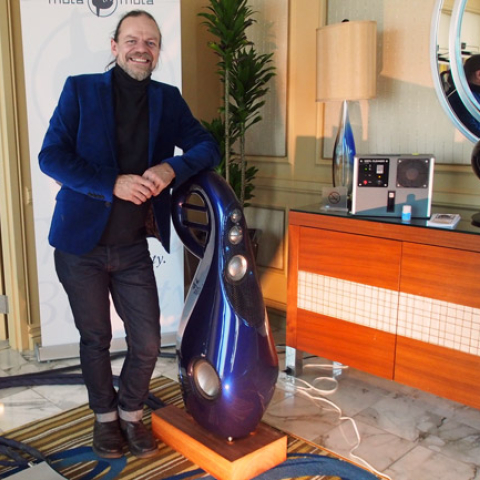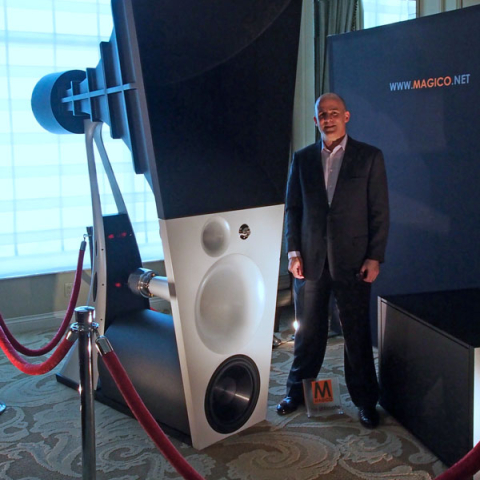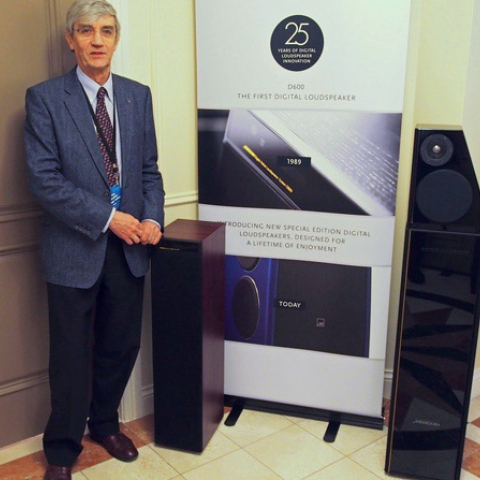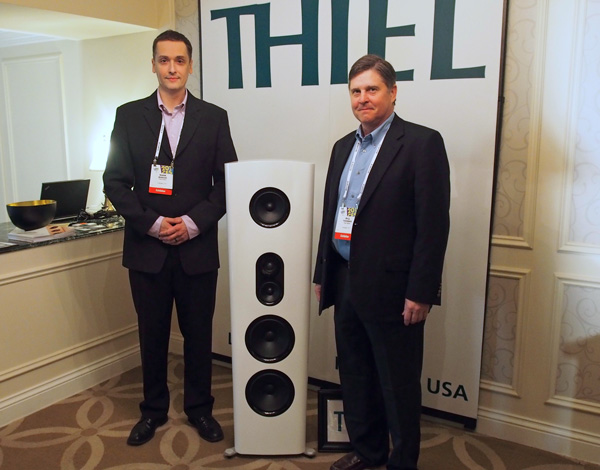
When I interviewed Thiel’s new owner Bill Thomas (right in photo) at the 2013 CES, he was bullish about the company’s future. However, I felt that future was going to be dependent on whom Bill hired to head up the Kentucky company’s engineering team. At the 2014 CES, Bill introduced me to that person, Mark Mason (left), who had come to Thiel from PSB, where he had worked alongside veteran speaker engineer Paul Barton. Bill and Mark are flanking the new TT3 speaker, which is intended to replace the CS3.7 as the company’s flagship when it comes to market in the late summer. Bill feels that with Mark now leading the engineering, Thiel can be taken to a larger customer base.
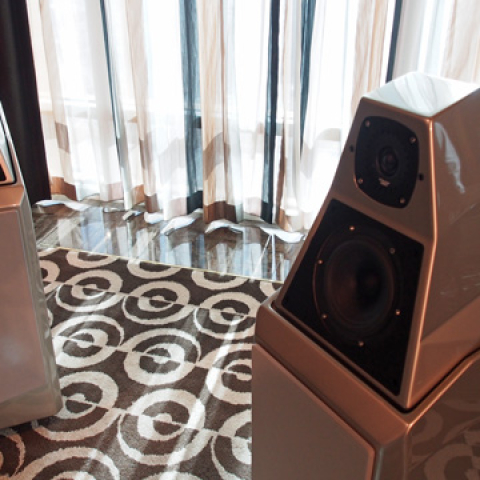
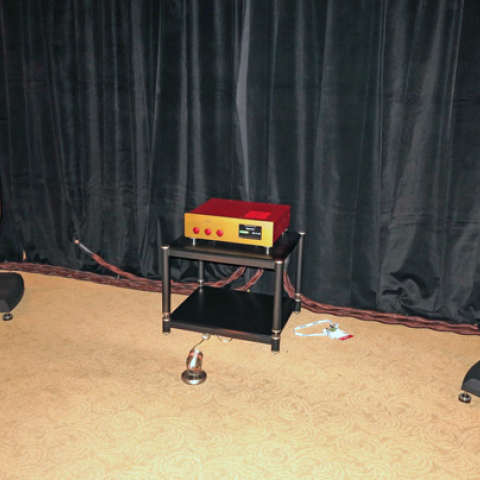
 The TT3 was on passive display at CES, but a system was set up to show off the other new design for Mark, the TM3 (above), which is expected to sell for $2999/pair when it reaches the market in the summer. The two-way design combines a proprietary 6.5" woofer using a cast basket with a 1" tweeter and sounded larger, with more extended lows than you would expect from its size, Muddy Waters’ “Good Morning Little Schoolgirl” also sounded palpably real. (The system included a dCS Puccini DAC, Dan D’Agostino amplification, and Tributaries cabling.)
I asked about the crossover, as the late Jim Thiel had been a strong proponent of first-order filters. Mark explained that without taking away from what Jim had achieved, he believed that while it is possible to achieve a flat, time-coincident on-axis response from a multiway design with first-order filters, this can involve compromises in the three-dimensional radiation pattern if the drive-units are not coincident. And as Floyd Toole has demonstrated, the time coherence of the first-arrival sound does not compensate, subjectively, for the problematic off-axis behavior. Although Mark believes Toole is correct, he performed extensive listening tests with prototypes of the TM3 before settling on the high-order crossover that was ultimately used.
The TT3 was on passive display at CES, but a system was set up to show off the other new design for Mark, the TM3 (above), which is expected to sell for $2999/pair when it reaches the market in the summer. The two-way design combines a proprietary 6.5" woofer using a cast basket with a 1" tweeter and sounded larger, with more extended lows than you would expect from its size, Muddy Waters’ “Good Morning Little Schoolgirl” also sounded palpably real. (The system included a dCS Puccini DAC, Dan D’Agostino amplification, and Tributaries cabling.)
I asked about the crossover, as the late Jim Thiel had been a strong proponent of first-order filters. Mark explained that without taking away from what Jim had achieved, he believed that while it is possible to achieve a flat, time-coincident on-axis response from a multiway design with first-order filters, this can involve compromises in the three-dimensional radiation pattern if the drive-units are not coincident. And as Floyd Toole has demonstrated, the time coherence of the first-arrival sound does not compensate, subjectively, for the problematic off-axis behavior. Although Mark believes Toole is correct, he performed extensive listening tests with prototypes of the TM3 before settling on the high-order crossover that was ultimately used.
The TT3 was on passive display at CES, but a system was set up to show off the other new design for Mark, the TM3 (above), which is expected to sell for $2999/pair when it reaches the market in the summer. The two-way design combines a proprietary 6.5" woofer using a cast basket with a 1" tweeter and sounded larger, with more extended lows than you would expect from its size, Muddy Waters’ “Good Morning Little Schoolgirl” also sounded palpably real. (The system included a dCS Puccini DAC, Dan D’Agostino amplification, and Tributaries cabling.)
I asked about the crossover, as the late Jim Thiel had been a strong proponent of first-order filters. Mark explained that without taking away from what Jim had achieved, he believed that while it is possible to achieve a flat, time-coincident on-axis response from a multiway design with first-order filters, this can involve compromises in the three-dimensional radiation pattern if the drive-units are not coincident. And as Floyd Toole has demonstrated, the time coherence of the first-arrival sound does not compensate, subjectively, for the problematic off-axis behavior. Although Mark believes Toole is correct, he performed extensive listening tests with prototypes of the TM3 before settling on the high-order crossover that was ultimately used.