

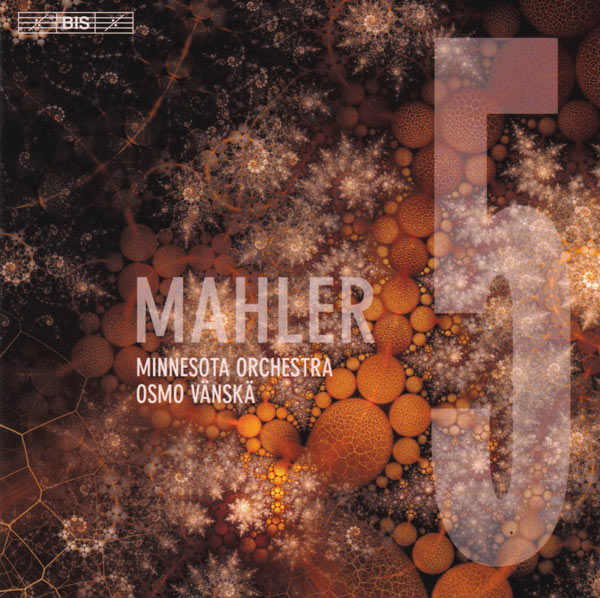
Conductor Osmo Vänskä, whose Minnesota Orchestra has previously distinguished itself in multiple recordings of Sibelius and Beethoven, is now turning to the symphonies of Gustav Mahler. Newly arrived is his hybrid SACD, for BIS, of Mahler's Symphony 5. The first issue in a projected series that will next offer Mahler's Sixth and Second Symphonies at dates unspecified, it may not win over those whose allegiance adamantly rests with Bernstein, Chailly, Rattle, Abbado, Tilson-Thomas, Fischer, and/or other distinguished Mahler interpreters. Nonetheless, the strength of the recording's first movement alone, and its hi-rez provenance as DSD derived from 24/96 file, make its epic journey from darkness to light essential listening.
Let's take that first movement, whose hi-rez layer delivers, on my reference system, the weightiest and most emphatic "Trauermarsch" (funeral march) I've ever heard from a Mahler Five. Minneapolis' percussion and double basses drive home the gravity of the movement's opening as few recordings can, while the higher pitched horns sound uncannily natural. If the dirge-like nature of Vänskä's opening does not touch you, you are most likely not a Mahler fan.
As the symphony's extended first part unfolds, the clarity and weight of instrumental lines is most impressive. Mahler stipulates "Mit grosster Vehemenz" (With great vehemence) for the movement's latter half, and there's no question that Vänskä is committed to whipping up the orchestra into a storm-like frenzy. The results are thrilling, with excellent percussive impact and triumphant brass contributing to a convincing close.
Nonetheless, other hi-rez recordings, namely those from Fischer and MTT, deliver brighter, more colorful sound and an even wider soundstage. (I have not heard the 17 other hi-rez versions.) How much the sonic differences between recordings have to do with the sound of the orchestra under Vänskä, or with the hall itself as opposed to the recording equipment and choices of sound engineer Thore Brinkmann of Take5 Music Production, I do not know. Certainly. the Minnesota Orchestra recordings from Eiji Oue that were issued on Reference Recordings abound in color, and sound very different than this one.
The almost 18-minute scherzo is wonderfully executed. Beginning with a lilting waltz, this extended movement serves as a bridge between the pessimism of the symphony's opening and the waves of consolation and exultation that bring it to a triumphant close.
The memorable, frequently heard Adagietto, taken at a considerably slower pace than on either Bernstein's first rendition with the New York Philharmonic or MTT's DSD landmark with the San Francisco Symphony, is quite wonderful. The final movement, which lasts virtually as long as MTT's and considerably longer the Bernstein's first take, is thrilling, but the final bars lack the punch that Bernstein delivers on both his commercial recordings. Mahler really challenges his orchestra to slow down and then, in just a few bars, quickly switch gears to drive it home. As a New Yorker accustomed to slamming on the brakes and then gunning it for all its worth, Bernstein knows just how to deliver the goods.
As great a piece of music as Mahler 5 may be, it would take a lot of Geritol and promise of a huge paycheck to give me the strength and motivation to listen all the way through multiple complete recordings of what, under Vänskä's hand, amounts to a 74'57 emotional tour-de-force. Spot checks, however, suggest that while Fischer's version is far more colorful, brightly illuminated, and detailed than Vänskä's, it is neither as poetic nor as strong in the bass department.
Not all of MTT's hybrid SACDs fulfill their promise, but the bass and air on No.5 are excellent. I found myself especially drawn to the lovely, clear waltz at the scherzo's opening, and the contrasts between its dynamism and winning stillness. The gorgeous strings in his adagietto can also hold their own next to Vienna's. MTT is very keen on rhythmic acuity—all his spotlighted detail may be too much for some Mahler lovers, and can get under your skin at times—but he provides a glorious close to a journey that begins mournfully and ends in triumph. Mahler 5 is a great piece of music, which, when listened to in its entirety, makes its great Adagietto sound all the more like the inspired masterpiece that it is.
Which leads to the question, shall I take the plunge? For the opening movement in its entirety, and the beauty that unfolds when Vänskä takes the adagietto slowly, absolutely. If you find the rest of his movements as persuasive, please let us know in the comments section below.















