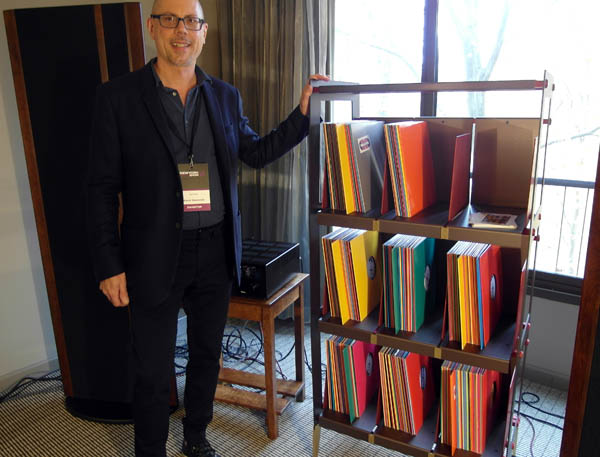
The day after I met manufacturer/industrial artist David Stanavich, it dawned on me why I was so taken with his Waxrax record racks: These sturdy, stylish, steel-and-aluminum structures resemble the shelving in my elementary school's library, ca 1960. If I could, I'd fill my home with multiples of the Waxrax LP-V3 tower seen here (LP capacity: 550). But at approximately $4000 per unit, depending on finish and options, this Brooklyn-built rack is too pricey. (To store 550 LPs for $4k works out to over $7 per record—which is more than many records themselves are worth.) Another item for my When-I-Win-The-Lottery list, next to the Porsche Maccan and the house on Martha's Vineyard.
 Yet a metro-area factory address doesn't necessarily imply exorbitant pricing—as demonstrated by the Adagio phono preamp ($1490) from new company Tavish Design, based in the northern-Westchester County town of Amawalk. The all-tube Adagio has an external power supply, internal Jensen transformers for moving-coil gain, and adjustable loading for moving-coil and moving-magnet cartridges. A review loaner has been promised, and I'm already looking forward to giving it a try.
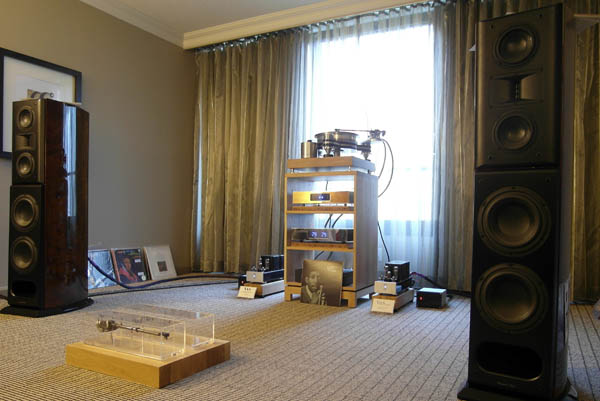 From Tavish Design's static display, I proceeded to an active dem by Brooklyn dealer Living Acoustics. This was my second chance to hear VPI's Avenger magnetic-drive turntable ($25,000 with two 12" JMW 3D-printed tonearms and outboard speed controller), and Living Acoustics put it to good use, spinning real (as opposed to audiophile) jazz LPs. Partnering equipment included the new VAS Audio moving-coil cartridge ($1500), the same company's Citation monoblock amps ($3500/pair), Merrill Audio's Jens phono preamp and Cara line preamp (($14,500 and $3500, respectively), and Acoustic Zen Crescendo II loudspeakers ($18,000/pair), with various Acoustic Zen cables and other accessories. The sound was solidly good, except for slight traces of mushy-harsh sound on loudly played cymbals and drums.
 Habitual readers of audio-show reports, whether written by myself or by numerous others, can guess my reaction to the system demonstrated by Audio Note UK—yet it bears saying nonetheless: I heard few other systems at the New York show that played music with the same musical momentum, sonic tone, and all-around humanness as this one—which comprised Audio Note's TT Two Deluxe turntable with Arm Three ($5650), IQ3 moving-magnet cartridge ($1000), 20Wpc, 6L6-powered P2SE Signature amplifier ($6000, pictured above), and brand new AZ Two D floorstanding loudspeakers ($3250/pair estimated). As I've written in a soon-to-be-published review of Audio Note's CDT One/II transport and DAC 2.1x Signature D/A converter, this company's gear seems able to load a listening room in very much the same manner as real music—and that capability was in full flower here.
 A real treat awaited me at the room sponsored by Edison, New Jersey-based Care Audio: a fully reconditioned Ampex ATR-102 studio reel-to-reel deck, fitted with Ampex MR-70 electronics (not for sale). Combined with the well-known KR Audio Kronzilla single-ended amplifier ($23,000) and a Canadian-built pair of Bastanis Audio Mandala Solo loudspeakers ($12,000/pair, including Crown amps for the system's specially treated 18" bass drivers), this provided the most timbrally natural and spatially present sound I heard at the show. (Perhaps understandably, the Care room was often crowded with listeners—and I noticed that the sound was notably better from a centrally positioned seat than when I stood off to one side.) Pure magic!
 For a transformer lover such as myself, a visit to the room of Music First Audio was no less a treat. I was especially drawn to the company's latest phono transformer, the MC Step-Up 632 ($1000). According to company founder Jonathan G. Billington, the name is a tribute to the original Stevens & Billington No.632 transformer—the first of that company's products dissected by the young J.G. Billington when, in 1986, he took his own place in the venerable family-owned firm. (Music First Audio is an offshoot of Stevens & Billington, which endures.) A sample of the new MFA phono transformer has been promised for review.
 My visit to the room sponsored by Wes Bender Studio marked a happy reunion—not only with Wes himself, who has visited me here in Cherry Valley, but also with the very sample of the Pear Audio Kid Howard turntable and Cornet 2 tonearm ($5000 for the combo) that I reviewed in Stereophile's June 2015 issue. At the New York show that analog source was used with a Transfiguration Proteus cartridge ($6000), Pear Audio's own Reference phono preamp ($4495), an EAR MC4 transformer ($2295), GamuT Audio Di150 Limited Edition integrated amp ($11,990), and GamuT RS3 loudspeakers ($19,900/pair including integral stands), the latter two products in their NYC debut. This system had especially fine stereo imaging, but with a good deal more substance than the high-end norm: There was timbral meat on these spatial bones.
 Early in the show I ran into New Jersey retailer Koby Koranteng, who described in excited terms a line of horn-loaded loudspeakers made by Brian Charney of Charney Audio. It wasn't until late Saturday that I made it to the Charney room, but my efforts were rewarded with good music and a close-up look at lots of fine craftsmanship. Charney's flagship is the Concerto ($22,000/pair painted, $29,000/pair with wood veneer and clear finish). The Concerto, whose design is similar to that of the large Carfrae horn, uses a single Lowther DX4 driver—and, according to Brian Charney, the speaker is surprising lightweight, given its imposing size: only 45lbs per cabinet. A perpetually crowded room prevented me from gaining a detailed impression of the sound of the Concerto—which was driven by Charney's own stereo 300B amp ($6500). That said, the workmanship appeared flawless, and the prices seem quite reasonable for this sort of thing.
 You know how it is: At every show there's at least one new company that seems a bit removed from the perfectionist-audio mainstream. At the New York show that role was assumed by Riva Audio, a southern Californian company who claims as their chairman one Rikki Farr, a music entrepreneur best known as the MC of the legendary Isle of Wight Festival of 1970. (Yes, that's the one where Emerson, Lake, and Palmer's set was augmented with cannon fire.) Riva's calling card is the Riva Turbo X ($349.99), a portable Bluetooth speaker with a playing time of up to 26 hours on a single charge. Also claimed for the Turbo X are a 33' range and use of ADX's Trillium "immersive sound" technology.
Yet a metro-area factory address doesn't necessarily imply exorbitant pricing—as demonstrated by the Adagio phono preamp ($1490) from new company Tavish Design, based in the northern-Westchester County town of Amawalk. The all-tube Adagio has an external power supply, internal Jensen transformers for moving-coil gain, and adjustable loading for moving-coil and moving-magnet cartridges. A review loaner has been promised, and I'm already looking forward to giving it a try.
From Tavish Design's static display, I proceeded to an active dem by Brooklyn dealer Living Acoustics. This was my second chance to hear VPI's Avenger magnetic-drive turntable ($25,000 with two 12" JMW 3D-printed tonearms and outboard speed controller), and Living Acoustics put it to good use, spinning real (as opposed to audiophile) jazz LPs. Partnering equipment included the new VAS Audio moving-coil cartridge ($1500), the same company's Citation monoblock amps ($3500/pair), Merrill Audio's Jens phono preamp and Cara line preamp (($14,500 and $3500, respectively), and Acoustic Zen Crescendo II loudspeakers ($18,000/pair), with various Acoustic Zen cables and other accessories. The sound was solidly good, except for slight traces of mushy-harsh sound on loudly played cymbals and drums.
Habitual readers of audio-show reports, whether written by myself or by numerous others, can guess my reaction to the system demonstrated by Audio Note UK—yet it bears saying nonetheless: I heard few other systems at the New York show that played music with the same musical momentum, sonic tone, and all-around humanness as this one—which comprised Audio Note's TT Two Deluxe turntable with Arm Three ($5650), IQ3 moving-magnet cartridge ($1000), 20Wpc, 6L6-powered P2SE Signature amplifier ($6000, pictured above), and brand new AZ Two D floorstanding loudspeakers ($3250/pair estimated). As I've written in a soon-to-be-published review of Audio Note's CDT One/II transport and DAC 2.1x Signature D/A converter, this company's gear seems able to load a listening room in very much the same manner as real music—and that capability was in full flower here.
A real treat awaited me at the room sponsored by Edison, New Jersey-based Care Audio: a fully reconditioned Ampex ATR-102 studio reel-to-reel deck, fitted with Ampex MR-70 electronics (not for sale). Combined with the well-known KR Audio Kronzilla single-ended amplifier ($23,000) and a Canadian-built pair of Bastanis Audio Mandala Solo loudspeakers ($12,000/pair, including Crown amps for the system's specially treated 18" bass drivers), this provided the most timbrally natural and spatially present sound I heard at the show. (Perhaps understandably, the Care room was often crowded with listeners—and I noticed that the sound was notably better from a centrally positioned seat than when I stood off to one side.) Pure magic!
For a transformer lover such as myself, a visit to the room of Music First Audio was no less a treat. I was especially drawn to the company's latest phono transformer, the MC Step-Up 632 ($1000). According to company founder Jonathan G. Billington, the name is a tribute to the original Stevens & Billington No.632 transformer—the first of that company's products dissected by the young J.G. Billington when, in 1986, he took his own place in the venerable family-owned firm. (Music First Audio is an offshoot of Stevens & Billington, which endures.) A sample of the new MFA phono transformer has been promised for review.
My visit to the room sponsored by Wes Bender Studio marked a happy reunion—not only with Wes himself, who has visited me here in Cherry Valley, but also with the very sample of the Pear Audio Kid Howard turntable and Cornet 2 tonearm ($5000 for the combo) that I reviewed in Stereophile's June 2015 issue. At the New York show that analog source was used with a Transfiguration Proteus cartridge ($6000), Pear Audio's own Reference phono preamp ($4495), an EAR MC4 transformer ($2295), GamuT Audio Di150 Limited Edition integrated amp ($11,990), and GamuT RS3 loudspeakers ($19,900/pair including integral stands), the latter two products in their NYC debut. This system had especially fine stereo imaging, but with a good deal more substance than the high-end norm: There was timbral meat on these spatial bones.
Early in the show I ran into New Jersey retailer Koby Koranteng, who described in excited terms a line of horn-loaded loudspeakers made by Brian Charney of Charney Audio. It wasn't until late Saturday that I made it to the Charney room, but my efforts were rewarded with good music and a close-up look at lots of fine craftsmanship. Charney's flagship is the Concerto ($22,000/pair painted, $29,000/pair with wood veneer and clear finish). The Concerto, whose design is similar to that of the large Carfrae horn, uses a single Lowther DX4 driver—and, according to Brian Charney, the speaker is surprising lightweight, given its imposing size: only 45lbs per cabinet. A perpetually crowded room prevented me from gaining a detailed impression of the sound of the Concerto—which was driven by Charney's own stereo 300B amp ($6500). That said, the workmanship appeared flawless, and the prices seem quite reasonable for this sort of thing.
You know how it is: At every show there's at least one new company that seems a bit removed from the perfectionist-audio mainstream. At the New York show that role was assumed by Riva Audio, a southern Californian company who claims as their chairman one Rikki Farr, a music entrepreneur best known as the MC of the legendary Isle of Wight Festival of 1970. (Yes, that's the one where Emerson, Lake, and Palmer's set was augmented with cannon fire.) Riva's calling card is the Riva Turbo X ($349.99), a portable Bluetooth speaker with a playing time of up to 26 hours on a single charge. Also claimed for the Turbo X are a 33' range and use of ADX's Trillium "immersive sound" technology.