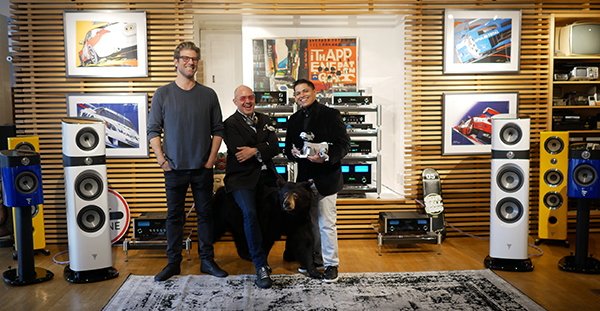
L–R: NoHo Sound's Chris Petranis, Alex Roy, taxidermy bear, & Ron Kain
In an industry constantly perplexed by the absence of youth, diversity, and appreciation for the hobby, three audiophiles set out to revolutionize the industry with the opening of a new hi-fi shop in New York City that is anything but ordinary.
NoHo Sound & Stereo (NoHo Sound for short) is located in a swanky loft in the lower Manhattan district NoHo—open seven days a week, by appointment only, with a second location in Chelsea. They offer: Analog Domain, Audio Research, Aurender, Box Furniture, Croft Acoustics, Devore Fidelity, Focal, Grand Prix Audio, Larsen, McIntosh Labs, Micromega, Musical Fidelity, Naim, Sonos, Sonus Faber, Vicoustic, and XLO Electric. In addition to selling hi-fi, they host weekly—yes,
weekly—live music events of all genres, where startups like Groupmuse and Sofar Sounds use their space for performances, with 100% of proceeds going to the musicians. They also host events in collaboration with the nearby World of McIntosh Townhouse.
It's not very often—actually, it's almost never—that you hear about a new hifi shop opening, so I sat down with co-founder/CEO Alex Roy, president Ron Kain, and co-founder Chris Petranis to hear their take on where the industry's going, how they plan to attract millennials, and why they're starting a new venture in a market so deeply set on discussing its own decline.
Aside from all having extensively worked as hi-fi salesmen in New York, Alex is the editor-at-large for
The Drive, co-host of the show
Drive on NBC Sports, and has set eight Cannonball Run Driving records in the USA, Sweden, and Spain; Ron has origins in pro-audio and was consistently the top salesman at NYC hi-fi retail giant Stereo Exchange; and Chris is a restaurateur, real-estate developer, and film producer. With a crew like this, it's no surprise that NoHo Sound has already been mentioned in
Billboard despite only having been officially open for a few months.
Alex Roy: I worked at Stereo Exchange in college because I was obsessed with high-end audio but I couldn't afford anything. By working there, I could afford to pay for the gear and get the discount. I bought a pair of [B&W] DM602s . . . and eventually 802 Series 3s, which are sitting over there. [
gestures] I always dreamt of opening an audio store, but in the 90s it didn't make a lot of sense. Then AudioGon arrived and the used business got crushed. But I always knew that sooner or later, something had to change in this sector, because high-end audio stores haven't changed at all, but the world's changed around them. AudioGon and eBay crushed the used high-end audio business for brick and mortar retailers who weren't operating online. If you look at how they operate today, the majority of stores on the ground
still haven't changed. And
that's why NoHo Sound exists.
I worked at Stereo Exchange then I was a customer at Stereo Exchange. I used to go there every day for 20 years. I also would go to Lyric and other stores, but they really wouldn't let me in, because they thought I was a tire kicker. I could've afforded to buy pretty much anything any store in New York ever had on display. And here I am. I'm the target customer and I'm treated like shit. So I ended up going back to Stereo Exchange, where at least there's Ron and he's fun. He tricked me into buying a Sonos I didn't need! [
laughter]
Ron Kain: I sold him the Sonos, then later on an Audio Research SP20 preamp. And in the whole process, we actually built a relationship, a friendship—which I did with many other clients as well. I'm not just here to sell you a box, I'm here to build a relationship—and a long-term one at that.
 Roy:
Roy: And, by the way, every single store—every business in the world—has some asshole writing the copy on their website, which is probably not a guy who works at the store, which says "we're here to build relationships. Customer service is number one. We believe in resolution, fidelity, honesty, and presentation of soundstage." It's all fucking bullshit. Because the reality is: all of high-end audio retail deserves to die. It buried itself. And it buried itself because, if I'm the target customer and I don't want to buy anywhere in New York City—the most important market in the Eastern half of the United States—then the whole model is broken. And online cannot replace it, because there are some products like sports cars and luxury watches where price isn't everything. And the product itself isn't everything. It's an experience. You want to feel like you're a part of something, and the people you're paying are not fucking assholes moving boxes.
I come from the car-racing world. I host a television show about sports cars on NBC and I own a fashion line. The relationship is everything. The presentation is everything. There are many expensive, good products. There's no shortage. But the hourglass, the conduit of how they get to people has to be excellent.
That's the missing piece.
The stores we have in New York today worked at one time, but that ended in about 1995. And the Internet buried it, but the Internet's not the end. It's just part of it. People thought the Internet was going to replace brick and mortar—not at all. It's the hinge upon which brick and mortar swings. Luxury brick and mortar has its place, but no one's doing it.
NoHo Sound is a total reboot of what high-end audio retail can be on the ground. And it requires the reverse approach: you don't have necessarily a storefront, you can't wait for people to walk in, and every day you have to sell the idea that coming to the store is fun. People need to be educated, so if they come in and are treated badly, then you've lost them forever, and they're walking over to Best Buy across the street, and they're buying the best thing Best Buy has. Or they're buying a Devialet. Devialet, in my opinion, isn't really a high-end sound, but it
is very much a high-end brand. They completely understand how to package, market, and use social media and modern methods to get to people. This is something most audio manufacturers and retailers don't understand. A Devialet store looks like an Apple store. Is Apple
better than PC or Chromebook? It's different, but it's packaged
perfectly. It's a completely seamless, holistic experience.
If you want to disrupt something, you've got to give customers something they've never seen before. That's not a lower price. It isn't necessarily even a different product. It's something fun, and better than what they can get anywhere at any price.
Put all these pieces together. These stores have had 50 years to build an audience and community. Go on Facebook and Instagram and look at the size of their audiences. They're somewhere between zero and a few hundred. If they've got more than a couple thousand, they bought them. They have no connection to the next generation of audiophiles. In fact, they've completely given up attempting to attract younger people to become audiophiles, because they've given them nothing. They haven't given them a home to see the equipment, to learn about the equipment, the salespeople don't care, they don't even have the patience! If they can't sell something in the first five minutes—or even the first minute—they won't take the time to invest in the person.
 Dagdagan:
 Who's your target customer?
Roy: 5% old audiophiles who'd like a place to have a place to go to in three years, when most of the stores in New York are closed. And 95% people who've never heard good audio ever in their lives. The first customers like that have already purchased from us.
Based on our organic social-media growth, we will surpass every New York City area dealer. (We already surpassed most of them in social media presence in the first three days.) We'll surpass all of them combined within two weeks, and I wouldn't be surprised if we surpassed all of them in the country combined within six months—and that's for organic, unpaid likes. Eventually, this will convert into more sales and this will snowball. You cannot buy this audience. They have to believe that you're doing something cool; they have to want to come to you. If you have to be paying for them to want to come to you every single time, you're going to go out of business.
If you want to build a brand that people love, they have to love it from day one. You have to give them a reason to love it. Give them something fun; give them something they haven't seen before. It's not a box or a price tag.
Dagdagan: Do you think there's anything existing high-end dealers can do to survive?
Roy: [
laughs] No.
Kain: It's a culture change.
Roy: They have to do what we're doing or something like what we're doing. I don't know what the alternative is. You cannot have a store paying $50,000 or $100,000 a month in rent unless you're monetizing that location in a real way—maybe through events. And if you're making money from [custom install], you should become a CI business.
Today, we are very clear that we are
not a CI business. We
can do CI if someone wants to have it, but that's not our primary focus, because where's the opportunity in New York City? Every culture's different. In New York, the majority of young people with money do not own their homes. If you're an attorney or banker under the age of 35, you do not own your home, which means you're not a CI customer. But you
are a customer for some very cool wireless integration. And who's targeting those people? No one. In fact, most people with money in NYC don't own their homes at all. In Manhattan they never will. If they're going to invest in a home, it'll be outside the city. That's a different customer; that's not our store. Our customer is somewhere between 25–50, they've never heard of good audio, and the younger the better, because that means they don't need CI. You can't sell it to them. They're buying network Naim systems; maybe some cool Mac. It's a piece of art.
Kain: Regular retailers just turn on their lights in the hopes that they're open and that's it—that's their thing. The main reason I always felt that I was the top salesman in the North Eastern region is because I sold to everyone my constituents wouldn't sell to. They saw a young kid walking in, they thought nothing of him; I sold him a 20k stack. It was literally that simple: basic customer service. No other dealer is doing that. Bottom line.
Roy: Look at what Tesla and Uber have done to transportation, electric cars, and autonomy. You don't have to like Tesla or Uber to see; the entire taxi industry saw and knew that it was inefficient and shitty. All the carmakers in the world knew that electric vehicles were possible, but they did nothing. Tesla had to arrive. Even if Tesla goes out of business tomorrow, electric cars are inevitable and they're going to get here a lot sooner because Tesla existed. So the lessons of disruption are: you've got to reinvent the model but also accept the realities of the math. You can't be too ambitious or you'll disappear and everyone else will take the lessons from you. So what have we learned here? All these other stores doing used business ignored Audiogon and eBay. And Facebook is 7, 8 years old? Instagram is 4 years old? Go on to their sites and look at the social media presence of pretty much all the big retailers in the country. The way we got all these lines is: we walked in the door of all the biggest companies in the sector and we pulled out a spreadsheet we created ourselves—we didn't have to hire a consulting company or some schmuck thief consultant.
Think about all the snake oil and horseshit being fed to people. At best, I've been a C-minus celebrity in my life, but I'll go into stores and ask questions about cables, bi-wiring, Shakti stones . . . do you know what a Shakti stone is? It's a $400 magnet surrounded by rubber that was sold years ago. I sold them. Things we don't even know if they work or what they do. But the point is: when a customer asks me about Shakti stones or about any of these things, I could be talking to an electrical engineer, so I'm not going to bullshit them. And yet I got bullshitted to so many times!
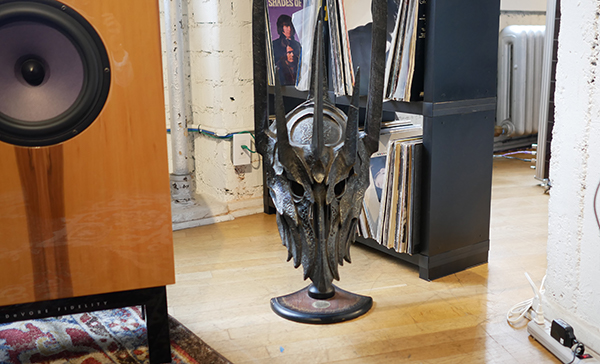
Spotted in NoHo Sound. For all my fellow Tolkienites.
Chris Petranis: We're trying to incorporate the lifestyle component into it. We want to grow this into something unique where we marry the high-end purchasing experience with the experiential part. Those are words that are typically overused, but no one has ever, ever even come close to using them in this business. People just have air-conditioned, pretty cheesy spaces with a bunch of expensive boxes, and people walk in, and they try to sell you them, and then there's no follow-up whatsoever.
When we announced ourselves, people said, "Oh my god, thank god, we hated dealing with x, y, and z." So this has been a "product" that this market desperately needs to migrate and grow into, and we're having a blast doing it. We do music, film, people, artists, wine—and it's a lot of fun! I think that's the other component: no other dealers actually have
fun. Really, they're selling you boxes. No one cares about music.
Roy: When's the last time a dealer held a Formula One viewing party at four in the morning on a Sunday? We do. Have you ever heard a Formula One racecar through a Focal Sopra No.3? It's awesome.
Dagdagan: What are you optimistic about in this industry?
Roy: The automotive sector's a great example because so many of our customers are into luxury automotive. A Toyota Camry today will out accelerate, out break, and out handle a Ferrari 308 from
Magnum P.I. It's a better car . . . but it looks like a Toyota Camry. But Ferrari still exists, and people still buy fast cars. You can get a Subaru WRX for $30,000, and it's better, faster—as fast as many sports cars from sports car companies.
Performance in all parts of society is becoming commoditized. In theory, Sonos or everything at Best Buy should win, and there's no reason this sector should exist. People aren't buying numbers. They're buying
flavors of sound, they're buying character, they're buying an
idea that the box doesn't need to be hidden behind a wall; the box is
art. It's art, replicating art. "If only I had that, I'd be a little closer to real life." That's part of the human condition, and that will never change. As long as someone is giving customers a place to learn and see what the absolute best is at the intersection of art, science, and engineering, the high-end will always exist.
So I'm more optimistic than ever because the more digitized, virtualized, and synthetic the entertainment that Hollywood is trying to foist on us—virtual reality, augmented reality, self-driving cars, lower-quality bit rate files—the more that the mass of people believe that that's all there is, the more likely it is that there's going to be a 180-degree turn—that people are going to place value on tangible, organic, real things. Why are record players making a comeback? Even shitty record players. Even shitty records sold at Urban Outfitters. Why? Because they believe in the
idea of authenticity, and authenticity is best delivered by the highest quality engineering. (If only the software were better, we'd be closer to the real thing.)
I'm totally an optimist. What I'm a pessimist about is the
way it's being sold. Stores suck. They do. If stores were great, we wouldn't exist.
Kain: We're truly passionate about what we do. What I look forward to is sitting down with a prospect and enjoying the reproduction of a performance—really allowing myself to decompress. It's meditation. Whether it's a glass of scotch, a cigar—I'm there and I'm engulfed in the experience. That's what I look forward to. I want to transcend that experience to the next person, because I feel that it's a part of people's lives that is missing significantly. And at the core of it, that's why we do this. Aside from filling the void in the industry, what I hold true is the passion. I'm not here to sell you a box; I'm trying to sell you the lifestyle behind it. I'm trying to make sure that when you get home, you're enjoying this stuff.
What I don't want to get lost in translation within this story is that we're mad at anyone else. As consumers, we're frustrated, and the result will be this [NoHo Sound]. But at the core of it is what we're talking about right now, which is us having fun—translating and transcending that to our customers. We want to broaden the awareness of our industry. We're disappointed at what others haven't done.
Roy: And if we don't do this, where are we going to buy gear in New York City? Who's going to sell it to us?