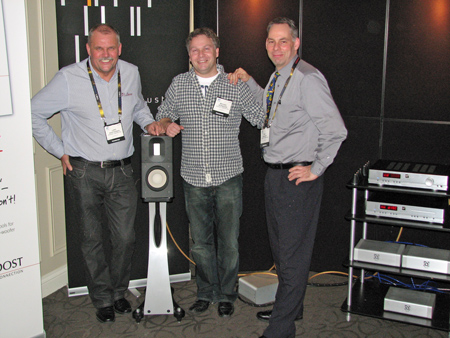
When I entered the Nordost room, Roy Gregory and Lars Kristensen of Nordost were in the midst of preparing a demo of their Foundation Theory. Although the literature on the theory, which should be available on Nordost's website, consumes five small-print pages, the basic theory boils down to this: consistency in your brand of cabling, whatever the brand may be, produces greater rewards than mixing different lines of cabling.
Asking me to choose the music—I selected the opening few minutes of Channel Classic's extremely dynamic, R2D4 DSD-native SACD of Mahler's Symphony No.2, conducted by Ivan Fischer—the men began with a true hodge-podge mix of cabling from a number of deservedly respected companies. These included Transparent, PS Audio, and Van den Hul. They also added an Audience power conditioner to the mix.
Frankly, the components were so excellent that the Mahler sounded pretty good even with the mix of cabling. I couldn't make sense of a rapid descending zig-zig-zig pattern in the double basses, but everything else sounded like really good hi-fi.
After each round of listening, the cables were slowly changed. First, we heard Nordost's entry-level power cables. Then Nordost Blue Heaven cabling entered the picture. Then came Nordost's new Sort Kones, which are resonance control devices designed to provide a route for a component's sonically damaging internal vibrations to exit a component's chassis. (Microphonics, I was told, are more damaging inside solid-state equipment than tube gear). Somewhere along the line, Roy removed the Audience conditioner, replacing it with one Quantum device, then a full complement of two Quantum QX4s and one QX2. Finally, the Nordost Blue Heaven was replaced by Nordost higher level mono-filament cabling, in this case, Tyr.
The difference each successive change made in the sound of this Simaudio amplification and Raidho Ayra loudspeaker system was striking. Each time, timbres became more distinct, soundstage width increased, and images took on palpable three-dimensionality. Most important, the images began to cohere, and that formerly confusing zig-zag in the double basses made musical sense. Once the two Quantum QX4s and single QX2 were switched on, I was able to hear around and behind images, getting an uncanny sense of acoustic space.
The real shocker was the complexity of sound and color that emerged once the final switch was made to Tyr mono-filament cabling. I can only imagine how good the system would have sounded like had Nordost Odin been introduced instead.
Pictured, left to right, are Lars Kristensen, Michael Borresen of Raidho loudspeakers, and Roy Gregory.