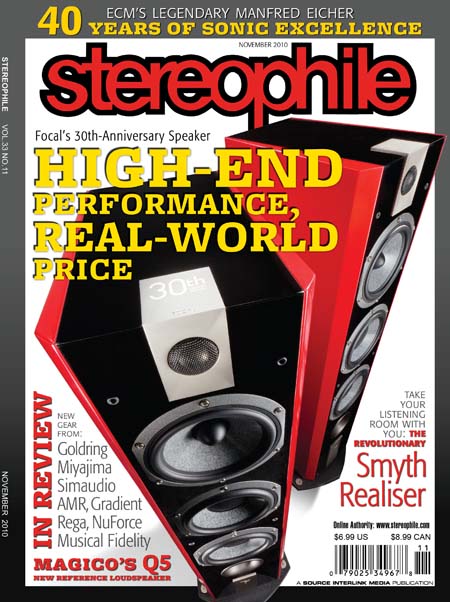
The November 2010 issue of
Stereophile is now on newsstands. Immediately after shipping the issue to press, we had to redirect our focus to shipping the
2011 Stereophile Buyer’s Guide. And almost immediately after shipping the
Buyer’s Guide, we had to redirect our focus to shipping the December 2010. While the December issue was in its very final stages, we had to fly to Denver to cover the outstanding
Rocky Mountain Audio Fest. It’s been a whirlwind and I can honestly say that I hardly remember
working on the November issue.
Our designer, Natalie Baca, tried a few new things on the cover, going to a sleeker, more modern typeface and playing with the placement of the cover lines in an attempt to reinforce the drama and impact of Eric Swanson’s photograph. I think it worked out very well, and I hope you agree.
The issue opens with a fine “As We See It” by Steve Guttenberg, pondering the many strange variables that add up to a believable hi-fi experience.
“There’s
something going on. We just don’t know precisely what it is.”
He’s right, and not knowing doesn’t bother me at all. In fact, I kind of like it that way.
Our trip to Denver got me thinking a lot about hi-fi and the sound of music. Now more than ever I feel it’s important to point out that
Stereophile is a hi-fi magazine. We review hi-fi components. We don’t review live music performances. The two are very different things. So, why should we use live music as the ultimate standard against which we judge hi-fi? Now more than ever I think it would be a mistake to hold any hi-fi component or system up against a live performance. There are many, many reasons for this, among them the fact that a live performance
can sound awfully bad. But here's the more obvious thing: Even the most skilled and enchanting pianist would fall short in terms of creating a wide and deep soundstage or throwing a well-focused image or any number of other things that most good hi-fi components achieve without any problem. Does this make the pianist a bad pianist? No, it only makes him a bad loudspeaker. I wouldn’t try plugging my speaker cables into Robert Silverman expecting him to play a song.
If you want to compare Bob Silverman to, say, Lang Lang, fine. Have a blast. They’re both pianists, and comparisons can be made, I’m sure. Similarly, hi-fi should be compared to hi-fi, and the standard by which we judge a hi-fi component or system should be its ability to get us lost in the
music, to fire our search for
more music, because without music, a hi-fi component or system has absolutely no purpose. Isn’t that right? Why is this so hard to understand? What am I missing?
Also in this issue: Robert Baird talks with ECM founder, Manfred Eicher. Robert was so psyched about this. I think he had been trying for about a decade to schedule the interview. He and Eicher met on more than one occasion, and after each visit, Robert would come back to the office drenched in sweat and looking all perplexed. He would say cryptic things like, “Manfred is really something.” Or: “It’s going to be hell transcribing these tapes.” The result, in my opinion, is some of Robert’s best writing. And I love learning about Eicher’s process and motivation. “You have to find the secret of music somehow. You have to be able to understand the mystery.”
He’s obviously talking about love. Whenever anyone says anything about “understanding the mystery,” you can be sure that that person is talking about love. And, yes, he continues: “It’s very, very important that you love the music.”
We have four full Equipment Reports in this issue, and they’re good ones: Bob Deutsch reviews the Focal Chorus 826W 30th Anniversary Edition loudspeaker; Michael Fremer reviews the innovative (
and surprisingly heavy) Magico Q5 loudspeaker; Erick Lichte listens to the Simaudio Moon i3.3 integrated amplifier; and Wes Phillips falls in love with the NuForce CDP-8 CD player. We also have full Follow-Up reviews on the
Gradient Helsinki loudspeaker (John Atkinson set them up in his own room and performed some in-room measurements), the Abbingdon Music Research PH-77 (originally reviewed by Michael Fremer in his “Analog Corner” column, JA wanted to subject the expensive phono preamp to a full course of measurements), and
Rega’s P3-24 turntable (equipped with Rega’s own drive belt upgrade, which caused
such a stir here on the blog).
Meanwhile, in “Sam’s Space,” Sam Tellig reviews new gear from Musical Fidelity—the M3i integrated amplifier and matching M3CD CD player. In “Analog Corner,” Mikey Fremer auditions the Miyajima Premium BE Mono phono cartridge, Goldring Legacy phono cartridge, and Bellari MT502 step-up transformer. In “Listening,” Art Dudley recommends Aaron Copland’s book,
What to Listen For in Music. (I have an unfair advantage in that I get to read
Stereophile before almost anyone else. After reading Art’s column, I immediately went out and bought a copy of Copland’s book. It’s excellent, an invaluable resource.) Finally, in “Music in the Round,” Kal Rubinson tries out the fascinating Smyth SVS Realiser A8 system, which somehow allows you to experience true stereophonic listening from headphones!
November’s “Recording of the Month” is a new recording of Beethoven’s Piano Concertos 1-5 on the Harmonia Mundi label, engineered by Philip Noth. We also have reviews of new albums by Deerhunter, Dmitry Baevsky, Mike Mainieri, and Rebecca Martin, and, in “Aural Robert,” Robert Baird discovers wonderful collections of obscure recordings from Sublime Frequencies. Yes, indeed, you have to love the music.