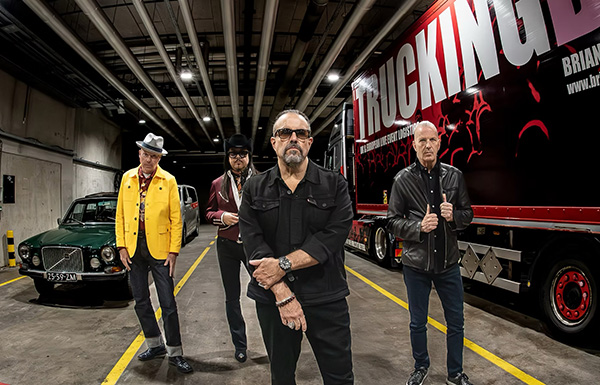
The Mavericks: Photo by Charlie Spieker
Just before Christmas 2025, American music suffered two irreplaceable losses with the passings of Raul Malo (December 8) and Joe Ely (December 15). While a lot of musicians exist on the artistic and commercial fringes, Malo and Ely were foundational artists, gifted creators and performers who refused to be confined by artistic boundaries. Though not without their struggles, each eventually found widespread respect and success. Each leaves behind a significant body of wonderful recordings.
Malo's demise was expected. He was diagnosed in summer 2024 with stage 4 colon cancer, which eventually led to leptomeningeal carcinomatosis. Yet Malo's rapid descent then passing at the too-young age of 60 was still a shock.
Amid all the recent tributes to Malo and the band, it's important to respect just how hard The Mavericks, who disbanded twice, in 2000 and in 2004, struggled for success. I vividly remember sitting at dinner with Malo in Austin at a South by Southwest conference during one of the band's uncertain periods. Genuinely confused, he nevertheless remained committed to soldiering on.
With a svelte young Malo clad in black on the cover, The Mavericks' third MCA album, 1994's
What a Crying Shame, which contained a vibrant cover of Bruce Springsteen's "All That Heaven Will Allow," was the first sign that this band was special. Defying easy descriptions, the band's original music, much of it written by Malo, fused Mariachi-influenced brass, country music heartbreak, dramatic Roy Orbison–like ballads, and exuberant rock and roll. Malo's inestimable tenor voice was always at the heart of The Mavs' sound. His breathtaking bravura vocal performance of the title track of the 2004 Stephen Foster tribute collection
Beautiful Dreamer remains his most powerful recording.
The Mavericks and Joe Ely both made albums later in their careers that were obvious attempts to reach larger audiences. Both albums were solid, and both were puzzling failures.
After three years of silence, Malo and the band reunited and released, in 2003, a self-titled collection on the UK's Sanctuary label, the eventual home of the Black Sabbath catalog.
The Mavericks and its follow-up on the same label,
Live in Austin Texas, remain highpoints in the band's distinguished catalog. Yet, despite critical acclaim, neither sold particularly well. After a second breakup, the band reunited in 2014 with a new mission: build an audience through endless touring. Eventually a big band, complete with saxophone, trumpet, and world-class Norteño accordion player Percy Cardona, they recorded for their own Mono Mundo label and played for audiences large and small. Their dedication to the road eventually turned venues like the Beacon Theater in New York City into home ice, where a cult of devoted, rapturous fans could never get enough.
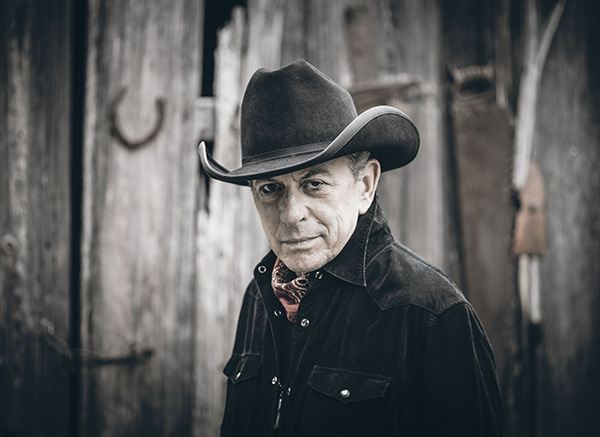
Joe Ely: Photo by Barbara FG
Initially a folk singer from Buddy Holly's hometown of Lubbock, Texas, Earle Rewell Ely Jr., who went by Joe Ely (EEE-Lee), found his groove mixing rock, blues, country, and Tex-Mex, all while employing rocked-up electric guitar slashers including Jesse Taylor, David Grissom, and Ian Moore. Among his group of West Texas friends—a group that included Jimmie Dale Gilmore and Butch Hancock, with whom he formed the early Americana band The Flatlanders—Ely proved himself a natural showman. He and his Flatlanders bandmates remained close, and Ely often made many of his friends' best songs—"Dallas" by Gilmore comes to mind—the centerpieces of his albums.
Impishly handsome with a swashbuckling outlaw's gleam in his eye, he was catnip to a certain stratum of females. A dedicated fanboy, I once wrote a story about him in an Arizona alternative weekly that rudely began—and I paraphrase—"There's an informal sorority in Texas who proudly say 'I slept with Joe Ely.'" Later, when I bravely asked him to sign a copy of the paper, he shot me a grin and emphatically scrawled, in extra-large letters, "Yellow Journalism at its Finest!"
The Clash saw Ely's heart and fire early, inviting The Joe Ely Band to open their 1980 tour. That resulted in one of Ely's best-known albums, 1981's
Live Shots. His six early albums on MCA, including 1978's
Honky Tonk Masquerade, his classic of West Texas troubadourism, all show a fast-growing songwriting talent and an increasingly confident singer.
Lord of the Highway (1987) and
Dig All Night (1988), two albums he made for California indie label HighTone Records, show him experimenting with a larger, Mellencamp/Petty-inspired heartland rock sound.
1990's
Live at Liberty Lunch (which was never released on vinyl in the US) is an accurate, well-recorded portrayal of Ely and his band at the peak of their powers. The next album, 1992's
Love and Danger, was, like The Mavericks' self-titled 2003 set, Ely and his label's attempt at finding a larger audience. Despite robust promotion from MCA, unforgettable tunes like their cover of Dave Alvin's "Every Night About This Time," and a more commercial production style, it failed to connect with an audience.
Here's hoping that Ely's passing, at age 78 in Taos, New Mexico (where Doug Sahm also died), from Lewy body dementia, Parkinson's disease, and pneumonia, will inspire UME (which now owns the MCA catalog) to produce a deluxe reissue of
Love and Danger.
If eloquent tributes on social media are any gauge, Ely was much loved by fellow musicians and the music community. Michael Hall's profile in
Texas Monthly, written days after Ely's passing, is heartbreaking and a gorgeous piece of writing. Bruce Springsteen ended his Facebook tribute post with "We've lost an American Classic." But it was longtime
Austin City Limits producer Terry Lickona who said it best: "A maverick genre-agnostic songwriter who gave performances that alternated between touching our hearts and melting down our cameras, ... Joe was and will always be a superstar."