

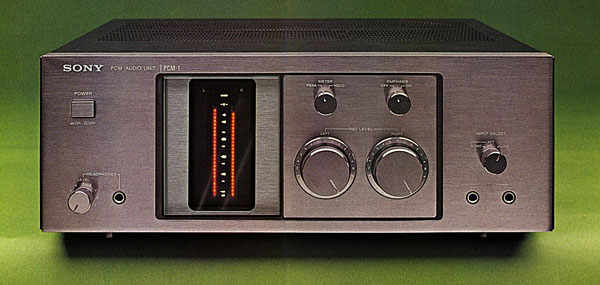
Long-time Stereophile readers May be dismayed by what appears to be our unfettered satisfaction with some of the recent crop of new components. Aren't we, after all, dedicated to the pursuit of perfection? Do we really feel that some products are all that close to it? The answer to both questions is "Yes."
Certain components we have tested recently—the Sony PCM-1, the Berning TF-10 preamplifier, the Infinity HCA amplifier, the Shure V15-IV phono cartridge and its companion SME 3009 Series III tonearm—are good enough that further performance improvement to them can result only in sonic improvements so slight that they could be lost within the normal range of sample-to-sample variations of those components.
This is not really as heretical a view as it sounds. The pursuit of perfection in anything is a worthy cause, but we must also bear in mind that perfection in audio is not really a Holy Grail—an object that can, finally, be grasped and held and fondled. It is, in the truest sense, an unattainable ideal, because as soon as we think we have finally deceived our ears into perceiving reality, our ears grow more sophisticated and start to perceive the imperfections. We can only continue to approach perfection, as we can approach but never reach a distant point by progressively halving our distance from it. And inevitably there comes a point where an audio product is able to reveal everything in the program material without audibly adding or exaggerating anything that doesn't belong there. It still may not be perfect, but further improving its performance will rarely provide a sonic improvement concomitant either with the effort involved in doing so or the added cost to the buyer.
We will dutifully report and applaud such technological accomplishments as they occur, although we may find it hard to be as enthusiastic about them as we were when every component had several deficiencies of the kind which actively impair the enjoyment of music listening. To us, the real challenge now lies in the design of moderately-priced components that can approximate the performance of the state-of-the-art units.
Only in the area of loudspeaker design do we still see substantial need for improvement. For every $2000 speaker system with stupendous lows and fantastic highs there are three $200 speakers that can put those costly behemoths to shame in the reproduction of the musical middle range. We can see no earthly reason why this should continue to be the case, and this is the area, now, where we anticipate the greatest fidelity advances within the new few years.
We can no longer view commercial recordings as "the weakest link" in the audio system. The fact that most audiophiles get indifferent sound from the best discs is the fault of their choice of playback equipment, not of the recordings. Despite the availability of accurate disc-reproducing equipment, we see little hope that signal source material in the audiophile home will improve significantly until mechanical disc reproduction is superseded by digital.
The final area for improvement as of now is in the recreation of spatial information. SQ had the potential for doing this, but most record producers abused it, and truly effective decoders never became available in time to rescue SQ from oblivion. Today, most audiophiles seeking spatial effects use ambience synthesizers such as the Audiopulse and ADS. Digital recordings will be able to produce discrete 4-channel sound, and probably will.—J. Gordon Holt















