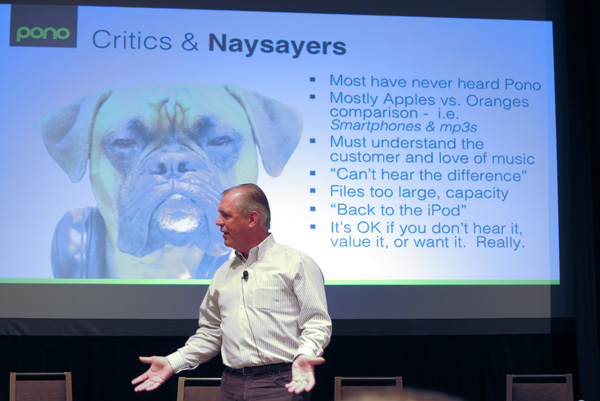
As if an impressive array of products, great seminars, and lots of other goodies were not enough, AXPONA capped its first day with an hour-long presentation by PONO CEO and confirmed audiophile, John Hamm (above). Even before the talk began, John walked through the audience, giving sneak peak, hi-resolution listens to attendees via Sennheiser HD650 headphones.
The word “pono,” you may know, is Hawaiian for “righteous.” The player was created by Neil Young, who wants to “rescue an art form” from the throes of sonically degrading MP3 and the limitations of Red Book CD sound.
John framed his talk by saying, “The big picture is better music for the masses.” He also noted that all the advance auditions of PONO have only given us a taste of the final product, because “30% more engineering is going into it before it’s released in July or August.” That engineering, as you may know from other interviews with Hamm, includes contributions from Ayre’s Charlie Hansen.
John explained that Neil first approached record labels 2½ years ago, when everything was in transition, streaming was emerging, and no one was clear as to what their new business model would be. It was then that he proposed a high-resolution antidote to MP3, and a portable player that would bring the music to them.
“This is an artist-driven movement,” said John. “Neil created PONO to communicate the emotion the artist meant for you to feel. We intend to sell the player for the least possible price we can for now.”
John Hamm called PONO’s recently closed, remarkably successful Kickstarter campaign “a very democratic outreach to get the word out.” With 18,000 backers, $6.2 million raised (half of which will go toward manufacturing PONO players, and the other half toward “bringing up the quality of the PONO site,” and 15,000 units pre-sold, PONO now has 15,000 evangelists spreading the word. “The bottom line is getting quality music to the people,” he said.
After word of PONO and its Kickstarter campaign first got out, one thing that threw John for a loop was the volume and intensity of the naysayers. For several weeks, he attempted to engage them, until he realized that all the arguing in the world would not make a bit of difference. Instead, he concentrated on spreading the word among people who understand that hi-resolution recording and playback make a difference.
John sees 24/48 as a baseline starting point for hi-resolution. Warner, which began started archiving its projects in 24/192 five years ago, currently offers the most hi-res content of any label. PONO is now giving other labels a reason to follow suit. The PONO player is completely open; it will play music from multiple sources, including personal collections, in all different formats. You will not have to buy music exclusively from the PONO store in order to be able to play it on PONO.
Even as John gave ample credit to the Chesky brothers’ HDTracks venture, he also made clear, both during the talk and in a private chat afterwards, that PONO’s own store is poised to offer some of the same material and much more in multiple genres, including classical, sourced from masters. “We think our 44.1 content will sound better than that ripped from CDs,” he said. “We will not remaster or remix. All content will be signed off by the artists. We plan to deliver the finest digital sound you can get. We care about provenance and the chain of custody.
“A lot of independent artists have come to us, including Fleetwood Mac, asking how they can be part of the PONO hi-resolution movement. We plan to tell them, if you want to play on PONO, here’s how you should record and how you should master.”
By the time John Hamm’s AXPONA talk had ended, I came away hungry for the finished product. I know that a lot of people have greeted PONO with a mixture of anticipation and skepticism. While an open-minded critical approach is always a healthy thing, I see every reason for optimism, and no cause for outright dismissal.
It’s clear from everything Neil Young and John Hamm have said and done so far that they truly see PONO as a collective movement of artists to get better, emotionally truthful sound to those who love music and want to hear it as its creators wish it to be heard. Unless you hate Neil Young and his music, and resent his financial success, or wish the player would retail for $199 rather than the projected $399, what’s there to complain about?
As to how PONO’s sound will compare with units from Astell&Kern and other companies, stay tuned.