

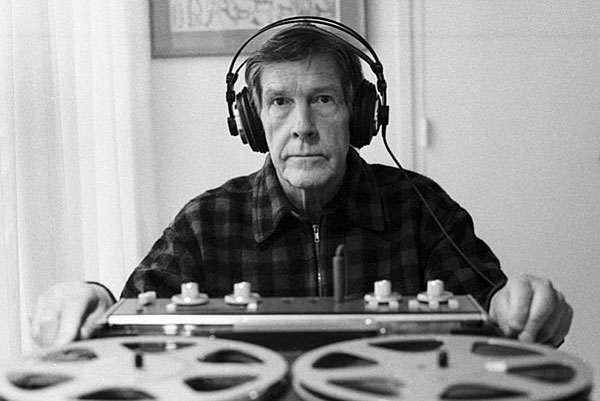
Way back when, I met this maenad woman at Caffe Reggio in Greenwich Village and told her I was an artist. She told me she was an art collector and invited me to her loft to see her collection. While she was showing me an impressive assortment of African and contemporary art, she was dropping names: William Burroughs, Bob Marley, John Cage, etc. Hmmm . . . really? I spoke up. "Oh, I love John Cage. What was he like?"
She told me that Cage picked her up one day to go to an art party in the Hamptons. When they arrived, he said he needed her help putting batteries in a box full of transistor radios. As they walked to the party, he instructed her to tune the radios to any stations she could find, but between stations would be okay too. He began placing them under cars, behind bushes, and in mailboxes by the road. Once inside, they put one behind the toilet, and another under a pillow in the bedroom.
Remembering that story made me wonder what effect this unconventional composer was hoping to have on his unsuspecting audience. Likewise, what did revolutionary artists like the Beatles, Charlie Parker, and Igor Stravinsky hope to accomplish with their creations? My brain began to tumble. Unexpectedly, I realized I had never asked myself that really big question: What is the purpose of music?
Last Saturday, that question came racing back at me. I went to the WFMU Record Fair specifically to buy a copy of Rutherford Chang's album The White Album, based on his art installation We Buy White Albums. The place was crammed with collectors pushing and bumping, spending hundreds on obscure punk zines and prog-rock LPs. As I wound my way to Chang's booth, one record stopped me in my tracks: a near-mint, white-label, mono promo pressing of Jimi Hendrix's Axis: Bold as Love—for $5000. Two weeks earlier, a Tommy Johnson 78 on Paramount had gone for $37,000. I had to wonder—what are people doing with these things?
Typically, audiophiles like me collect records, listen to music, and build extraordinary audio systems—all to demonstrate to our comrades and ourselves what we believe is important. I remember exactly why I started buying records. Of course I loved music, but I also wanted to be loved, and to belong to a larger group of more fabulous beings. To win affection, I needed to show people that I shared their tastes and attitudes. More than anything else I've accomplished, the ritual of playing recorded music has created and sustained my social, emotional, and intellectual lives. Therefore, I am compelled to ask myself, when I play recordings for friends, What effect am I hoping to have on them?
The Cage story impressed me because, when I spin discs for an audience I know, I try to work a similarly provocative strategy—to surprise the unsuspecting, to soften the most jaded, and to parlay a shared musical experience into something significant and memorable. By simply lowering the tonearm, offering music as a gift, I compel my guests to listen. With a soft smile, I ask, Is this not beautiful and wonderful? Are you not grateful we are friends? Won't you please invite me to your house and tease me with your own musical discoveries?
The main purpose of music in my life has been to illuminate a set of values that I, the artists whose records I play, and my listeners all share and cherish in ourselves. Music shows us our cultural identity. Music sorts us out and separates the Dionysian from the Apollonian. Musical genres are the fences we build to keep the maenads safe and the barbarians out.
Pick your favorite music—bebop, hip-hop, the blues. Each speaks to its fans about shared conditions of the soul. When music is deeply felt, the artist is simply reminding us that we are not alone. Musical genres are signifiers of tribal identity. When Leonard Cohen sings about "Suzanne," he is singing about my desires and dreams as well as his own. This is where music's real beauty lies. I believe that beauty is our most fundamental need and our primary survival tool. Why? Because form, style, and taste draw us together and force us to communicate. As new guests arrived at that art party in the Hamptons, all they could talk about was the surprise, the invention, the beauty of John Cage's creation.
Composing original music and playing it for others is surely among the greatest talents a human being can possess. Regrettably, I have never had that ability—but by the age of 12 I had realized that I possess a talent for finding records, and playing them in ways that would amaze my friends. With that ability, I transformed myself from a lonely, nerdy pre-teen with a squeaky voice and pipestem arms into a swaggering, deep-voiced 16-year-old. That talent got me a job at a Chess Records outlet. That flair became my calling card in the realms of girls, rat rods, audio, and construction. It pulled me through art school. It caused me to study engineering. It made me new friends and kept me connected to the old ones.
I suspect that you and I share this talent. I imagine we both read Stereophile, collect recordings, and build hi-fis because, even if we don't realize it, we want to be a bit like John Cage—to be loved and admired for our work. Like artists, we want to create surprising and memorable musical happenings. Like archeologists, we want to unearth what is hidden in the pits and grooves and share our discoveries with others. I believe that playing recorded music—whether along the road, in the concert hall, or in our listening rooms—is a noble Arcadian pursuit that elevates our minds and lets us mingle with the ancient gods—especially if the discs are in VG+ condition or better!—Herb Reichert















