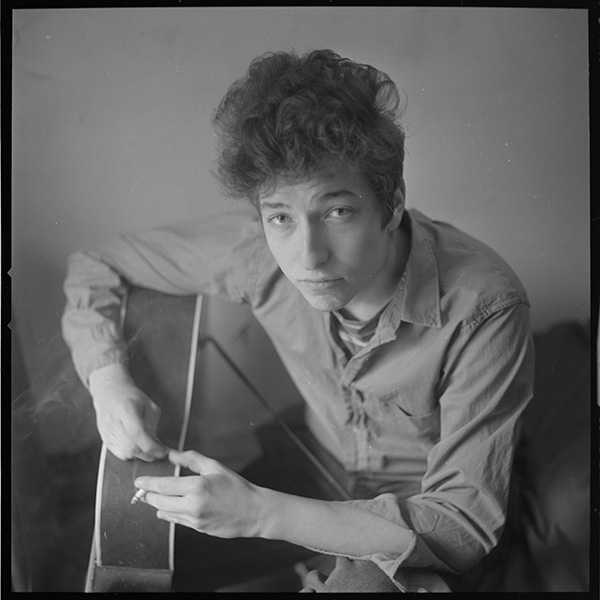
Photo: Don Hunstein, courtesy of Sony Music Ent.
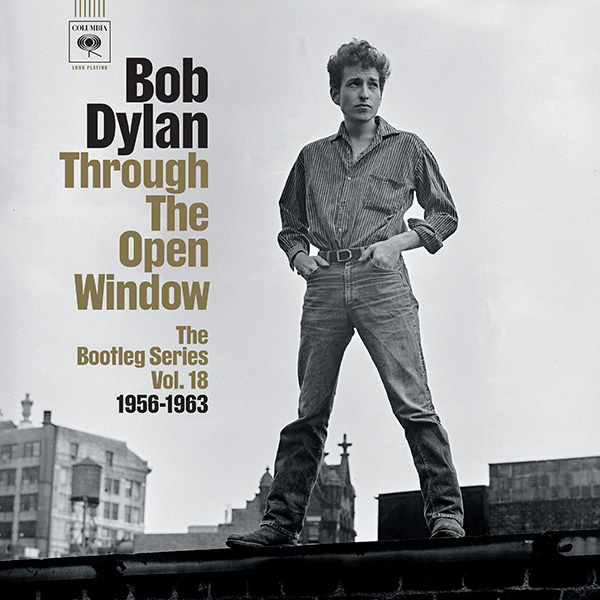
Columbia Legacy has released Vol.18 of the Bob Dylan
Bootleg Series. Through the Open Window covers the years 1956–1963. The collection is available as three physical sets: two-CD or four-LP "Highlights" versions that contain 42 tracks, and an eight-CD "Deluxe Edition Box Set" that contains 139 tracks and has a running time of 8 hours, 59 minutes. The "Highlights" package is available streaming at 24/192, but the other 97 tracks are only available in the big box. That big box also includes a 124-page hardback book containing full credits, 100 photos, and liner notes—really a substantial monograph—by Sean Wilentz, professor of American History at Princeton University and author of the book
Bob Dylan in America.
Steve Berkowitz (footnote 1) and Sean Wilentz share production credit for
Through the Open Window. This continues Berkowitz's involvement with the
Bootleg Series, which goes all the way back to the first release,
Volumes 1–3 (Rare & Unreleased) 1961–1991, where he was credited for "production coordination, marketing." Mastering and restoration were carried out by engineers Michael Piacentini and Steve Addabbo. Many others are credited with archival and tape research.
In the Deluxe Edition box set, the tracks are presented in known chronological order, concluding on discs 7 and 8 with the first release of Dylan's complete performance at Carnegie Hall on October 26, 1963. The range of sources is unique: a combination of home/party tapes (many heard here for the first time), live performances at various clubs, bars, and venues in New York City and elsewhere, and studio recordings from the Columbia Records sessions for Dylan's first three albums.
There's an ear-bending number of firsts in the set, starting with the first recording of Dylan known to exist, with him and some pals covering "Let the Good Times Roll" on Christmas Eve, 1956, at the Terlinde Music Shop in St. Paul, Minnesota, on one of those "make your own record" acetate machines stores used to have. Bob, age 15, also plays piano.
There's a home tape from his apartment in Minneapolis, covering Woody Guthrie's "Jesus Christ," September 1960. Bob arrives in New York in January 1961, and by that April he is opening for John Lee Hooker at Gerdes Folk City, a club where he made several memorable recordings—included here. Another hang that year was at the Folklore Center, owned by Izzy Young, who in November of '61 rented the Carnegie Chapter Hall to present Bob. A few days later, having been signed by John Hammond, Dylan was at the Columbia Records studio on 7th Avenue, making recordings for his first album,
Bob Dylan. Several outtakes and alternates are included here.
Dylan was bouncing back and forth from Minnesota to New York in this early period. Eight tracks here were recorded in the home of Bonnie Beecher in Minneapolis on December 22, 1961, including one of the most beautiful and heart-rending songs Bob has ever laid down, "I Was Young When I Left Home." This is the only known recording of this song, though it was released previously as a bonus track on Bob's
Love and Theft from 2001.
So many twists and turns in Bob's story can be heard—like Dylan playing harmonica on "Midnight Special" for a Harry Belafonte session in February 1962. In Gerdes Folk City, you can hear him playing his latest material, such as "Talkin' New York," alongside such traditionals as "Corrina, Corrina" and "Deep Elem Blues"; "Deep Elem Blues" gives a glimpse of what was to come much later, specifically his connection to Jerry Garcia and the Grateful Dead.
Other beautiful standouts include the earliest known version of "Tomorrow Is a Long Time," which was unfinished when Bob presented it to friends at the home of Dave Whitaker in Minneapolis in August 1962.
Then the sessions for
The Freewheelin' Bob Dylan begin; many wonderful examples are in this set. I did not know, prior to reading Wilentz's detailed history, that these sessions stretched out over a lengthy period, a half-dozen sessions from April 1962 through April 1963. There are tracks here on which producer Hammond paired Bob with a band for the first time, which did not make the cut for the album. An example: a cookin' version of "That's All Right," practically a precursor to the sound Bob would get years later on
Nashville Skyline. We hear first versions of "Masters of War," "A Hard Rain's a-Gonna Fall," "Blowin' in the Wind," "Don't Think Twice"—the list goes on and on, and the history behind the recordings is wonderfully illuminated by Wilentz.
Through the Open Window is
so unique,
so well assembled, and
so important that it adds to Dylan's legacy in real, significant ways.
I was most pleased to have the opportunity for a three-way Zoom interview with co-producers Berkowitz and Wilentz. Here are some excerpts from our conversation.
Sasha Matson: Describe the process for making
Volume 18.
Steve Berkowitz: Scholarly archiving and cataloging the materials to start with. Then what you turn it into is another matter—not to mention how it's distributed and how people actually hear it. Because you have to work on it like crazy to make it sound as good as it can—and then they're going to hear [it as] MP3s. The goal is to try and get the track to sound as much like the moment of creation and capture as possible.
Matson: How did you go about tracking down so many wonderful home/party tapes and tapes from venues that no longer exist?
Berkowitz: There are four or five very well-known Dylan archivists who are friends of the Dylan camp, of the Dylan Center, of [Dylan manager] Jeff Rosen, and also of Sean's and mine. It is their ministry to find and locate all the Bob and to bring it forward. They are historians of great consequence. We have been collecting all this material for a long time and putting it in a bucket in chronological order. When it was decided what would approximately be the contents of the box, Sean and I, along with Jeff Rosen and the Dylan camp, would get all the music in one place. Then it was my and the engineer's job to put it into listenable form. I would listen to all the versions we have and say, "Oh look, this one has an Intro, or that one has Bob saying something." Then we go between them and see if we have a complete version, and which one sounds the most listenable. Then we have the editing process: deciding what would go into the box.
Matson: What words come to mind to describe Bob's journey as it plays out in
Through the Open Window?
Sean Wilentz: Rapid, swift, extraordinary. The rapidity with which he became
who he became.
Berkowitz: Evolution. In the box set, there are a number of pivot points. He comes to the Village, and he's gathering and learning. By the time he plays Town Hall, he's on the way to becoming a very established folkie. The rate at which he excelled and went forward from '61 to '63 is the fastest musical evolution of any professional musician we've ever seen.
Matson: Name another songwriter who has a larger range than Dylan.
Wilentz: Nobody. [
Laughter.]
Matson: Describe the home/party tapes, as differing from the studio recordings.
Wilentz: When we talk about these home tapes, there are different situations and different kinds of them. The Bonnie Beecher tapes, or the tapes with David Glover—there he's with friends back home in Minneapolis. He's showing off, showing what he can do, with old friends. In other cases, for example the Bailey tapes or the McKenzie tapes [in New York], he's trying different things out that are going to influence his performing and songwriting. These tapes tell aspects of the story that could never have been done only with the studio tapes.
Berkowitz: Some of them are sort of "fly on the wall." What you're not hearing is they could be jamming, or others perform, or he's asked to sing a song at a party.
Matson: For this new
Through the Open Window set, were you both involved with choices and final sequencing? Did Dylan provide any input or approval?
Berkowitz: Yes, Sean and I were locked throughout in a dance, an improvisational sculpture. The notes were written and illuminated by what actually took place. There was a chronology that existed, that we then followed. There's the evolution of the music, and Sean is telling the story, the history. We would go back to the notes and ask "Are we illuminating this?" Because the album has to have a size; it can't just ramble on forever. This is a very good presentation of the time and the period.
Bob Dylan has complete control of all music of his that gets released by any label. All our tapes and work and notes were passed through to the Dylan camp, and we got approvals for them.
Matson: Do you think there was a point at which Bob thought he was documenting himself?
Wilentz: I don't think so, but I think other people might have thought that. There were people in the communities who understood that this was important to try and get down. This is an album of Bob Dylan's, but it's also about the communities he grew up in.
Matson: Do you think Dylan's first trip to England in 1962 was decisive in terms of influences and sources?
Wilentz: Absolutely. He gets a crash course in Anglo-Celtic balladry, among other things. He had heard things in America, but now he's hearing the originals. He makes a good friend in Martin Carthy at the King & Queen club in London, and Carthy teaches him a great deal. In fact, it's Carthy's version of "Scarborough Fair" that Dylan is to later transform into both "Girl from the North Country" and "Boots of Spanish Leather." There's an inflection point as he's making
Freewheelin', after his postgraduate course in Anglo-Celtic music.
Matson: He's going deeper into the well.
Wilentz: No question.
Matson: Do you think Bob was listening to old 78s?
Wilentz: I don't know about 78s in particular, as a lot of that music was being reissued right around that time. [But] Bob Dylan knows every inch of American music.
Berkowitz: [Dylan had a] voracious appetite to hear everything and ingest it. Whether he put that back out in a form we recognize or not, that's for musicologists to look into for the next hundred years. He listened to everything, and as far as I can tell, he still does!
Matson: Where is the boundary between being a Dylan fan and being a Dylanologist? [
Laughter.]
Wilentz: I hate the term "Dylanologist." A.J. Weberman had a lot to do with inventing that term. I think of it as silly pseudoscholarly. Whenever anyone refers to me as a Dylanologist, I run the other direction!
Footnote 1: See my interview with Berkowitz, "
A Record Man for All Seasons."