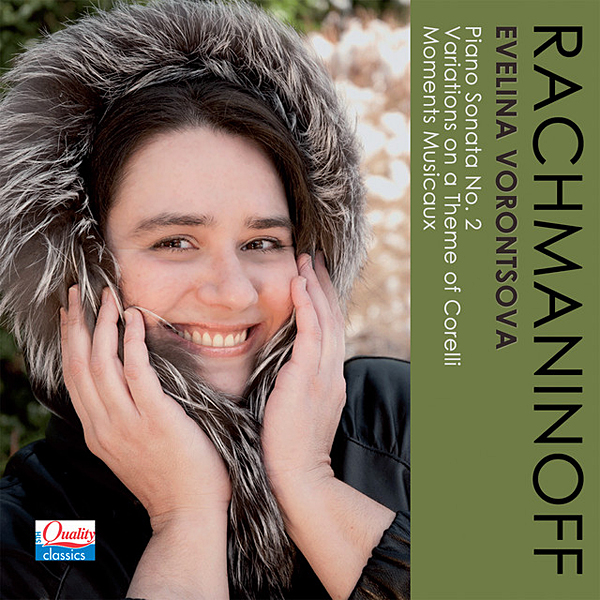
Rachmaninoff: Piano Sonata 2, Variations on a Theme of Corelli, Six Moments Musicaux
Evelina Vorontsova, piano
STH Quality Classics CD1416092 (CD). 2017. Paul Steverink, Boudwijn Zwart, prods.; Jaco van Houselt, eng. DDD. TT: 74:42
Performance ****½
Sonics ***** This is Russian-Dutch pianist Evelina Vorontsova's second recording; the first was in 2002. Born in 1972, she took fourth prize in the Rachmaninoff Competition at 18, and second prize at the International Franz Liszt Piano Competition two years later; in 2006, she won second prize in the International Piano and Orchestra Competition in Cantù, Italy (at which there was no first prize awarded). Judging from this CD and its very challenging program, she is a remarkable talent; one wonders why she is not more famous and signed to a major label. A good section of the notes accompanying this release focus on Vorontsova's position in the Romantic tradition of the Moscow Conservatory, tracing her teachers far back and reading like those parts of Genesis 5 and 11 that offer the timeline from Adam to Abraham. Mikhail Voskresensky was Vorontsova's teacher; he was taught by Lev Oborin, who was taught by Konstantin Igumnov, a major player in Rachmaninoff's life. The notes will give you far more information than I needed. Vorontsova's playing is athletic and Romantic, her use of rubato (clearly a feature of all the other guys) pronounced. Nuf sed—but I would like to point out that, despite never rushing, she also never drags, or artificially underlines anything in the music. She is unaffected and profoundly musical.
The second piano sonata dates from 1913, but Rachmaninoff, finding some if its complications "superfluous," revised it in 1931; Vorontsova plays the revision. It's still not the proverbial walk in the park—its technical requirements are plentiful, and its mood changes extreme. After the impressively played fortissimi of the opening few minutes, in which Rachmaninoff seems to ask for too many notes to be played in too short a time, Vorontsova meets the lovely cascades of sweet, luscious melody (at about 6:00) with grace and a gentle touch, playing with lyricism all the way into the maniacal Allegro molto, which is played with care and clarity at a tempo at which one can actually hear the music.
The Corelli Variations, also from 1931, are yet another bête noire that must be conquered by serious Russian pianists. The theme is "La Folia"—not, in fact, by Corelli, but an anonymous tune that began to appear at the end of the 15th century, almost simultaneously in France, Italy, Spain, and Portugal. Corelli famously used it for the 23 variations in his sonata for violin and harpsichord, but C.P.E. Bach, Alessandro Scarlatti, and Francesco Geminiani (among others) also fell for its lovely, catchy simplicity. There are 20 variations here, and even Rachmaninoff tended to eliminate a few in performance—he claimed he could tell by the audience's coughing whether or not they were too much.
Vorontsova begins with an amazingly slow, clear, delicate Theme in the translucent upper octaves of her Steinway; Variation I, in the lower half, is dark, dark, dark—and then, of course, the Variations' complexities take hold. Vorontsova's command of rubato is spectacular in Var. IV; the charm of V and VI are rudely interrupted by the ferocity of VII. The odd syncopation of VII, marked misterioso, is mysterious indeed. The jolly X should be merrier; it's a bit heavy here, and XI and XII should be the dark contrast to it. Var. XIV recalls the opening theme in its tempo—it's as close to a jazz improvisation as Rachmaninoff gets. The Vivace of XVI is wonderfully weird, and XVII's moodiness rings true. Vorontsova's skill and awareness of both the forest and the trees are remarkable throughout, and the sensitive coda dies with grace.
The early Six Moments Musicaux are studies of forms distinguished by styles typical of their eras: a nocturne, a barcarolle, etc. Moods range from "easy listening" to the gloomy Rachmaninoff we know and tolerate. The Allegretto is played ravishingly and with heart, and so is the Adagio sostenuto (the Barcarolle). The gigantic Maestoso is a five-course meal unto itself.
The recording was made in a former monastery, with Brüel & Kjær 4040 omni hybrid and DPA 4015A microphones. It allows us to spotlessly hear Vorontsova's very original playing, which never lacks intellectual or emotional depth. A beautiful if challenging CD.—Robert Levine
Evelina Vorontsova, piano
STH Quality Classics CD1416092 (CD). 2017. Paul Steverink, Boudwijn Zwart, prods.; Jaco van Houselt, eng. DDD. TT: 74:42
Performance ****½
Sonics ***** This is Russian-Dutch pianist Evelina Vorontsova's second recording; the first was in 2002. Born in 1972, she took fourth prize in the Rachmaninoff Competition at 18, and second prize at the International Franz Liszt Piano Competition two years later; in 2006, she won second prize in the International Piano and Orchestra Competition in Cantù, Italy (at which there was no first prize awarded). Judging from this CD and its very challenging program, she is a remarkable talent; one wonders why she is not more famous and signed to a major label. A good section of the notes accompanying this release focus on Vorontsova's position in the Romantic tradition of the Moscow Conservatory, tracing her teachers far back and reading like those parts of Genesis 5 and 11 that offer the timeline from Adam to Abraham. Mikhail Voskresensky was Vorontsova's teacher; he was taught by Lev Oborin, who was taught by Konstantin Igumnov, a major player in Rachmaninoff's life. The notes will give you far more information than I needed. Vorontsova's playing is athletic and Romantic, her use of rubato (clearly a feature of all the other guys) pronounced. Nuf sed—but I would like to point out that, despite never rushing, she also never drags, or artificially underlines anything in the music. She is unaffected and profoundly musical.