

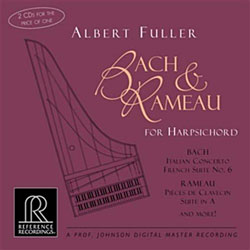
 RAMEAU: Works for Harpsichord
Albert Fuller, harpsichord
Reference Recordings RR 27 (LP), RR 27-CD (CD*). J. Tamblyn Henderson, Jr., prod.; Keith O. Johnson, eng. AAA/DDD. TTs: 57:45, 63:57* I have to admit that I gave Reference Recordings' last Baroque release somewhat short shrift: I was disappointed enough in the performance that even KOJ's usual superb recording was insufficient to redeem things. Here, however, Albert Fuller (who was also present the last time out) is in fine fettle, giving as good an account of these works as we could wish. Clearly he is more sympathetic to Rameau than he seemed to be toward Bach; the French emotionalism of the former is apparently more in accord with the performer's personality. I still enjoy the rendition given by a young Trevor Pinnock in the mid-'70s (Vanguard VSD 71271), and you will find the roots of Fuller's style on the old Bach Guild releases of Gustav Leonhardt, but the present recording stands on its own merits musically and is orders of magnitude better sonically than any of the previous versions. Fuller also sticks to real English in his liner notes, which he most emphatically did not do on the previous RR disc. Of all the later Baroque writers for keyboard, Rameau is probably the most likely to appeal to the general listener; the emotional content of his works is closer to the Romantic spirit, and his complex figurations will satisfy those who appreciate pure virtuosity. For reasons which will become obvious in a moment, this recording carries the highest possible recommendations for audiophiles. Out of courtesy to Reference Recordings, I wanted to compare the LP and CD versions of this release on the best possible equipment. My thanks go to Jack Rubinson of Chestnut Hill Audio for making this possible. Analog front end was the VPI TNT 1/ET II/Spectral MCR 1, feeding a Spectral DMC 10 preamp. Digital front end consisted of the digital output from a Mod Squad Prism into the Theta DS Pre (combined D/A converter and preamp). A Spectral DMA 50 power amp drove Merlin 4B+ and Vandersteen 2C speakers. Interconnects were MIT, and speaker cable was LiveWire and Audio Research. Levels were carefully matched, and the tape-switching facilities of a Mod Squad Line Drive (sans volume control) were used to enable easy switching between sources.















