

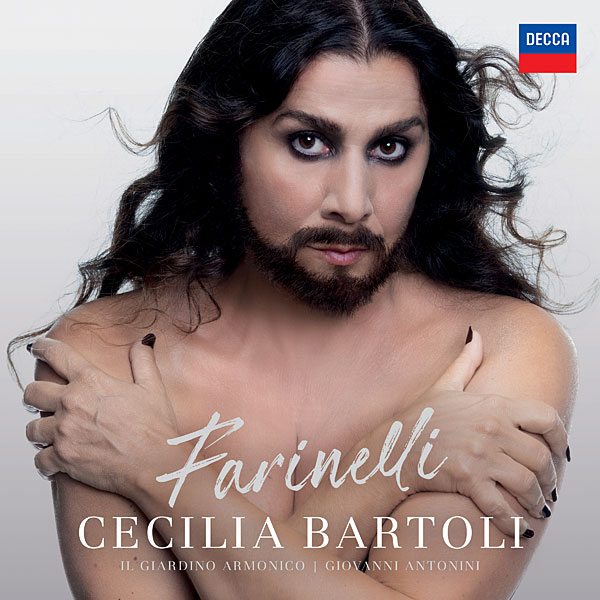
Cecilia Bartoli: Farinelli
Cecilia Bartoli, mezzo-soprano; Il Giardino Armonico, Giovanni Antonini, cond.
Decca 4850214 (24/96 download). 2019. Arend Prohmann, prod. and editor; Philip Siney, eng.
Performance: *****
Sonics: **** When I first heard mezzo-soprano Cecilia Bartoli in person some 29 years ago, at her West Coast debut in the "Cal Performances" series at Berkeley's Hertz Hall, she was just 24 years old. Along with the rest of the audience, I was astonished at her ability to ally phenomenal coloratura technique with an out-of-the-box range of expression—unheard since the prime of Maria Callas. It was clear why Decca had already signed her and released her first recording the year before, when she was just 23. Astonishingly, 30 years later, Bartoli's musical powers have increased. On Farinelli's 11 tracks, she spans nearly three octaves and executes multi-octave leaps without apparent effort. Her embellishments remain as tasteful and consonant with the music's emotional expression as they were at the start of her career—but now they have grown more elaborate, demanding breath control attained by few. The individual notes in her rapid-fire coloratura are now more smoothly connected, with less of the idiosyncratic "shotgun" effect that divided opinion early in her career. Her tessitura, if anything, has risen, with freer and sweeter top notes. She can turn on a dime from some of the most limpid and lyrical singing on record to passages that boil with unbridled fury.
It seems natural that, after tackling the repertoire of her great predecessor Maria Malibran, on her 2007 album Maria, Bartoli would delve further back in time and follow the lead of others who have recorded arias written for Farinelli, the great 18th century Italian castrato. Her timing, though, is canny: Bartoli's album of castrati's songs comes at a time when gender fluidity is a key social (and legal) issue, and in a package featuring a photo of herself sporting a beard.
Farinelli was born Carlo Maria Michelangelo Nicola Broschi and tutored by Nicola Porpora, who composed a number of his most demanding operatic roles. Farinelli's fame spread quickly from Italy, where he debuted at age 15, to the rest of Europe, leading to his first appearance in Vienna in 1724. Upon encountering his phenomenal range, intonation, breath control, and technique, one composer after another wrote impossibly demanding music for him until 1737, when he became a chamber musician for King Philip V and thereafter confined his vocal activities to the relative privacy of the Spanish court.
Four of the strongest tracks on Farinelli are by Porpora. The album begins with his "Nell'attendere il mio bene" (I shall await my beloved) from the opera Polifemo (1735). Bartoli grows breathtakingly soft and sweet in the aria's demanding middle section, where her succession of perfect trills defies belief, before launching into the aria's take-no-prisoners coloratura reprise.
On Maria, Bartoli focused more on limpid lyricism than arias of fury. Here her singing knows no bounds. After Porpora's pastoral and lovely "Vaghi amori, grazie amate" (Pretty cupids, beloved graces), from La festa d'Imeneo, she turns up the heat and allows her voice to boil over with passion in Hasse's "Morte col fiero aspetto (The grim countenance of death), from Marc' Antonio e Cleopatra.
Abetted by instrumental embellishments, Bartoli delivers glowing, radiant highs and some surprisingly deep lows. Recorded at close range in the Salzburg Odeêon's intimate, wood-and-glass–lined Dorothea Porsche Saal and at the 900-seat Le Rosey Concert Hall in Rolle, Switzerland, her voice sounds natural and resonant, and the small baroque orchestra sounds surprisingly full. Don't miss the viola and organ duet in Caldara's "Questi al cor fin'ora ignoti" (I do not understand why my blood is rising within me) from La morte d'Abel.
Anyone wishing to assess the extent of Bartoli's mastery need only compare her recording of Porpora's beautiful 10-minute lyrical expanse "Alto Giove" (Almighty Jove), from Polifemo, with those by mezzo Julie Boulianne and countertenors Franco Fagioli and Philippe Jaroussky. Boulianne, who mostly avoids trills, sounds tame by comparison, and the accompaniment is rather staid. Fagioli, singing over a much heavier bass section and with electronically enhanced ambience, is a monster in his own right, but he lacks Bartoli's peerless emotional resonance. The very French Jaroussky is all pearly elegance and loveliness until he tries to turn up the heat—then his dynamic and expressive limitations become apparent.
Beyond her absolute technical mastery, Bartoli's ability to touch the heart as she sings from music's palpating core remains unmatched.—Jason Victor Serinus
Cecilia Bartoli, mezzo-soprano; Il Giardino Armonico, Giovanni Antonini, cond.
Decca 4850214 (24/96 download). 2019. Arend Prohmann, prod. and editor; Philip Siney, eng.
Performance: *****
Sonics: **** When I first heard mezzo-soprano Cecilia Bartoli in person some 29 years ago, at her West Coast debut in the "Cal Performances" series at Berkeley's Hertz Hall, she was just 24 years old. Along with the rest of the audience, I was astonished at her ability to ally phenomenal coloratura technique with an out-of-the-box range of expression—unheard since the prime of Maria Callas. It was clear why Decca had already signed her and released her first recording the year before, when she was just 23. Astonishingly, 30 years later, Bartoli's musical powers have increased. On Farinelli's 11 tracks, she spans nearly three octaves and executes multi-octave leaps without apparent effort. Her embellishments remain as tasteful and consonant with the music's emotional expression as they were at the start of her career—but now they have grown more elaborate, demanding breath control attained by few. The individual notes in her rapid-fire coloratura are now more smoothly connected, with less of the idiosyncratic "shotgun" effect that divided opinion early in her career. Her tessitura, if anything, has risen, with freer and sweeter top notes. She can turn on a dime from some of the most limpid and lyrical singing on record to passages that boil with unbridled fury.















