

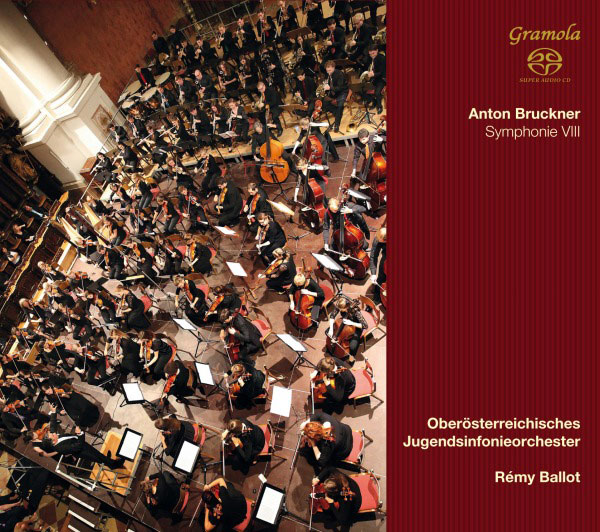
Bruckner: Symphony 8
Rémy Ballot, Upper Austrian Youth Symphony Orchestra
Gramola 99054 (2 SACD/CDs). 2015. John Proffitt, prod., eng.; Richard Winter, prod.; Rémy Ballot, Matthias Kronsteiner, eds., mastering. DDD. TT: 103:44
Performance ****½
Sonics ***** This performance of Bruckner's greatest, most generous work, his Symphony 8, took place in August 2014 in the basilica of St. Florian, the Austrian monastery where Bruckner was schooled and served as organist. It was taped before an audience, directly above the crypt in which Bruckner is buried. The band was the Upper Austrian Youth Symphony Orchestra: 130 players, average age 17, conducted by Rémy Ballot, a student of the late Sergiù Celibidache. Serge Ioan Celibidache paraphrased his father: "the more notes . . . the more time needed for them to develop and to be 'digested' acoustically. Thus, the richer the music, the slower the tempo." This is some of the richest music ever composed. Add St. Florian's reverberation time of six seconds, and this performance of the shortest edition of this work—Bruckner's much-cut version of 1890—lasts 103 minutes, exceeding Celibidache's own by one minute. The very special results make clear just how much Ballot learned from his teacher.
Even at such a pace, nothing here is self-indulgent or inchoate. Ballot's taste is impeccable: each phrase is beautifully shaped, and the rhythmic pulse, however slow, never falters. The proportions of the tempos—from slow to very slow to almost static—are meticulously measured, as well balanced as the various sections of this vast ensemble. The deep structures of Bruckner's daunting counterpoint—even harder to play so slowly—are made clear. The brass sound like gold, liquid and molten and airy all at once, their choirs seeming to emerge from the basilica's stones from far, far away, their substance, tone, and heft mysteriously undiminished. Before each of Bruckner's long caesuras, particularly in the Adagio, Ballot waits until the music has died entirely away before beginning to hold the pause. These silences can be of such terrifying length that one wonders how or if the music will resume. Then, with tectonic inevitability, it does. These caesuras have never carried so much musical meaning, or pulsed with more life and vitality. Never has silence been so thrilling.
Nor has this immense, dark work ever sounded more like a long, lingering caress—or, in the case of the perfectly measured Totenuhr (deathwatch) that closes the first movement, without ritard even in the final bar, more like last dying breaths. Ballot's refusal to indulge in unscored deccelerations or accelerations evinces a deep trust in the score. Even the shortest movement, the Scherzo, becomes, at 18 minutes, a world of its own. Its Trio is languid, dreamlike, rapt, with the tenderest imaginable playing from the horns. The string playing is fully fleshed, ardent, despite some rough ensemble work and inadvertent portamenti in the da capo—this is not the Berlin Philharmonic. But that so many people so young could play so difficult a work so beautifully together in so challenging a venue strikes me as almost miraculous.
Miracles manifest most often in the winds, but each section has its moments. The many exposed lines for solo flute, oboe, and clarinet are so extended, so delicately negotiated, that each becomes a small, hushed meditation. The string chords at the beginning of the 33½-minute Adagio pulse whale-heart slow. If the solo horn call linking the first and second subjects has been more gracefully played, I haven't heard it. The chorale for harp and diaphanous strings descends like an angel's feather drifting slowly earthward. Midway through the Finale, the grand, doomed, fanfaric reprise in low brass of the first subject's second half will melt hearts colder than mine. My prose purples. This is the most transcendent, most sensual, most moving performance of this work I have heard.
In the two-channel DSD tracks the strings have a lushness, and luminescent highs, that seem to celebrate their own beauty without narcissism: There is none of the harshness of even the best 16/44.1 sound, only sweetness and audible light. The 16/44.1 tracks evince a bit more bite in the strings and less ambience (which some will prefer, though not I), and give the orchestra a sound more German (darker, thicker), less Austrian (lighter, warmer, sweeter)—less a loss of resolution than a matter of aural taste. I lack a multichannel system; if you have one, you no doubt have a treat in store from these discs' surround tracks.
This may not be the best performance of Bruckner's Eighth, but it has become the one I most cherish, because it is the one that most cherishes the music. More than any other, it takes me where I want to go when I listen to Bruckner. If music so rich needs to be listened to as slowly as possible, well, with this recording, it can be.—Richard Lehnert
Rémy Ballot, Upper Austrian Youth Symphony Orchestra
Gramola 99054 (2 SACD/CDs). 2015. John Proffitt, prod., eng.; Richard Winter, prod.; Rémy Ballot, Matthias Kronsteiner, eds., mastering. DDD. TT: 103:44
Performance ****½
Sonics ***** This performance of Bruckner's greatest, most generous work, his Symphony 8, took place in August 2014 in the basilica of St. Florian, the Austrian monastery where Bruckner was schooled and served as organist. It was taped before an audience, directly above the crypt in which Bruckner is buried. The band was the Upper Austrian Youth Symphony Orchestra: 130 players, average age 17, conducted by Rémy Ballot, a student of the late Sergiù Celibidache. Serge Ioan Celibidache paraphrased his father: "the more notes . . . the more time needed for them to develop and to be 'digested' acoustically. Thus, the richer the music, the slower the tempo." This is some of the richest music ever composed. Add St. Florian's reverberation time of six seconds, and this performance of the shortest edition of this work—Bruckner's much-cut version of 1890—lasts 103 minutes, exceeding Celibidache's own by one minute. The very special results make clear just how much Ballot learned from his teacher.















