

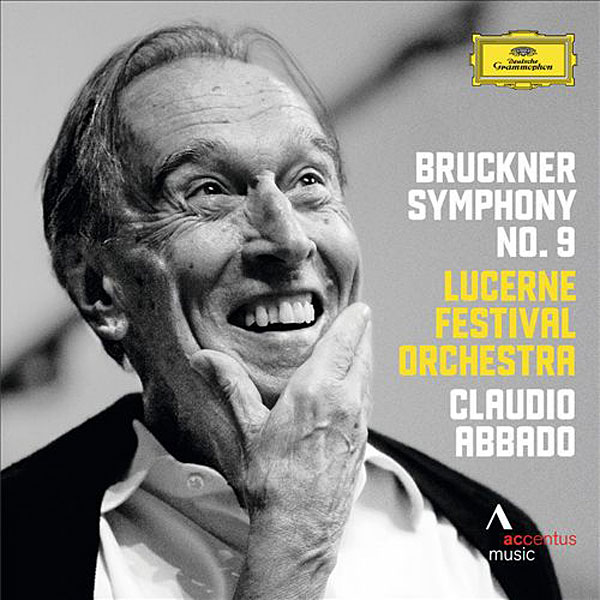
Bruckner: Symphony 9
Claudio Abbado, Lucerne Festival Orchestra
Deutsche Grammophon 479 3441 (CD, 48/24 download from HDTracks). 2014. Georg Obermayer, prod., ed.; Urs Dürr, Toine Mertens, engs. DDD. TT: 63:09
Performance *****
Sonics ****½ This performance of Bruckner's last, all-but-finished composition was recorded at the last concert conducted by Claudio Abbado. It is a fitting final statement by an interpreter of unparalleled sensitivity, intelligence, and taste. The Ninth is no serene work, and Abbado's earlier recording, with the Vienna Philharmonic, is a darker, more intensely driven vision of Bruckner's fight to live long enough to complete his most profound, most ambitious composition. The difficulties of that double struggle are evident throughout the three movements Bruckner completed (Abbado never conducted a completion of the nearly finished Finale), and in 1996 in Vienna, those struggles seemed the story Abbado wanted to tell.
But in Lucerne in August 2013, Abbado took slightly longer to tell a different tale. As before, anguish is often audible, but despair is now gone. The feeling, and thus the listener's experience, are no less deep, but the work now seems a vision of mortal struggle viewed from beyond the grave—a hardwon serenity that denies none of the angst just weathered. I hear in this performance deep acceptances of all aspects of life: joy, anguish, sweetness, bitterness, weakness, strength. The fact that life is mostly struggle is not struggled against. But that is only my interpretation of any extramusical meaning Abbado or Bruckner may have intended. The facts are the thousands of musical choices Abbado made to communicate what words cannot.
Perhaps uniquely among the many recordings I've heard, Abbado uses Bruckner's constant cross-rhythms of two against three less to build a stressing tension than to balance and strengthen the work's basic architecture—an almost vanishingly small difference that here somehow looms large. Under other batons, these cross-strains, so difficult for an orchestra to play accurately at such slow tempi, often seem about to prise the music apart; here, so sure are Abbado's beat and the Lucerne's skills, they lovingly stitch it together. Midway through the first movement (12:41) is a pair of falling bassoon figures that are too often buried. But Bruckner wanted these brief statements heard: an early edition of the score marks the bassoons hervortretend (step forth), but with no dynamic marking to indicate precisely how this was to be done. Abbado has the strings' tremolo suddenly recede to make the bassoons more prominent. Elsewhere, the two halves of this movement's coda are linked by an ascending triplet on three horns; this has not worked in any other recording I've heard, sounding like an error in playing or composition. Abbado solves this (25:44) by having the horns quickly crescendo from ff to seamlessly lead into and kick off the fff opening triplet of the coda's coda. Though again not marked, it works perfectly: everything locks in place.
The Scherzo is less brutal than emphatic, the violins' fierce, fast patterns balancing the grimly pounding brass and drums with unprecedented clarity. Following the final note of this and the first movement, Abbado evidently instructed the double basses to let their instruments' bodies ring. They boom, low and hollow, for entire measures of resonance past the double bar, to haunting effect.
In the Adagio, the trumpets' "Alleluia" in bar 5 is pristinely clear, for once sufficiently prefiguring its reappearance at the end of the movement (and at the end of the Finale's lost coda, as the dying Bruckner promised). At 16:07, Abbado reins in the sumptuously divided strings precisely where every other conductor I've heard leans heavily. It makes one want more—then instantly realize it is just enough. Immediately after, the reeds tolling their major second some 80 times manage to sound sour and sweet. In the great fff tutti dissonance at the movement's climax (20:50), the chord's many pitches and sonorities fan out in a peacock's tail of perfectly balanced chromaticism.
All of these are examples, of course, of the sorts of things conductors and orchestras do in every rehearsal, every performance. But so many of these have been achieved by no one else I have heard, including Abbado himself in 1996, that this performance becomes far more than the sum of so many finely turned moments.
The Lucerne Festival Orchestra sounds even warmer and sweeter than the Vienna Philharmonic—this is no "German" sound—and is more flawless in execution. The brass are so nuanced, sensitive, and rich that they fairly purr. Golden. The recorded sound is excellent: deep, richly warm, spacious, with a wide dynamic range and a fine sense of space and depth in an acoustic both darker and sunnier than the Vienna Musikverein's. It fully deserves 4.5 stars—but get the 24-bit/48kHz download, not yet released when this went to press (footnote 1).
In a world even less happy than Bruckner's, I nonetheless feel lucky to live at a time when his music can be heard in performances of such tenderness, care, precision, and strength. Abbado, like Bruckner, saved his best for last. What a way to go.—Richard Lehnert
Footnote: I bought the downloads from HDtracks, and as the original sample rate of the recordings appears to be 48kHz rather than the CD's 44.1kHz—the recorded signal extends naturally to the 24kHz Nyquist frequency—the HDtracks release would appear to be the urtext, ie, the version with less processing.—John Atkinson
Claudio Abbado, Lucerne Festival Orchestra
Deutsche Grammophon 479 3441 (CD, 48/24 download from HDTracks). 2014. Georg Obermayer, prod., ed.; Urs Dürr, Toine Mertens, engs. DDD. TT: 63:09
Performance *****
Sonics ****½ This performance of Bruckner's last, all-but-finished composition was recorded at the last concert conducted by Claudio Abbado. It is a fitting final statement by an interpreter of unparalleled sensitivity, intelligence, and taste. The Ninth is no serene work, and Abbado's earlier recording, with the Vienna Philharmonic, is a darker, more intensely driven vision of Bruckner's fight to live long enough to complete his most profound, most ambitious composition. The difficulties of that double struggle are evident throughout the three movements Bruckner completed (Abbado never conducted a completion of the nearly finished Finale), and in 1996 in Vienna, those struggles seemed the story Abbado wanted to tell.
Footnote: I bought the downloads from HDtracks, and as the original sample rate of the recordings appears to be 48kHz rather than the CD's 44.1kHz—the recorded signal extends naturally to the 24kHz Nyquist frequency—the HDtracks release would appear to be the urtext, ie, the version with less processing.—John Atkinson















