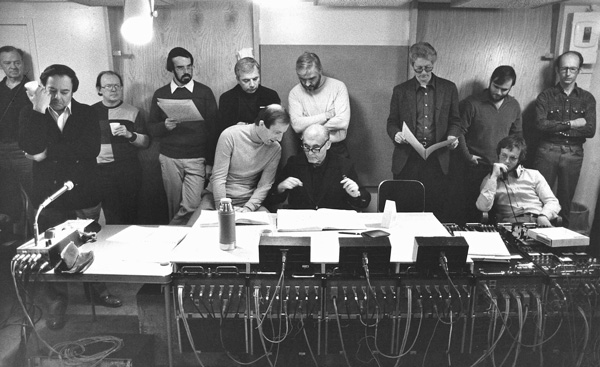
James Mallinson confers with Sir Georg Solti during playbacks for Mahler's Symphony No.3 in Chicago's Orchestra Hall in November 1982, from the
CSO Archives
Legendary British record producer James Mallinson, whose close to five decades of work with Decca/London, Telarc, and the labels of the major orchestras in London, Chicago and St. Petersburg, died unexpectedly on Friday night, August 24. He leaves behind, in addition to his beloved wife and son, an estimable recorded legacy that earned him no less than 16 Grammy Awards and 49 Grammy nominations.
John Atkinson remembers attending Decca sessions in the late 1970s and early 1980s where James held forth as producer. Telarc's famed producer/engineering team of Elaine Martone and Bob Woods, who hired Mallinson as a consultant from the mid-1980s to early 1990s, counted him as a great and dear friend. Everyone from Georg Solti and Daniel Barenboim to Valery Gergiev and Bernard Haitink had stories to tell.
As Martone explained by phone, just one week after she and Bob had last spoken with Mallinson, "He took a stand for what he believed in. He would go toe-to-toe with a conductor, and he worked with the best—in his estimation, all the superstars except for Pierre Boulez—and tell him exactly what he thought. He'd be tactful and diplomatic about it, but he would have a distinct point of view about interpretation, and he was interested in the best possible performance."
Honing his craft with Decca during the period when its artists included Benjamin Britten, Joan Sutherland, and Luciano Pavarotti, Mallinson recorded all 104 Haydn Symphonies with Antal Dorati, and a major series of 20th century works by Messiaen, Ligeti, Cage, Maxwell Davies, Birtwistle, and Glass. After he went freelance in 1984, he worked with all the major labels. As the record industry changed, Mallinson was central to the establishment of orchestra-owned labels LSO Live, CSO Resound, and Marinski Live. He also pioneered the use of SACD and high-resolution surround in orchestral recording, as exemplified by the ongoing issues from those labels. His most recent project was the Britten Sinfonia's ongoing Beethoven Symphony cycle, conducted by composer/pianist Thomas Adès.
According to Martone, "I occasionally referred to him as Sir James, because he was extremely knowledgeable musically. He was impeccably prepared, and had no room for nonsense. If you had your act together, James could not have been a more wonderful collaborator. Musically, he knew exactly what worked.
"Bob and I stayed with him when we were recording Mahler, and he'd always have an opinion about the way to it should be done. It was always fun to spar with him. He had a very brilliant mind, and would love to engage in dialog about music and politics. You liked to be around him because he was interesting and full of life, brilliant, fun, quirky, and super progressive."
The oft-controversial critic Norman Lebrecht was characteristically more explicit in the short tribute on his website,
Slipped Disc. "I have seen him stand up to the most fearsome conductors and face them down," he wrote. "He worked with Solti, Barenboim, Itzhak Perlman, Colin Davis, Prince Charles, you name it, he never backed down. He would rather lose a lucrative client than approve an unsatisfactory performance.
"I first watched him at Gil Kaplan's original Mahler Second in Cardiff, shepherding an avowedly amateur conductor through one of the biggest, toughest symphonies and doing it with such tact and precision that they remained friends ever after."
After some prodding, Martone shared a similar story. "In the latter part of his career, he worked with Gergiev. He would not let him get away with things that were off the wall, and would explain to him why something wasn't okay. They got into some real knockdown fights. But he kept going all out and got Gergiev to make some really great recordings, because Gergiev would listen. He brought out the best that anyone could do."
Woods and Martone first hired Mallinson to help them expand Telarc into a worldwide label whose repertoire and artists reflected that stature. Wood recalled with fondness that, thanks to Mallinson, Telarc was able to work with André Previn and the Vienna Philharmonic to pair Richard Strauss's
Also Sprach Zarathustra and the
Four Last Songs (with Arleen Auger) on a single disc. ("It was a thrill to hear from the musicians that it was most accurate representation of their orchestra they had ever heard.") Mallinson also paved the way for Telarc's best-selling Wagner disc with Lorin Maazel,
The Ring Without Words, and Charles Mackerras's recordings of all 41 Mozart symphonies.
Pull out your Grammy-winning recording of Haitink's CSO recording of
Shostakovich's Fourth Symphony, or the Decca issues of Solti conducting Mahler, or Del Tredici's
Final Alice or a
host of others, and raise your platter in tribute to one of the great recording producers of our time.