

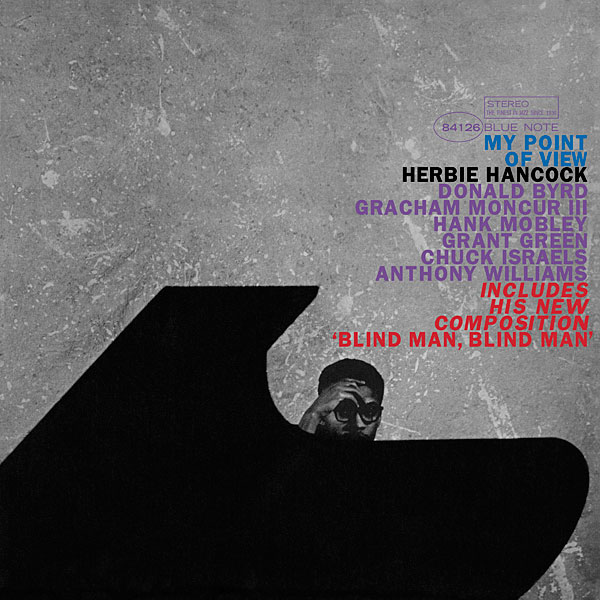
For jazz fans, a new batch of releases in Blue Note's Tone Poet series—vinyl reissues remastered with care and cut from the original analog tapes—is reason for celebration. Fortunately, the batches come frequently. The latest releases, as I write in late October 2020, are very solid, musically and sonically.
Herbie Hancock's reputation, at least with me and I think generally, is as a pianist of great versatility, which is to say, he is all over the place stylistically. That's true on My Point of View, Hancock's second record as leader, which veers from soul jazz (with Grant Green on guitar on several tracks, including "Blind Man, Blind Man" and the final track, "And What If I Don't"), to modal jazz (at least it sounds modal to me; I'm thinking of "King Cobra" here) and to straight-ahead hard bop. All six cuts are Hancock compositions. I'm a sucker for that 1960s groove, so for me the supersimple, unpretentious soul jazz tracks are the record's highlights.
Like most Blue Notes of its era, My Point of View was first issued in mono; it is reissued here in stereo. As for sonics, there's some variation from track to track; "A Tribute to Someone" sounds very fine indeed. On other tracks, the sound is slightly fuzzy, a little hooded. In general, the horns come off well, especially Donald Byrd's trumpet. The piano is less muffled than it sometimes is on Rudy Van Gelder recordings. Chuck Israels's bass is balanced well—prominent—but also a little wooly: Some things even mastering engineer Kevin Gray can't fix. The vinyl is flat, clean, and quiet.
 Jimmy Smith's Prayer Meetin' with Stanley Turrentine is an unchallenging jazz album. It's basically blues, with Smith and Turrentine accompanied by Quentin Warren on guitar and Donald Bailey on drums. Smith covers the bass part with his organ's pedals.
Musically, the highlight of this record is probably Turrentine's solo on "I Almost Lost My Mind"; Joe Goldberg's liner notes suggest as much, and I agree. Otherwise, this is just a fun album. Hancock's My Point of View and Smith's Prayer Meetin' were recorded only about a month apart, both in Rudy Van Gelder's studio, yet the sound on Prayer Meetin' is significantly crisper. Another perfectly flat, totally quiet vinyl slab.
I know Horace Silver mainly from his earlier work with the Jazz Messengers and his later work as leader—especially Song for My Father, which is one of the most joyful, easy-to-listen-to jazz albums I know. (A new version will be out in Blue Note's Classic Vinyl Reissue Series—2021's successor to the Blue Note 80 series—a month or so after this magazine hits the streets.) Horace Silver's Further Explorations, from the cover of which a dapper, young Silver smiles subtly at his fans, is new to me, so I will defer to Fred Kaplan's excellent capsule review, which you will find among this month's Record Reviews.
And now for something completely different.
Jimmy Smith's Prayer Meetin' with Stanley Turrentine is an unchallenging jazz album. It's basically blues, with Smith and Turrentine accompanied by Quentin Warren on guitar and Donald Bailey on drums. Smith covers the bass part with his organ's pedals.
Musically, the highlight of this record is probably Turrentine's solo on "I Almost Lost My Mind"; Joe Goldberg's liner notes suggest as much, and I agree. Otherwise, this is just a fun album. Hancock's My Point of View and Smith's Prayer Meetin' were recorded only about a month apart, both in Rudy Van Gelder's studio, yet the sound on Prayer Meetin' is significantly crisper. Another perfectly flat, totally quiet vinyl slab.
I know Horace Silver mainly from his earlier work with the Jazz Messengers and his later work as leader—especially Song for My Father, which is one of the most joyful, easy-to-listen-to jazz albums I know. (A new version will be out in Blue Note's Classic Vinyl Reissue Series—2021's successor to the Blue Note 80 series—a month or so after this magazine hits the streets.) Horace Silver's Further Explorations, from the cover of which a dapper, young Silver smiles subtly at his fans, is new to me, so I will defer to Fred Kaplan's excellent capsule review, which you will find among this month's Record Reviews.
And now for something completely different.
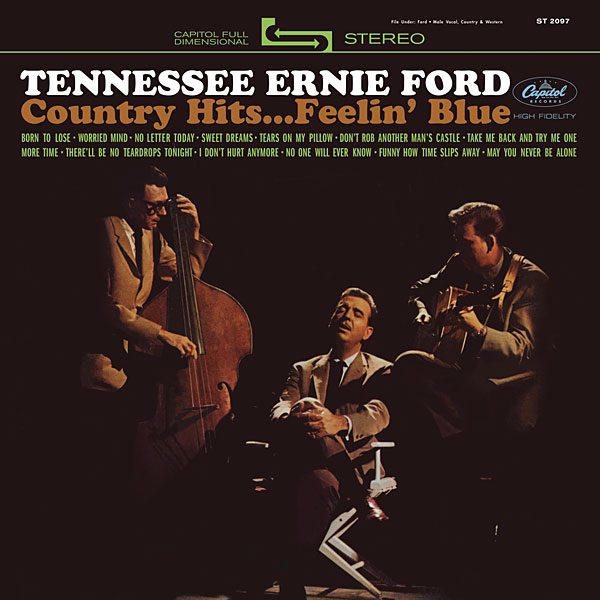 Like Jimmy Smith's Prayer Meetin', Country Hits...Feelin' Blue by Tennessee Ernie Ford was released in 1964. These two records have something else in common: Both were reissued in 2020, and both were remastered for vinyl from the original tape by Kevin Gray.
Otherwise: very different.
Country Hits is a simple recording: just Ford's voice singing old-timey, sentimental songs by Hank Williams, Ernest Tubb, Willie Nelson, Don Gibson, and others accompanied by string bass (John Mosher) and acoustic guitar (Billy Strange). Think Patsy Cline with a really low voice. Country Hits was produced by Lee Gillette, who in 1964 also produced great-sounding records from Dean Martin, Nat King Cole, and many others.
The sonics are the point here, or at least the main point. Ford's deep, resonant voice, with a bit of reverb, is very well recorded. You could consider this a voice-fetish record of the "Wonderful world of...Vocals" variety, and I'm sure many will buy it for that reason. But I hope some will buy it for the music: It may be an acquired taste for 21st century hi-fi sophisticates, but on its own terms, it's good, so broaden your horizons. Pressed for Analogue Productions on flat, quiet, 200gm vinyl.
I'll end this column with some unobtanium.
I prefer to listen to symphonic work in digital formats; I find the complexity of symphonic music benefits from digital audio's black backgrounds and practically limitless dynamic range, especially in high resolution. I also find that massed violins take on an edge when reproduced via vinyl; they don't quite sound natural.
The recent Electric Recording Company reissue of Shostakovich's Symphony No.13 "Babi Yar," with André Previn conducting the London Symphony Orchestra, hasn't completely lost that edge, but it sounds very good. It was released on vinyl in late July, and of course it sold out quickly. (They only made 150 copies.) Those desperate for a copy can find one on Discogs, sealed, for £750, or about $880.
Seeking a better deal? As I write this, two copies of the original 1981 US release—Angel Records SZ-37661—are listed at Discogs in VG+ condition, one for $3, the other for $1.95, plus shipping. A NM copy is listed at $15.
The $900 version does sound good, however.
Like Jimmy Smith's Prayer Meetin', Country Hits...Feelin' Blue by Tennessee Ernie Ford was released in 1964. These two records have something else in common: Both were reissued in 2020, and both were remastered for vinyl from the original tape by Kevin Gray.
Otherwise: very different.
Country Hits is a simple recording: just Ford's voice singing old-timey, sentimental songs by Hank Williams, Ernest Tubb, Willie Nelson, Don Gibson, and others accompanied by string bass (John Mosher) and acoustic guitar (Billy Strange). Think Patsy Cline with a really low voice. Country Hits was produced by Lee Gillette, who in 1964 also produced great-sounding records from Dean Martin, Nat King Cole, and many others.
The sonics are the point here, or at least the main point. Ford's deep, resonant voice, with a bit of reverb, is very well recorded. You could consider this a voice-fetish record of the "Wonderful world of...Vocals" variety, and I'm sure many will buy it for that reason. But I hope some will buy it for the music: It may be an acquired taste for 21st century hi-fi sophisticates, but on its own terms, it's good, so broaden your horizons. Pressed for Analogue Productions on flat, quiet, 200gm vinyl.
I'll end this column with some unobtanium.
I prefer to listen to symphonic work in digital formats; I find the complexity of symphonic music benefits from digital audio's black backgrounds and practically limitless dynamic range, especially in high resolution. I also find that massed violins take on an edge when reproduced via vinyl; they don't quite sound natural.
The recent Electric Recording Company reissue of Shostakovich's Symphony No.13 "Babi Yar," with André Previn conducting the London Symphony Orchestra, hasn't completely lost that edge, but it sounds very good. It was released on vinyl in late July, and of course it sold out quickly. (They only made 150 copies.) Those desperate for a copy can find one on Discogs, sealed, for £750, or about $880.
Seeking a better deal? As I write this, two copies of the original 1981 US release—Angel Records SZ-37661—are listed at Discogs in VG+ condition, one for $3, the other for $1.95, plus shipping. A NM copy is listed at $15.
The $900 version does sound good, however.
Jimmy Smith's Prayer Meetin' with Stanley Turrentine is an unchallenging jazz album. It's basically blues, with Smith and Turrentine accompanied by Quentin Warren on guitar and Donald Bailey on drums. Smith covers the bass part with his organ's pedals.
Musically, the highlight of this record is probably Turrentine's solo on "I Almost Lost My Mind"; Joe Goldberg's liner notes suggest as much, and I agree. Otherwise, this is just a fun album. Hancock's My Point of View and Smith's Prayer Meetin' were recorded only about a month apart, both in Rudy Van Gelder's studio, yet the sound on Prayer Meetin' is significantly crisper. Another perfectly flat, totally quiet vinyl slab.
I know Horace Silver mainly from his earlier work with the Jazz Messengers and his later work as leader—especially Song for My Father, which is one of the most joyful, easy-to-listen-to jazz albums I know. (A new version will be out in Blue Note's Classic Vinyl Reissue Series—2021's successor to the Blue Note 80 series—a month or so after this magazine hits the streets.) Horace Silver's Further Explorations, from the cover of which a dapper, young Silver smiles subtly at his fans, is new to me, so I will defer to Fred Kaplan's excellent capsule review, which you will find among this month's Record Reviews.
Like Jimmy Smith's Prayer Meetin', Country Hits...Feelin' Blue by Tennessee Ernie Ford was released in 1964. These two records have something else in common: Both were reissued in 2020, and both were remastered for vinyl from the original tape by Kevin Gray.
Otherwise: very different.
Country Hits is a simple recording: just Ford's voice singing old-timey, sentimental songs by Hank Williams, Ernest Tubb, Willie Nelson, Don Gibson, and others accompanied by string bass (John Mosher) and acoustic guitar (Billy Strange). Think Patsy Cline with a really low voice. Country Hits was produced by Lee Gillette, who in 1964 also produced great-sounding records from Dean Martin, Nat King Cole, and many others.
The sonics are the point here, or at least the main point. Ford's deep, resonant voice, with a bit of reverb, is very well recorded. You could consider this a voice-fetish record of the "Wonderful world of...Vocals" variety, and I'm sure many will buy it for that reason. But I hope some will buy it for the music: It may be an acquired taste for 21st century hi-fi sophisticates, but on its own terms, it's good, so broaden your horizons. Pressed for Analogue Productions on flat, quiet, 200gm vinyl.















