

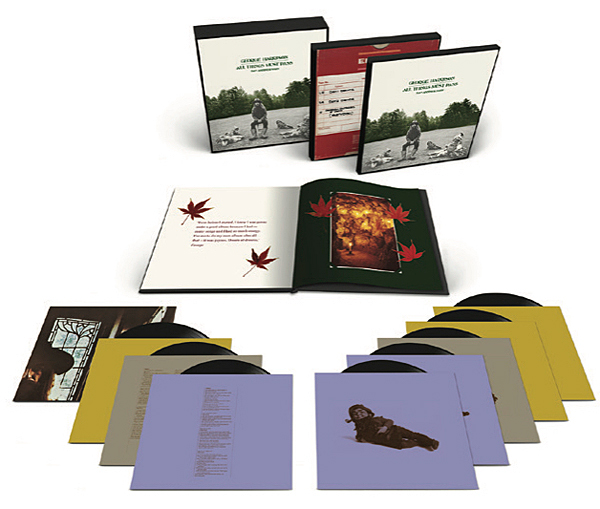
Capitol/UMe 3565238 (5 CD, 1 Blu-ray). 2021. George Harrison, Phil Spector, Harrison, David Zonshine, prods.; Ken Scott, Philip McDonald, Paul Hicks, engs.
Performance *****
Sonics ***** Six weeks after the world's biggest pop group broke up, the "Quiet Beatle" began work on a monumental three-LP album that stands tall a half-century later. George Harrison's first solo album (his third if you count a movie soundtrack and an experimental-music record) is a masterpiece, a musical minestrone of influences and timestamps. For the artist, it was a sprawling release of creative energy too often pent up in the context of the Beatles. Beginning with two days of demos for co-producer Phil Spector, Harrison walked away from the smoldering wreckage that was the Beatles and immediately stood on his own as a fully formed solo artist. While sometimes referencing his earlier songwriting and guitar licks (and including songs written as far back as 1966), Harrison went in new directions, influenced by his spirituality and interactions with his many prominent musical friends including new friend Bob Dylan as well as Eric Clapton and the rest who became Derek and the Dominoes.
This Golden Anniversary Super Deluxe Edition of All Things Must Pass contains five CDs and a Blu-ray disc; an LP version is available with eight LPs (footnote 1). Serious ATMP partisans can get the "Uber Deluxe" reissue with eight LPs, five CDs, and a Blu-ray, all in a wood box. There will also be two-CD and three-LP releases of just the original album.
ATMP's tracks received a refreshing remix at Abbey Road Studios by Paul Hicks, who has worked on Beatles remix projects and the ongoing project of reissuing John Lennon's solo albums. Hicks subjected the sound of ATMP to a bit of de-Spectorizing—removing some "Wall of Sound" mud—resulting in more clarity and zing, with Harrison's voice more forward. "Luckily these [songs] were recorded by great engineers, so everything sounds good on the tape," Hicks said. "We mixed this project using new 192k transfers into Pro Tools and continued HD until the end."
Reverb mud is heaped on some songs' individual tape tracks, Hicks said, "so there isn't much you can do in those cases. But we reduced the reverbs in many cases." In some songs, layers of guitar licks gain more separation. In others, Ringo Starr's rock-steady drumming is more pronounced.
The bonus Blu-ray includes 5.1 surround and Dolby Atmos mixes, which spread things out further, revealing more detail. It also contains 24/48 and 24/192 stereo mixes, suggesting eventual availability as an HD download and better-than-CD streaming.
ATMP compares favorably to solo premieres by other Beatles. Paul McCartney was first out of the gate with his namesake first album, a collection of home recordings with a bit of studio polish applied in secret, released into a buzzsaw of lukewarm reviews and Fleet Street accusations about "the Traitor Beatle" (footnote 2). John Lennon's Plastic Ono Band—like ATMP, recorded at Abbey Road and anchored by Starr on drums and Klaus Voorman on bass—was released a month after Harrison's. Brooding, self-absorbed, and minimalist, it was artistically significant but smaller in scale and scope than ATMP, which has outsold Lennon's Imagine and McCartney's Band on the Run combined.
The main reason Harrison's album succeeded was its songs. Harrison was a great songwriter with spot-on musical sensibilities and a gift for lyrics. He had amassed a backlog of songs about faith, love, tragedy, and friendship, skillfully worded and scored into rock hits.
Harrison had offered some of these songs—"Isn't It a Pity," "Let It Down," "Hear Me Lord," the album's title track—to the Beatles; none made it past polite tryouts. "Wah-Wah" and "Run of the Mill" were Harrison's reactions to the frustrating and acrimonious Let It Be sessions. The songs were enlivened by creative energy from his friendship with Dylan, his mutual respect and musical affection for Clapton, and contributions and influences from Billy Preston, Spector, members of Spooky Tooth and Badfinger, and the troop of Hare Krishnas living with him at the time. Through four months of sessions (including a break to visit his dying mother and some time off after her passing) and a flaked-out, premature exit by Spector, Harrison held it together and brought out every bit of excellence from each song.
The Super Deluxe set includes the album (originally two LPs of complete, produced songs plus a third LP of "Apple Jams") spread over two CDs. The third and fourth CDs are "First Day" and "Second Day" demos (May 26 and 27, 1970) that Harrison performed for Spector. These demos are mostly spectacular, fully formed songs, confidently rendered and ready for production. Disc 5, "Session Outtakes and Jams," is the weakest disc of the set, but it has its moments: Its rendition of "Wedding Bells (Are Breaking Up That Old Gang of Mine)," played off the cuff with smiles all around, is a great performance.
Capping off the box is a refreshing, beautifully illustrated booklet, with photos of Harrison's original, handwritten lyrics and an essay providing background and perspective song by song.
Footnote 1: Michael Fremer's report on the sound of the LPs can be found here and an article of the making of the album in our sister publication Sound & Vision here.—Ed. Footnote 2: McCartney released his album in competition with the group's Let It Be, despite personal appeals by his bandmates to wait a couple of months.
Performance *****
Sonics ***** Six weeks after the world's biggest pop group broke up, the "Quiet Beatle" began work on a monumental three-LP album that stands tall a half-century later. George Harrison's first solo album (his third if you count a movie soundtrack and an experimental-music record) is a masterpiece, a musical minestrone of influences and timestamps. For the artist, it was a sprawling release of creative energy too often pent up in the context of the Beatles. Beginning with two days of demos for co-producer Phil Spector, Harrison walked away from the smoldering wreckage that was the Beatles and immediately stood on his own as a fully formed solo artist. While sometimes referencing his earlier songwriting and guitar licks (and including songs written as far back as 1966), Harrison went in new directions, influenced by his spirituality and interactions with his many prominent musical friends including new friend Bob Dylan as well as Eric Clapton and the rest who became Derek and the Dominoes.
Footnote 1: Michael Fremer's report on the sound of the LPs can be found here and an article of the making of the album in our sister publication Sound & Vision here.—Ed. Footnote 2: McCartney released his album in competition with the group's Let It Be, despite personal appeals by his bandmates to wait a couple of months.















