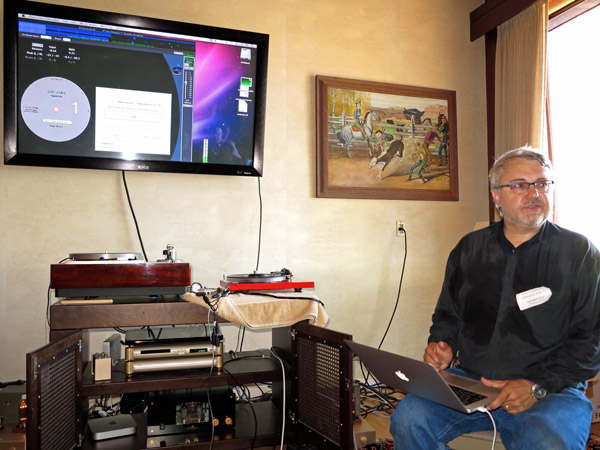
"Our goal is not just to create a portable digital copy of an analog LP; it is to honor the high-fidelity aspects of vinyl by making a digital copy that sounds indistinguishable from the original." So spoke Rob Robinson, PhD (above), creator of Channel D's Pure Vinyl and Pure Music Mac apps, at the start of a recent presentation members of the Bay Area Audiophile Society.
Speaking to a capacity group of 22 BAAS members, who gathered in the living room of a hillside-perched Marin County home, Robinson spent close to two hours reviewing all aspects of using Pure Vinyl to rip LPs. His visit, which came less than three months after the release of Pure Vinyl 4, and a little over a month after the release of Pure Music 2 file playback app, was arranged by Peter Truce (below left), the newly appointed treasurer of what may soon become the non-profit San Francisco Audiophile Society, "serving music and audio enthusiasts throughout the greater Bay Area."
 After the session, Robinson explained by phone that Pure Vinyl 4 has over 50 new features compared with the original version. Most important are a simplified user interface that hides more specialized options so as not to confuse users, and a simplified rendering/mastering window. Greatly improved features for editing tracks include an automatic track locator, a snap-to function that enables the program's virtual stylus to snap to the start of a track, and a new Tidy Tail feature that trims silence at the end of a track.
It goes without saying that to use Pure Vinyl, you need, first of all, an LP player. Robinson does not recommend the USB turntables currently on the market because of their quality limitations. Of equal importance is an Apple computer and, if you frequently rip vinyl to CD-R, a durable, external, tray-style burner such as those supplied by OWC.
After the session, Robinson explained by phone that Pure Vinyl 4 has over 50 new features compared with the original version. Most important are a simplified user interface that hides more specialized options so as not to confuse users, and a simplified rendering/mastering window. Greatly improved features for editing tracks include an automatic track locator, a snap-to function that enables the program's virtual stylus to snap to the start of a track, and a new Tidy Tail feature that trims silence at the end of a track.
It goes without saying that to use Pure Vinyl, you need, first of all, an LP player. Robinson does not recommend the USB turntables currently on the market because of their quality limitations. Of equal importance is an Apple computer and, if you frequently rip vinyl to CD-R, a durable, external, tray-style burner such as those supplied by OWC.

 "There are probably more reasons to apply RIAA in the digital domain than I can count on my 10 fingers," Robinson clarified after the event. Many of these have to do with the conversion chain's absence of a phono preamp, which would normally apply the RIAA de-emphasis. "We eliminate the phono stage because I don't want its sonic signature on the signal," he added. "Performing the RIAA equalization in the digital domain also significantly increases resolution from 24 to about 26-bits. Since each bit is approximately equivalent to 6dB, applying RIAA in the digital domain gives you an extra 12dB headroom that you lose with a conventional phono stage." It also allows Pure Vinyl to incorporate an adjustable rumble filter.
Take a deep breath, DSD diehards. Pure Vinyl operates in the PCM domain, rather than DSD, because you can't perform mathematical operations on DSD data. In Robinson's opinion, "As PCM converters have improved, the advantages of DSD over PCM have diminished. If the recording engineer has done a good job, I really think PCM is better at this point."
All calculations in Pure Vinyl are done with 64-bit precision (Double Precision, Floating-Point). Robinson's preference is to use a 24-bit word length and a 192kHz sample rate for digital conversion because he wants his customers to use the highest amplitude and sample rate commonly available. "Vinyl has an extended frequency response up to at least 96kHz," he said, "and its amplitude resolution is much closer to 24-bits than 16 bits. Yes, some converters, not all, do introduce more noise when you go from 96 to 192, but it's so far below the noise floor of vinyl that you don't need to worry about it. In addition, RIAA compensation in the digital domain works much better at 192 than at either 44.1 or 96. You can find more about this in the "Getting Started with Computer Audio" section of the A HREF=http://www.channld.com/>Channel D website.
"When I was first working on Pure Vinyl 12 years ago, I used 176.4kHz with the notion that it would be easier to create CD copies and more faithful to the signal," Robinson explains. "But in practice, while conversion of 192 to 44.1 is mathematically a little more involved, there's no difference in quality whatsoever. And there aren't enough really great ADC/DAC units out there that will do 384kHz sampling. If there were, I would be using 384."
"There are probably more reasons to apply RIAA in the digital domain than I can count on my 10 fingers," Robinson clarified after the event. Many of these have to do with the conversion chain's absence of a phono preamp, which would normally apply the RIAA de-emphasis. "We eliminate the phono stage because I don't want its sonic signature on the signal," he added. "Performing the RIAA equalization in the digital domain also significantly increases resolution from 24 to about 26-bits. Since each bit is approximately equivalent to 6dB, applying RIAA in the digital domain gives you an extra 12dB headroom that you lose with a conventional phono stage." It also allows Pure Vinyl to incorporate an adjustable rumble filter.
Take a deep breath, DSD diehards. Pure Vinyl operates in the PCM domain, rather than DSD, because you can't perform mathematical operations on DSD data. In Robinson's opinion, "As PCM converters have improved, the advantages of DSD over PCM have diminished. If the recording engineer has done a good job, I really think PCM is better at this point."
All calculations in Pure Vinyl are done with 64-bit precision (Double Precision, Floating-Point). Robinson's preference is to use a 24-bit word length and a 192kHz sample rate for digital conversion because he wants his customers to use the highest amplitude and sample rate commonly available. "Vinyl has an extended frequency response up to at least 96kHz," he said, "and its amplitude resolution is much closer to 24-bits than 16 bits. Yes, some converters, not all, do introduce more noise when you go from 96 to 192, but it's so far below the noise floor of vinyl that you don't need to worry about it. In addition, RIAA compensation in the digital domain works much better at 192 than at either 44.1 or 96. You can find more about this in the "Getting Started with Computer Audio" section of the A HREF=http://www.channld.com/>Channel D website.
"When I was first working on Pure Vinyl 12 years ago, I used 176.4kHz with the notion that it would be easier to create CD copies and more faithful to the signal," Robinson explains. "But in practice, while conversion of 192 to 44.1 is mathematically a little more involved, there's no difference in quality whatsoever. And there aren't enough really great ADC/DAC units out there that will do 384kHz sampling. If there were, I would be using 384."
 The session concluded with lunch on the host's pricey-view deck (below), and listening to a most impressive system. Robinson's presentation was a hard act to follow, but Coincident Pure Reference Extreme (93dB-sensitivity) loudspeakers, Shindo Giscours preamp, and WAVAC 805M amps equipped with "super rare NOS tubes including. 1943 RCA 805s," High Fidelity Enhanced loom, Shindo 301 System turntable, Auditorium 23 Hommage T1 SUT, MSB UMT Plus transport and MSB Analog DAC, AudioQuest Diamond USB cable, and a Mac mini proved a pleasure to listen to.

After the session, Robinson explained by phone that Pure Vinyl 4 has over 50 new features compared with the original version. Most important are a simplified user interface that hides more specialized options so as not to confuse users, and a simplified rendering/mastering window. Greatly improved features for editing tracks include an automatic track locator, a snap-to function that enables the program's virtual stylus to snap to the start of a track, and a new Tidy Tail feature that trims silence at the end of a track.
Pure Vinyl 4's user interface is based on the LP cutting and playback paradigm
While a phono preamp is not necessary—see later—you do need a device that contains both an ADC (analog-to-digital converter) and DAC slaved to the same clock. In practice, that usually means that both are in the same box. This enables you to monitor audio and hear what you're recording. Although Robinson recommends the reasonably priced TC Impact Twin, which is manufactured for the pro-audio market, or the far more expensive Lynx HiLo for those who desire the highest-quality conversion, he brought along a diminutive Baby Face ADC/DAC because of its portability. If needed, Channel D markets adapters for these units that work with different cartridge loads.
"Assuming your ADC is good, once you get above a certain price point, it doesn't matter that much," Robinson claims. "The prime factor for creating excellent quality copies is applying RIAA in the digital domain. Most of the sound quality improvement you get is from our application of the RIAA curve in the digital domain, not from the ADC."
"There are probably more reasons to apply RIAA in the digital domain than I can count on my 10 fingers," Robinson clarified after the event. Many of these have to do with the conversion chain's absence of a phono preamp, which would normally apply the RIAA de-emphasis. "We eliminate the phono stage because I don't want its sonic signature on the signal," he added. "Performing the RIAA equalization in the digital domain also significantly increases resolution from 24 to about 26-bits. Since each bit is approximately equivalent to 6dB, applying RIAA in the digital domain gives you an extra 12dB headroom that you lose with a conventional phono stage." It also allows Pure Vinyl to incorporate an adjustable rumble filter.
Take a deep breath, DSD diehards. Pure Vinyl operates in the PCM domain, rather than DSD, because you can't perform mathematical operations on DSD data. In Robinson's opinion, "As PCM converters have improved, the advantages of DSD over PCM have diminished. If the recording engineer has done a good job, I really think PCM is better at this point."
All calculations in Pure Vinyl are done with 64-bit precision (Double Precision, Floating-Point). Robinson's preference is to use a 24-bit word length and a 192kHz sample rate for digital conversion because he wants his customers to use the highest amplitude and sample rate commonly available. "Vinyl has an extended frequency response up to at least 96kHz," he said, "and its amplitude resolution is much closer to 24-bits than 16 bits. Yes, some converters, not all, do introduce more noise when you go from 96 to 192, but it's so far below the noise floor of vinyl that you don't need to worry about it. In addition, RIAA compensation in the digital domain works much better at 192 than at either 44.1 or 96. You can find more about this in the "Getting Started with Computer Audio" section of the A HREF=http://www.channld.com/>Channel D website.
A spectrum analysis of LP playback was shown as part of the Pure Vinyl 4 presentation.
Pure Vinyl is compatible with Apple's new Mavericks OS (10.9) As for RAM, Robinson recommends either 8 or 16GB. The performance of my own 3.4 GHz Intel Core i7 iMac running OSX 10.9.4 increased markedly when I recently upgraded the RAM from 8GB to 12GB.
When Robinson told BAAS members that he uses lossless compression for file storage to save disc space, I noted that some computer audio experts claim that on-the-fly conversion of lossless files (including FLAC and Apple Lossless) to PCM uses up vital computer power and denigrates sound quality. Robinson countered that because his software converts lossless compressed files to flat PCM before they are played, this is not a consideration.