

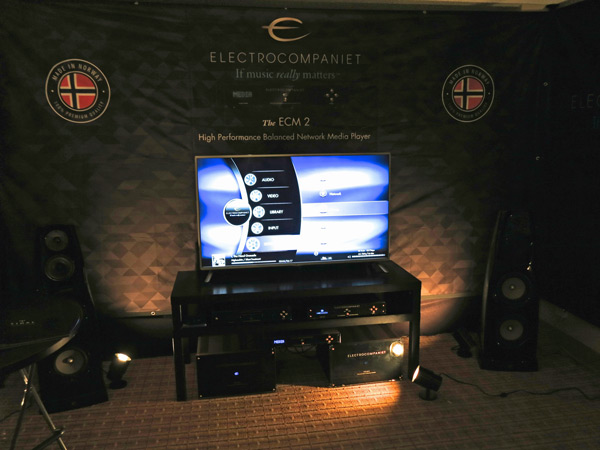
The big news—the really big news at RMAF—was the "before winter" US launch of five-year old Tidal of Oslo's full CD-quality, (lossless 1411kbps) music streaming service. Demonstrated in a fine sounding room with Electrocompaniet equipment, the sound was convincingly good when we cued up a track from pianist Leif Ove Andsnes' recording of Beethoven's "Emperor" Concerto. (More on the sound in another blog, where Hegel was using Tidal's service to source music for their room.)
Here's what you can learn if you visit the company's English-language website: Tidal is "the world's first music service with High Fidelity sound quality, High Definition music videos and Curated Editorial, tailor-made by music journalists." After the site compares its streaming rate to sonically inferior Spotify (Ogg Vorbis 320kbps) and iTunes (AAC 256kbps), it promises over 25 million tracks and 75,000 ad-free music videos; curated content by experienced music journalists that includes tailor-made recommendations, albums and playlists; and integrated articles, features and interviews. Once you sign up for the mailing list, you're promised early access, which you're told will get even earlier if you invite three friends.
David Solomon, Tidal's Director of Sales and Marketing for the US and a founding partner of Peachtree Audio, tells me that a lot more information will be available online very soon. Meanwhile, he filled in some very important blanks for Stereophile. Tidal currently has 90 employees and 580,000 paying customers. While its maximum capacity stream rate is currently 1411kbps, the fact that FLAC is a variable-bitrate lossless codec translates into a real-world data stream of between 700kbps and 1.2Mbps. Subscribers normally can only have one device or system streaming at any time, though people with Sonos can run several streams concurrently. Subscribers can also sign up three authorized offline devices to use when they are away from home.
 Tidal stores files as FLAC, and then generates other formats such as ALAC, the Apple Lossless Audio Codec, for iOS or other format-specific devices. While Tidal does not currently offer high-resolution streaming, it has successfully experimented with streaming 24/96, 24/192, and DSD. The buzz is that these will be available sooner rather than later.
Tidal's announcement comes shortly after Qobuz, the other CD-quality and hi-res music streaming service that had announced a US launch for December, filed for the French equivalent of Chapter 11 protection in late August. It seems that company failed to raise their third round of financing, and has four months to pull everything together.
Here's hoping that Tidal, which stared off in Europe under the Wimp name and is listed on the NASDAQ Stockholm stock exchange, succeeds in bringing their service to the US. Solomon tells me that a number of audio retailers and manufacturers already intend to use Tidal in their presentations. That the company offers specialized playlists, compiled by manufacturers and reviewers to show off specific system attributes or shortcomings, is a major plus. Sounds like I could become a Tidal surfer very soon.
Note: Streaming service Tidal of Norway is not related to the German loudspeaker manufacturer of the same name.
Tidal stores files as FLAC, and then generates other formats such as ALAC, the Apple Lossless Audio Codec, for iOS or other format-specific devices. While Tidal does not currently offer high-resolution streaming, it has successfully experimented with streaming 24/96, 24/192, and DSD. The buzz is that these will be available sooner rather than later.
Tidal's announcement comes shortly after Qobuz, the other CD-quality and hi-res music streaming service that had announced a US launch for December, filed for the French equivalent of Chapter 11 protection in late August. It seems that company failed to raise their third round of financing, and has four months to pull everything together.
Here's hoping that Tidal, which stared off in Europe under the Wimp name and is listed on the NASDAQ Stockholm stock exchange, succeeds in bringing their service to the US. Solomon tells me that a number of audio retailers and manufacturers already intend to use Tidal in their presentations. That the company offers specialized playlists, compiled by manufacturers and reviewers to show off specific system attributes or shortcomings, is a major plus. Sounds like I could become a Tidal surfer very soon.
Note: Streaming service Tidal of Norway is not related to the German loudspeaker manufacturer of the same name.
Tidal stores files as FLAC, and then generates other formats such as ALAC, the Apple Lossless Audio Codec, for iOS or other format-specific devices. While Tidal does not currently offer high-resolution streaming, it has successfully experimented with streaming 24/96, 24/192, and DSD. The buzz is that these will be available sooner rather than later.
Tidal's announcement comes shortly after Qobuz, the other CD-quality and hi-res music streaming service that had announced a US launch for December, filed for the French equivalent of Chapter 11 protection in late August. It seems that company failed to raise their third round of financing, and has four months to pull everything together.
Here's hoping that Tidal, which stared off in Europe under the Wimp name and is listed on the NASDAQ Stockholm stock exchange, succeeds in bringing their service to the US. Solomon tells me that a number of audio retailers and manufacturers already intend to use Tidal in their presentations. That the company offers specialized playlists, compiled by manufacturers and reviewers to show off specific system attributes or shortcomings, is a major plus. Sounds like I could become a Tidal surfer very soon.















