At 10am sharp on Friday, energized with a belly full of scrambled eggs, crispy bacon, and a regrettable amount of watery hotel "coffee," I set out to make good use of the designated press-only hours. My assignments: the 2nd floor, a few seminars of my choosing, Classic Album Sundays, and a last, mysterious task—anything else of interest.
Oddly, this instead turned into a good full hour of wandering in and out of vacant and/or unprepared rooms. In my hyper-caffeinated state, the complete abandonment made me begin to wonder if I had tripped and fallen onto the set of The Shining. Around 11am, exhibitors began to appear, but ironically I was then faced with a curious new obstacle: "I don't believe there are press hours. The show doesn't start till noon, you know." More than one exhibitor said that to me.
So instead of starting my first day with room coverage, I decided to start with the seminars.
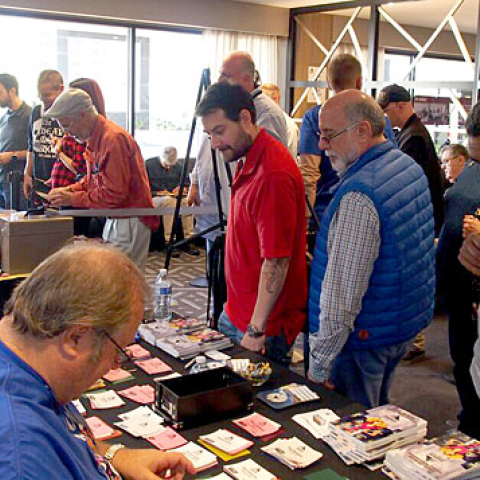
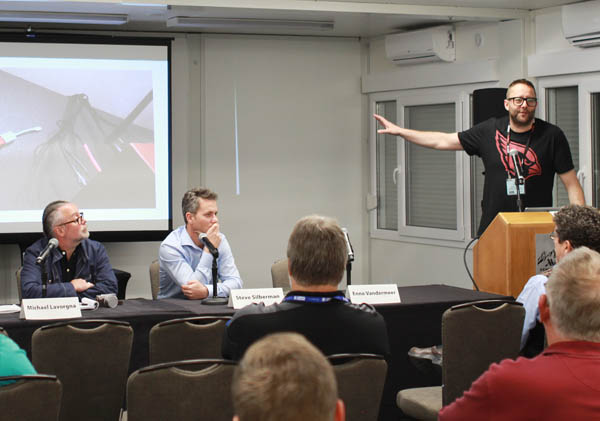
The first seminar of the day—and the show—was Affordability: How Low Can You Go?, hosted by John Darko of Digital Audio Review (on the right in the lead photo), with panelists Michael Lavorgna of AudioStream (left) and Steve Silberman of AudioQuest (center).
Darko posed the idea that, for a beginning audiophile with an entry-level budget, vinyl may not be the most financially prudent option—and I agree. The main point was that an analog system requires more financial commitment toward the music library (LPs) than does a digital system (streaming), the latter allowing said beginner audiophile to allot more of his/her budget to the equipment. When asked if they felt content with Spotify quality streaming, quite a few people—at a hi-fi show, mind you!—raised their hands (albeit reluctantly, and while nervously glancing around the room).
The panel also discussed the perceptions (or misconceptions) of Bluetooth, the idea that all audiophiles have to start somewhere, and a few other topics, the aforementioned being the strongest bits that stuck in my mind. In short, I left this seminar feeling surprisingly refreshed.
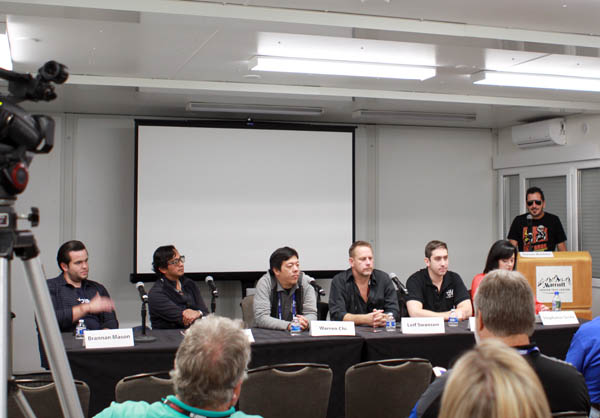 The second seminar I attended was The Young Guns of HiFi, hosted by Steve Rochlin of Enjoy the Music (far right), with, from left to right, Brannan Mason of Noble Audio, Arnold Martinez of Tweak Studio, Warren Chi of Cavalli Audio, Leif Swanson of Von Schweikert Audio, Mat Weisfeld of VPI Industries, and Stephanie Scola of KEF as panelists.
Considering myself, at 23, young (though not necessarily a "gun"), I was long intrigued by the title of this seminar. Hoping that the focus would remain on "retro-cool audio, hot new trends, and future tech," as described in a précis of the seminar, I was a bit disappointed with what I found to be a lack of focus and direction. Though the panel did briefly discuss the growing audience (aka millennials), their desires, and their spending patterns, it was still but a mere fraction of the overall conversation. Regardless, it was still an enjoyable learning experience, as I have an immense amount of respect for everyone on the panel—but a more appropriate title might've been Industry Professionals Share Heartwarming Personal Stories.
Now off to the rooms
I decided to first tackle the five entry-level rooms on the 2nd floor. Each room consisted of a complete analog, digital, and headphone system, each aimed at a given total price: $500, $1,000, $1,500, $2,500, and $5,000. (Some were a bit over, and some were a bit under, but all were close enough.)
The three-systems-per-room concept was great. The emphasis on affordability was great. The aesthetic layouts were all great. But there was one minor flaw: No one could properly listen to headphones, whether open or closed, in a room where speakers were playing at very audible levels. But that was the sole Achilles' heel of a mostly well-conceived concept.
The second seminar I attended was The Young Guns of HiFi, hosted by Steve Rochlin of Enjoy the Music (far right), with, from left to right, Brannan Mason of Noble Audio, Arnold Martinez of Tweak Studio, Warren Chi of Cavalli Audio, Leif Swanson of Von Schweikert Audio, Mat Weisfeld of VPI Industries, and Stephanie Scola of KEF as panelists.
Considering myself, at 23, young (though not necessarily a "gun"), I was long intrigued by the title of this seminar. Hoping that the focus would remain on "retro-cool audio, hot new trends, and future tech," as described in a précis of the seminar, I was a bit disappointed with what I found to be a lack of focus and direction. Though the panel did briefly discuss the growing audience (aka millennials), their desires, and their spending patterns, it was still but a mere fraction of the overall conversation. Regardless, it was still an enjoyable learning experience, as I have an immense amount of respect for everyone on the panel—but a more appropriate title might've been Industry Professionals Share Heartwarming Personal Stories.
Now off to the rooms
I decided to first tackle the five entry-level rooms on the 2nd floor. Each room consisted of a complete analog, digital, and headphone system, each aimed at a given total price: $500, $1,000, $1,500, $2,500, and $5,000. (Some were a bit over, and some were a bit under, but all were close enough.)
The three-systems-per-room concept was great. The emphasis on affordability was great. The aesthetic layouts were all great. But there was one minor flaw: No one could properly listen to headphones, whether open or closed, in a room where speakers were playing at very audible levels. But that was the sole Achilles' heel of a mostly well-conceived concept.
 In the $500 room, the digital setup was a pair of Audioengine HD3 powered speakers ($399/pair), to which files were streamed via Bluetooth. It sounded good enough, and was a fine example of affordability-meets-convenience, but I don't know that I'd ever recommend this to a friend for the price.
The analog setup consisted of Audioengine A2+ Powered Desktop Speakers ($249), a U-Turn Audio Orbit Basic Turntable with an Ortofon OM 5E cartridge ($179), and a Pluto phono preamp ($89). I'm consistently impressed by how good affordable Audioengine speakers sound. We listened to a few tracks off of Eric Clapton's I Still Do LP, and everyone in the room was grooving to it. Makes me think
I need to revisit Eric Clapton.
The headphone rig consisted of HiFiMAN HE400S planar magnetic headphones ($299) and an AudioQuest DragonFly Red DAC-headphone amplifier ($199). If I had to recommend a setup based only on sound quality (and not on the social enjoyment factor) at the $500 price point, I would probably recommend this headphone rig over the digital and analog systems.
In the $500 room, the digital setup was a pair of Audioengine HD3 powered speakers ($399/pair), to which files were streamed via Bluetooth. It sounded good enough, and was a fine example of affordability-meets-convenience, but I don't know that I'd ever recommend this to a friend for the price.
The analog setup consisted of Audioengine A2+ Powered Desktop Speakers ($249), a U-Turn Audio Orbit Basic Turntable with an Ortofon OM 5E cartridge ($179), and a Pluto phono preamp ($89). I'm consistently impressed by how good affordable Audioengine speakers sound. We listened to a few tracks off of Eric Clapton's I Still Do LP, and everyone in the room was grooving to it. Makes me think
I need to revisit Eric Clapton.
The headphone rig consisted of HiFiMAN HE400S planar magnetic headphones ($299) and an AudioQuest DragonFly Red DAC-headphone amplifier ($199). If I had to recommend a setup based only on sound quality (and not on the social enjoyment factor) at the $500 price point, I would probably recommend this headphone rig over the digital and analog systems.
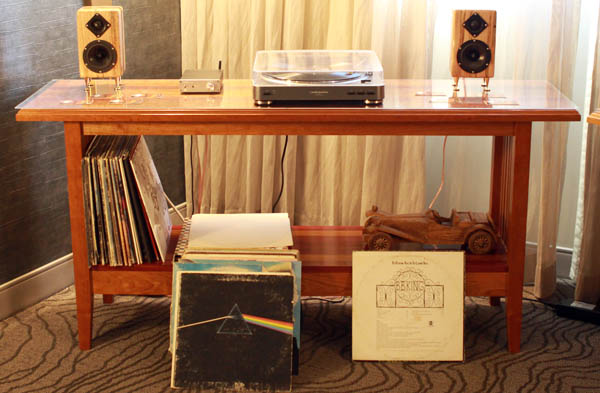 In the $1,000 room, the digital setup consisted of hipstery looking Law HiFi Sentinel Towers ($800) and a Lepai LP7498E integrated amplifier ($199) with Bluetooth streaming for the source. The Law speakers had a nice, warm midrange and not too much bass.
The analog setup replaced the Bluetooth receiver with an Audio Technica AT-LP60 turntable ($119). I've heard the AT-LP60 many times before and never really found it enjoyable. Sure, maybe I'd recommend it over a Crosley table, but not paired with $800 speakers. At $118 over the proposed $1,000 budget, I was kind of hoping that there would be more financial allotment for the turntable—especially when the $500 analog system's U-Turn Audio Orbit Basic Turntable at $179 sounded much better.
The headphone rig consisted of Fostex TH-610 ($599) headphones and a Fostex HP-A4BL Amplifier/DAC ($399).
In the $1,000 room, the digital setup consisted of hipstery looking Law HiFi Sentinel Towers ($800) and a Lepai LP7498E integrated amplifier ($199) with Bluetooth streaming for the source. The Law speakers had a nice, warm midrange and not too much bass.
The analog setup replaced the Bluetooth receiver with an Audio Technica AT-LP60 turntable ($119). I've heard the AT-LP60 many times before and never really found it enjoyable. Sure, maybe I'd recommend it over a Crosley table, but not paired with $800 speakers. At $118 over the proposed $1,000 budget, I was kind of hoping that there would be more financial allotment for the turntable—especially when the $500 analog system's U-Turn Audio Orbit Basic Turntable at $179 sounded much better.
The headphone rig consisted of Fostex TH-610 ($599) headphones and a Fostex HP-A4BL Amplifier/DAC ($399).
 In the $1,500 room, the digital setup consisted of Audioengine HD6 speakers ($749), an Audioengine S8 powered subwoofer ($349), and an Audioengine D2 wireless DAC ($399). (At this point, I began to catch on that "digital system" more specifically meant "wireless digital system.")
The analog source was originally supposed to be a Sony PS-HX500 turntable ($599.99), but at the time that I visited this room, I was informed that the PS-HX500 wasn't working properly, so only the digital setup was available to listen to. I visited this room again the following day and there was a U-Turn turntable.
The headphone rig consisted of Focal Elear headphones ($999), and a Schiit Audio Jotunheim headphone amp with DAC module ($499).
In the $1,500 room, the digital setup consisted of Audioengine HD6 speakers ($749), an Audioengine S8 powered subwoofer ($349), and an Audioengine D2 wireless DAC ($399). (At this point, I began to catch on that "digital system" more specifically meant "wireless digital system.")
The analog source was originally supposed to be a Sony PS-HX500 turntable ($599.99), but at the time that I visited this room, I was informed that the PS-HX500 wasn't working properly, so only the digital setup was available to listen to. I visited this room again the following day and there was a U-Turn turntable.
The headphone rig consisted of Focal Elear headphones ($999), and a Schiit Audio Jotunheim headphone amp with DAC module ($499).
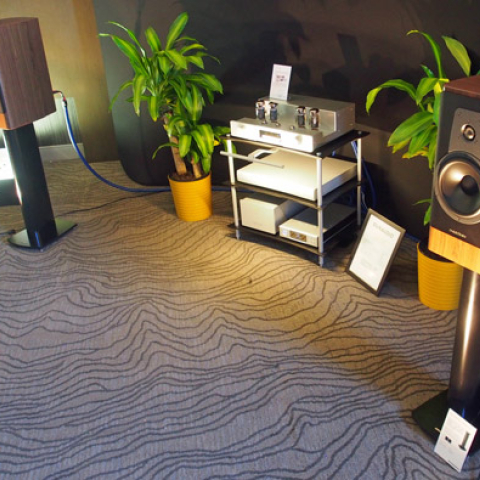
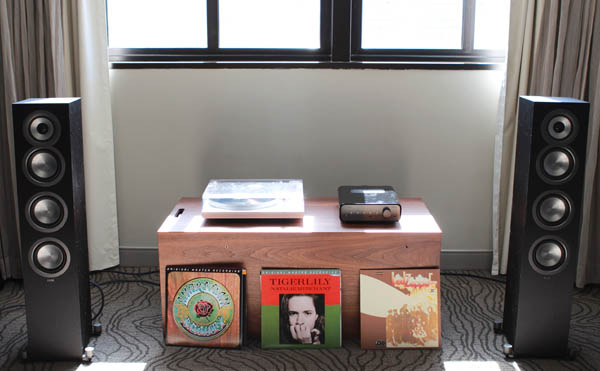 In the $2,500 room, the digital setup consisted of Elac Uni-fi UF5 speakers ($998/pair) and a Peachtree decco125 with wifi ($1,199). A neutral, clean, and satisfying sound.
The analog setup consisted of a Peachtree decco125 and a Pro-Ject Debut Carbon Esprit SB turntable ($599) with the same Elac Uni-fi UF5 speakers. The Peachtree decco125 unit at the show was a prototype and has not yet been released to the public. I am told that it'll be out sometime before the end of the year, and can be ordered with or without wifi (a $100 option.)
We listened to the LP Led Zeppelin II, usually an indicator of how unappealing higher frequencies can be, but the Esprit SB and Uni-fi UF5's released them into the room gently and with ease.
The headphone rig consisted of MrSpeakers ETHER C Flow headphones ($1,799) and the infamous portable beast, the Chord Electronics Mojo DAC-headphone amplifier ($599).
The $2,500 room was my favorite room out of all the affordable rooms in terms of sonic return on investment and financial allotment between components. I was equally impressed with the digital, analog, and headphone systems. Basically, it was the room that made the most sense to me.
In the $2,500 room, the digital setup consisted of Elac Uni-fi UF5 speakers ($998/pair) and a Peachtree decco125 with wifi ($1,199). A neutral, clean, and satisfying sound.
The analog setup consisted of a Peachtree decco125 and a Pro-Ject Debut Carbon Esprit SB turntable ($599) with the same Elac Uni-fi UF5 speakers. The Peachtree decco125 unit at the show was a prototype and has not yet been released to the public. I am told that it'll be out sometime before the end of the year, and can be ordered with or without wifi (a $100 option.)
We listened to the LP Led Zeppelin II, usually an indicator of how unappealing higher frequencies can be, but the Esprit SB and Uni-fi UF5's released them into the room gently and with ease.
The headphone rig consisted of MrSpeakers ETHER C Flow headphones ($1,799) and the infamous portable beast, the Chord Electronics Mojo DAC-headphone amplifier ($599).
The $2,500 room was my favorite room out of all the affordable rooms in terms of sonic return on investment and financial allotment between components. I was equally impressed with the digital, analog, and headphone systems. Basically, it was the room that made the most sense to me.
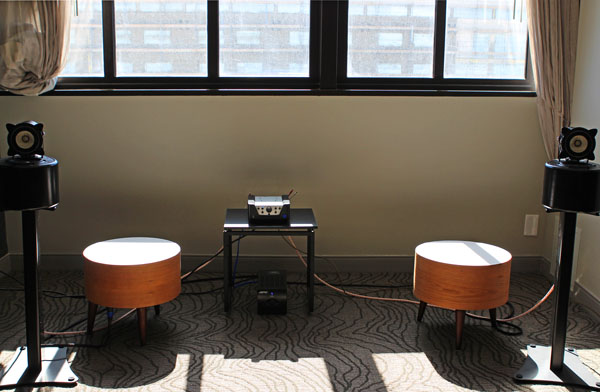 Which brings us to the $5,000 Room, where the digital setup consisted of Ono Lava speakers ($2,995), a Wyred4Sound mINT integrated amplifier ($1,499), and an Apple MacBook Pro ($1,299) as the source. (And assuming that most people already own computers, removing the MacBook Pro from the equation allows for more of the budget to go towards music!) The analog setup replaced the MacBook Pro with the VPI Player (an impressive rebranded Nomad) record player ($1,199) provided by Nokturne Audio Distribution.
Ono Audio is a new company that's only been around for a few months, making their debut at RMAF2016 a bold move. They're self-described as offering "a radical departure from traditional speaker design," utilizing a "large motor Fostex Sigma driver in an open baffle, crossoverless, tweeter and woofer augmented role." It was quite radical, indeed. I am curious to see how Ono Audio continues to develop.
The headphone rig consisted of the Sennheiser HD 800 S ($1,600), a Moon Audio Dragon Inspire IHA-1 headphone amp with tube upgrade ($1,249), and a Schiit Audio Gungnir Multibit DAC ($1,799).
In the world of high-end audio, we sometimes forget about high-performance audio—two concepts that exist both jointly and independently. The affordable rooms served as a pleasant reminder that 1) there actually can be good sound at every price point, and 2) that affordable entry-level systems are not to be looked down upon. There is a time and place for everything. Even Bluetooth.
Which brings us to the $5,000 Room, where the digital setup consisted of Ono Lava speakers ($2,995), a Wyred4Sound mINT integrated amplifier ($1,499), and an Apple MacBook Pro ($1,299) as the source. (And assuming that most people already own computers, removing the MacBook Pro from the equation allows for more of the budget to go towards music!) The analog setup replaced the MacBook Pro with the VPI Player (an impressive rebranded Nomad) record player ($1,199) provided by Nokturne Audio Distribution.
Ono Audio is a new company that's only been around for a few months, making their debut at RMAF2016 a bold move. They're self-described as offering "a radical departure from traditional speaker design," utilizing a "large motor Fostex Sigma driver in an open baffle, crossoverless, tweeter and woofer augmented role." It was quite radical, indeed. I am curious to see how Ono Audio continues to develop.
The headphone rig consisted of the Sennheiser HD 800 S ($1,600), a Moon Audio Dragon Inspire IHA-1 headphone amp with tube upgrade ($1,249), and a Schiit Audio Gungnir Multibit DAC ($1,799).
In the world of high-end audio, we sometimes forget about high-performance audio—two concepts that exist both jointly and independently. The affordable rooms served as a pleasant reminder that 1) there actually can be good sound at every price point, and 2) that affordable entry-level systems are not to be looked down upon. There is a time and place for everything. Even Bluetooth.
The second seminar I attended was The Young Guns of HiFi, hosted by Steve Rochlin of Enjoy the Music (far right), with, from left to right, Brannan Mason of Noble Audio, Arnold Martinez of Tweak Studio, Warren Chi of Cavalli Audio, Leif Swanson of Von Schweikert Audio, Mat Weisfeld of VPI Industries, and Stephanie Scola of KEF as panelists.
Considering myself, at 23, young (though not necessarily a "gun"), I was long intrigued by the title of this seminar. Hoping that the focus would remain on "retro-cool audio, hot new trends, and future tech," as described in a précis of the seminar, I was a bit disappointed with what I found to be a lack of focus and direction. Though the panel did briefly discuss the growing audience (aka millennials), their desires, and their spending patterns, it was still but a mere fraction of the overall conversation. Regardless, it was still an enjoyable learning experience, as I have an immense amount of respect for everyone on the panel—but a more appropriate title might've been Industry Professionals Share Heartwarming Personal Stories.
Now off to the rooms
I decided to first tackle the five entry-level rooms on the 2nd floor. Each room consisted of a complete analog, digital, and headphone system, each aimed at a given total price: $500, $1,000, $1,500, $2,500, and $5,000. (Some were a bit over, and some were a bit under, but all were close enough.)
In the $500 room, the digital setup was a pair of Audioengine HD3 powered speakers ($399/pair), to which files were streamed via Bluetooth. It sounded good enough, and was a fine example of affordability-meets-convenience, but I don't know that I'd ever recommend this to a friend for the price.
The analog setup consisted of Audioengine A2+ Powered Desktop Speakers ($249), a U-Turn Audio Orbit Basic Turntable with an Ortofon OM 5E cartridge ($179), and a Pluto phono preamp ($89). I'm consistently impressed by how good affordable Audioengine speakers sound. We listened to a few tracks off of Eric Clapton's I Still Do LP, and everyone in the room was grooving to it. Makes me think
I need to revisit Eric Clapton.
In the $1,000 room, the digital setup consisted of hipstery looking Law HiFi Sentinel Towers ($800) and a Lepai LP7498E integrated amplifier ($199) with Bluetooth streaming for the source. The Law speakers had a nice, warm midrange and not too much bass.
The analog setup replaced the Bluetooth receiver with an Audio Technica AT-LP60 turntable ($119). I've heard the AT-LP60 many times before and never really found it enjoyable. Sure, maybe I'd recommend it over a Crosley table, but not paired with $800 speakers. At $118 over the proposed $1,000 budget, I was kind of hoping that there would be more financial allotment for the turntable—especially when the $500 analog system's U-Turn Audio Orbit Basic Turntable at $179 sounded much better.
In the $1,500 room, the digital setup consisted of Audioengine HD6 speakers ($749), an Audioengine S8 powered subwoofer ($349), and an Audioengine D2 wireless DAC ($399). (At this point, I began to catch on that "digital system" more specifically meant "wireless digital system.")
The analog source was originally supposed to be a Sony PS-HX500 turntable ($599.99), but at the time that I visited this room, I was informed that the PS-HX500 wasn't working properly, so only the digital setup was available to listen to. I visited this room again the following day and there was a U-Turn turntable.
The headphone rig consisted of Focal Elear headphones ($999), and a Schiit Audio Jotunheim headphone amp with DAC module ($499).
In the $2,500 room, the digital setup consisted of Elac Uni-fi UF5 speakers ($998/pair) and a Peachtree decco125 with wifi ($1,199). A neutral, clean, and satisfying sound.
The analog setup consisted of a Peachtree decco125 and a Pro-Ject Debut Carbon Esprit SB turntable ($599) with the same Elac Uni-fi UF5 speakers. The Peachtree decco125 unit at the show was a prototype and has not yet been released to the public. I am told that it'll be out sometime before the end of the year, and can be ordered with or without wifi (a $100 option.)
We listened to the LP Led Zeppelin II, usually an indicator of how unappealing higher frequencies can be, but the Esprit SB and Uni-fi UF5's released them into the room gently and with ease.
Which brings us to the $5,000 Room, where the digital setup consisted of Ono Lava speakers ($2,995), a Wyred4Sound mINT integrated amplifier ($1,499), and an Apple MacBook Pro ($1,299) as the source. (And assuming that most people already own computers, removing the MacBook Pro from the equation allows for more of the budget to go towards music!) The analog setup replaced the MacBook Pro with the VPI Player (an impressive rebranded Nomad) record player ($1,199) provided by Nokturne Audio Distribution.