

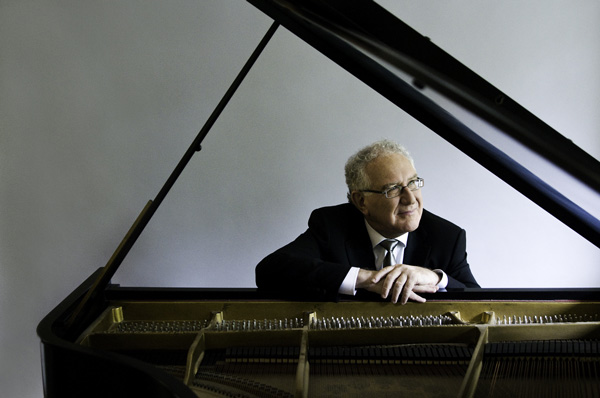
Just in time for the New Year, Audio High has released a new set of 23 of Beethoven's 32 piano sonatas, performed live by Robert Silverman and available in MQA, hi-rez, CD-quality, and MP3 formats. If the prospect of one of Canada's most feted pianists offering his mature thoughts on Beethoven in superb sound is not, in and of itself, sufficient reason to tempt you, the fact that the MP3 files can be obtained for free, with the others available for a donation to the Silver Linings non-profit charity, certainly will be. 100% of the proceeds will fund Silver Linings' many projects, which currently include helping design and fund the automation equipment installed throughout a new wing of Lucille Packard Children's Hospital.
The recordings were produced by Michael Silver, whose Audio High music, theater, and home automation retail locations in California's Los Angeles and Mountain View and Mexico's Los Cabos have together sponsored 16 Silver Linings for-charity concerts. Mark Willsher, whose credits include the soundtracks for Lord of the Rings and The Hobbit films, recorded Silverman playing the sonatas live on a Steinway in San José's intimate, acoustically superior Le Petit Trianon between September 2010 and April 2011. Willsher also did the mastering, with Zach Miley called in for the final editing.
"I've known Robert for a long time," Silver told Stereophile by phone. "He has a very special way of playing music. There are a lot of great Beethoven pianists in the world today, some more technically adept than others. After listening to a lot of their recordings - I've spent my entire life listening to these sonatas, playing them over and over while continuing to new things about them—I've discovered that Bob has a special way of bringing out the inner lines of the music.
"In addition to Bob's playing being wonderful and beautiful, he brings out things you've never heard before, and unifies the sonatas in miraculous ways. Take Op.111, for example, which is the greatest piano sonata ever written. While it's technically difficult, its greatest challenges are not technical, but rather because it's such a spiritual and delicate piece to play. If you don't have the kind of musical wisdom that Bob has, it doesn't work. But if you play it right, it's the most spiritual piece of music you've ever heard in your life. It's just amazing."
Silverman affirms that there is wisdom in every note of Beethoven's sonatas. He also believes that, save for a handful of exceptions, Beethoven wrote no extraneous notes.
"There isn't a single note that doesn't belong in these pieces exactly as and where it is," he said by phone. "Once you know all the sonatas, you realize that, by playing them, you're participating in an incredible process of artistic growth as you see Beethoven go from sonata to sonata, trying out things that no one has ever done before.
"Over the course of my life, I've rediscovered Beethoven again and again, and found new meaning in every note. He has a range of expression that few composers have had before or since. To hear him go from violence to tenderness is awe-inspiring. His early slow movements are excruciatingly beautiful. It's not that Mozart and Haydn's aren't, but Beethoven has the ability, from the second sonata on, to take that arrow and aim it right at your heart."

Silverman was also exceedingly honest with himself by choosing to release only those 23 interpretations he felt represented improvements on his initial recorded efforts. We, as well as many thousands of children, are the ultimate beneficiaries.
Robert Silverman (left) and Audio High's Michael Silver (right)
Heart is certainly the motivating force behind the recording project. Michael and Claire Silver were inspired by the cystic fibrosis diagnosis of their daughter, Rachel, to start Silver Linings in 1997 as a way "to enhance people's lives through music, film, and art." In addition to funding cystic fibrosis research and local music programs for children, their 501(c)(3) non-profit has funded a special room at Stanford Children's Hospital where kids can see music performances and films, including pre-releases of Pixar movies. Now they've moved on to the Lucille Packard Children's Hospital's new wing.
Silverman was happy to return to the sonatas. When he initially recorded all 32 of them with John Atkinson in 2000 for the now-defunct Canadian label, OrpheumMasters—the entire run has since sold out—they were set down in a less than ideal setting on a Bösendorfer. (The hall was too small for the piano but JA was not allowed to move the piano into a room location where the acoustics would work better with its sound.) This time, the Steinway artist was able to record in a better acoustic on a finer piano, and to offer more mature takes on some of the sonatas he had learned for the first time a decade earlier.















