

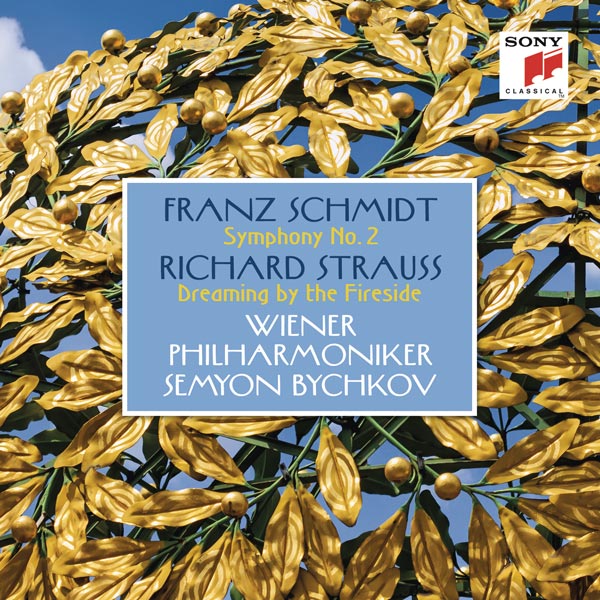
Semyon Bychkov and the Vienna Philharmonic's splendid recording of Franz Schmidt's Symphony No.2, recently released by Sony in CD and hi-rez formats, is dazzling in its pastoral splendor. The music is lush and liquid, with one gorgeous orchestral effusion after the other. Which is not to say that Schmidt's ideas, as verdant as they be, flow organically in a manner that creates a coherent whole.
Truth be told, the Second Symphony tends to careen from idea to idea, and from one key change to another, sometimes without apparent regard for the big picture. It opens with music so densely scored and deliciously performed that it sounds like spring in full flower. Around 8:50, as it continues to wander through fields, valleys, and lush forests, it reaches a big. juicy climax. (Don't quote me on that timing, because I was too overwhelmed by the impact of it all to think about opening my eyes to check my dCS Paganini transport's read-out until after the fact.) But after more flowing music, Schmidt seems unsure where to go.
Happily, once he drives a new idea forward, it is invariably pleasing, and often dazzling. Some themes may be a bit pedantic, but once everybody in the Vienna Philharmonic starts playing at once, the visceral experience is so overwhelming that the head tends not to care. As long as you can allow for the fact that Schmidt is wont to shift gears midstream, and that the endings of his first and third (final) movements are strangely anti-climactic, you may find yourself in love with his Second Symphony.
Before proceeding farther, some biographical information about Schmidt (1874–1939) is in order. It was between 1911 and 1913, while Schmidt served as both cellist in the Vienna Philharmonic and professor at the Vienna Conservatory, that he composed his Second Symphony. Premiered at the end of 1913, and first performed by the Vienna Philharmonic on November 29, 1914, it received such a scathing review from Karl Löbl in Der Express that the Vienna Philharmonic polled 2360 listeners to see if they agreed. As it turned out, only 13 agreed with the review, 112 declined to comment, but a whopping 2235 roundly condemned it! A number of players even wrote, "For us there is something sacrosanct about Franz Schmidt. We are connected to him by a kind of umbilical cord, and are touchy when anyone tramples on it."
Over a century later, in our paradoxically increasingly inter-connected universe in which people relate via quasi-sentences texted in isolation, it is possible to listen to the symphony in more objective fashion. Doing so, we can acknowledge that as beautiful as Schmidt's music may be, some of his transitions are downright weird.
The second movement, comprised of 10 variations on a simple woodwind theme, is an unquestionable symphonic showpiece that piles lushness upon lushness. At times Straussian in its excesses, as though one were attending a formal tea in the countryside and being plied with far too many sweet confections, the movement occasionally breaks into a waltz that threatens to whirl out of control. "What exactly is Schmidt on?" you may wonder, as he dizzily careens from one theme to the other. But as long as you don't become preoccupied with the direction in which he's heading, and can allow yourself to close your eyes and take it all in, there's no denying that it's a trip worth taking.
The last movement, which at times meanders in quasi-fugal fashion, leads to a huge explosion and glorious finale. What the strange key modulation that occurs shortly before the ending is about, we may never know.
Schmidt's Symphony No.2 may ultimately be one of those "love it or leave it" pieces, but there's so much to love that you won't be in a rush to leave anytime soon. Besides, you may be too delirious to do much else than stagger to your feet and wonder, after so much dessert in the woods, if there's any need for a main course.
Filling out the recording is Träumerei am Kamin (Dreaming by the Fireside), aka the Symphonic Interlude from Richard Strauss' rarely performed opera, Intermezzo. It's 6:51 of schmaltz, and hardly top-drawer Strauss. Nonetheless, it's a fitting companion to Schmidt's irrepressibly colorful, mostly joy-filled romp through nature. The brilliant Semyon Bychkov conducts as if to the manner born, even if it's unclear exactly what that manner is all about.















