

No prosaic formal classification can begin to describe the universal embrace of life and death that is Schubert's final, posthumously published String Quintet in C major, D.956. Written in his final year, as his health was rapidly deteriorating from syphilis (and, perhaps, the mercury that was likely administered as a "cure"), the quintet melds characteristically Viennese gemütlichkeit with far darker forebodings. Although that darkness is expressed musically rather than through words—Schubert's contemporaneous, bone-chilling song, Der Doppelgänger, is far more explicit in this regard—the rumblings of physical and emotional pain that punctuate the quintet's frequently high-spirited surface reflect a soul, deeply aware of his impending mortality and the transcendence of pain that death can deliver.
Transcendence, in fact, is key to understanding the quintet's breathtakingly beautiful second movement. Often called the most sublime adagio ever composed, it begins with a theme so serenely beautiful, so seemingly suspended beyond time and place, as to express the ultimate peace that death brings. What make the adagio even more astounding are the outbursts of pain and foreboding that eventually rip through its silken fabric and shake us to the quick before returning us to the sublime.
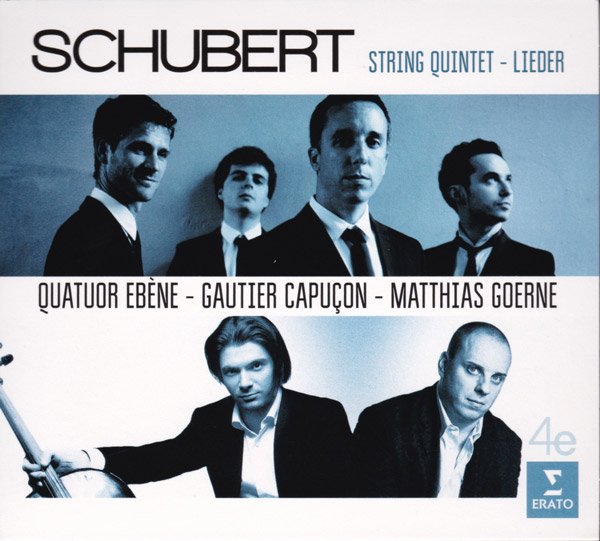
Those who love Schubert's final quintet await every announcement of another recording or live performance that will hopefully take them closer to the essence of Schubert's genius. Which is, in some ways, what Quatuor Ebène and cellist Gautier Capuçon's new recording of the work for Erato does (footnote 1).
Although other recordings have been even strong in expressing the work's drama—the justly celebrated 2013 recording from the Pavel Haas Quartet and cellist Danjulo Ishizaka conveys a radically dramatic perspective that is quite soul-shaking—this new version has a rare fineness of line in quieter passages that seems to sing right from the heart of Schubert's extremely sensitive soul. It is indeed a special and rare energy, too seldom encountered nowadays, that harks back to a time in Vienna (1828) that was both simpler and, in the case of Schubert, who likely contracted syphilis through one of many suspected homosexual liaisons, extremely difficult to live through.
A bonus of the recording is the opportunity to also hear the great baritone, Matthias Goerne, sing five glorious songs (lieder) by Schubert that, in one way or another, address pain and death. Here Goerne deviates from modern practice and, harking back to the lieder recordings of the late 1920s by Lotte Lehmann and Elisabeth Schumann, sings to the accompaniment of Quatuor Ebène and Laurène Durantel on double-bass. Although he is not at his most expressive—perhaps he felt constricted by the inability to work with a single piano accompanist who would breathe with his every move—the singing is quite beautiful. No one can beat contralto Marian Anderson's 1947 version of "Der Tod und das Mädchen" (Death and the Maiden), but, then again, few singers alive today can equal Goerne's profundity.
The engineering itself won't win awards. Folks accustomed to classical listening will discover themselves turning down the volume, as they would with pop recordings, because the overall recording level is higher. This often indicates dynamic compression. But any compromises in recording are transcended by the performance itself. Highly, highly recommended.
Footnote 1: Gautier Capuçon's recording of the Rachmaninoff cello sonata in g was our "Recording of September 2003."—Ed.
Footnote 1: Gautier Capuçon's recording of the Rachmaninoff cello sonata in g was our "Recording of September 2003."—Ed.















