

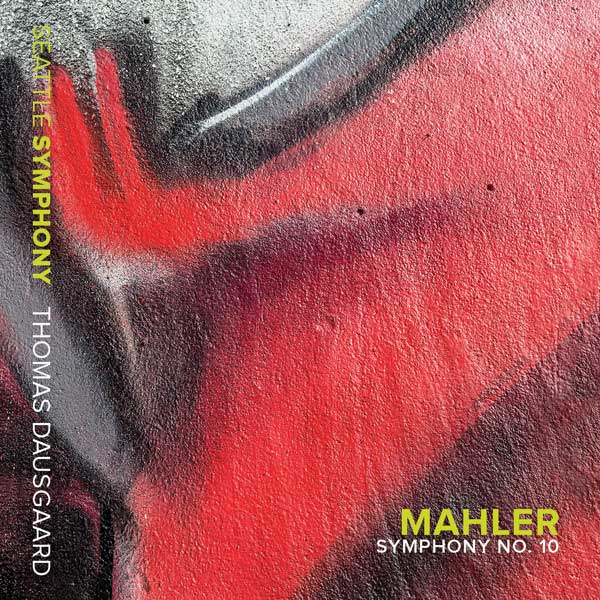
You will have to hunt far and wide for a finer-sounding recording of Mahler's final Tenth Symphony than this one of the Deryck Cooke completion from the Seattle Symphony under Principal Guest Conductor Thomas Dausgaard. Captured in 24/96 hi-rez by Dmitry Lipay and Alexander Lipay, and available as both a 5.1 surround sound and stereo 24/96 download as well as in 16/44.1 on CD, the recording stands apart for the richness of its lower midrange, the impact of its bass drum thwacks, and the supremely saturated colors.
The live recording, made in Seattle's Taper Auditorium in Benaroya Hall and edited down from three performances that took place in November 2015, is ear-opening. When heard as a 24/96 stereo mix, its transparency and breadth of soundstage far surpass those on a musically excellent 1999 recording from Sir Simon Rattle and the Berliner Philharmoniker. That earlier, highly praised recording, once available on a DVD-Audio that included both a 24/44.1 stereo mix and Red Book-resolution 5.1 presentation, was auditioned in hi-rez stereo via an Oppo BDP-93 NuForce Edition's transport feeding the very same dCS Rossini through which the Seattle Symphony files were auditioned.
With at least 19 versions of Mahler's Symphony 10 available in various completions, sound quality is but one of many factors to consider when making a purchase. But do keep in mind that midway through the symphony's gorgeous long opening adagio, irresistibly tender waves of sound that are profoundly sad and frequently heart-breaking are suddenly interrupted by a piercing, inherently dangerous 9-note orchestral scream. With the exception of the startling sustained high E in the final movement of Smetana's first String Quartet—a sound meant to signify the sudden onslaught of infernal ringing in the composer's ears that progressed into deafness—there's little or nothing else like it in music written before 1910.
The symphony's scream, and the finality of its equally startling, repeated muffled drum thwacks that come later on, set it apart from anything else Mahler wrote. Their root, as with so much of Mahler's music, is autobiographical. Mahler had been in emotional and spiritual crisis before, of course—anyone who endured years of anti-Semitic libel, as well as accusations from his wife that his Kindertotenlieder (Songs of Dead Children) cycle for voice and orchestra was somehow responsible for the death of his infant daughter, would be under great stress. But the heightened state of dread that came upon him when, toward the end of his life, he intercepted a letter from architect Walter Gropius to his wife that invited her to flee with him, was only exacerbated by newfound knowledge of his potentially fatal heart condition. Add to that the impact of his psychotherapy sessions with Sigmund Freud, and you have a man so stressed out that he did not live to complete the symphony.
Rattle may offer greater soaring intensity and drama around the screams and thwacks, but the sounds themselves are viscerally less startling than Dausgaard's. Given their central musical importance, the more powerful they are, the more the recording succeeds. That gives Seattle Symphony's version a major advantage.
The most startling sounds on Rattle's recording are his far too frequent extra-musical grunts and heavy breathing. Nor is his rendition of the symphony's lyrical and occasionally pastoral passages as heart-touching as Dausgaard's. It is the beauty of the symphony's lyrical unfolding, and the gut-wrenching contrast between it and the elements that break it apart, that make Seattle Symphony's recording of Mahler's magnificent farewell a must-hear.















