

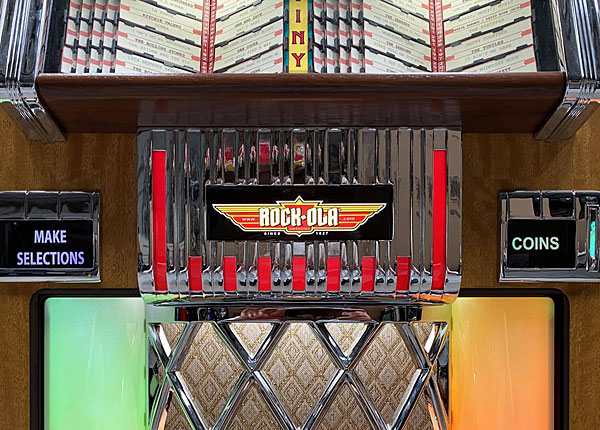
Jukeboxes were probably the first music servers to take a form we would recognize: a music-playing device that allows you to choose from several, or many, songs. The first commercial jukebox, Wikipedia says, was introduced in 1927 by the Automatic Musical Instrument Company, which came to be known as AMI.
For most of their history, audio servers were public things, providing entertainment in bars, diners, and pubs. Fast-forward decades to not long after the CD's introduction when CD servers appeared that could hold three, five, or 100 Compact Discs. They quickly became cheap and plasticky, or maybe they were always that way, but anyway people bought them, and that was the music server's first serious inroad into the home. CD servers were clunky nightmares: It was hard to find the tune you wanted to listen to, and if a disc got stuck, you were in trouble. I preferred the superior fidelity (and frankly ease of use) of a single-disc player combined with storage shelves and my own feet and hands.
The prototype modern-day music server, I would argue, was the '90s-era hard disc holding thousands of low-rez MP3 files downloaded from illegal sharing sites. Even today, the multipurpose computer remains an excellent, practical server choice, and it can sound very good if perhaps not optimal. A multipurpose computer is especially attractive when streaming is involved, since it's a cheap and convenient way to get music from streaming services into your DAC. It seems certain that the multipurpose computer is the most common species of music server in current use.
Not too many years ago, something interesting happened: DACs got an Ethernet port. One reason this was important was the advent of high-quality online music streaming. It was a turning point for audio servers: Now, with appropriate protocols and software, it was possible to send music directly to a DAC from anywhere.
This was the moment when the audio server exploded—conceptually, I mean, not physically. Now it no longer mattered where the music was stored; Qobuz files, I recently learned, are hosted at Amazon server farms all over the world. Our own audio files can be uploaded to the cloud and played from there, stored on a network-attached storage (NAS) drive elsewhere on our network or even in another state; all you need is an Ethernet cable on both ends and a big enough pipe.
Another crucial part of an audio server is a computer that runs the software that keeps track of your music and makes it available when you want to listen to it. A big step forward came recently when that software started presenting the music in a single, vast library, not caring where it was stored or whether it was owned or rented.
Thanks to that RJ45 jack—the standard Ethernet connector—the music computer, too, can be located elsewhere, in an office or spare bedroom far from your audio system.
Getting powerful computers and storage (especially spinning discs) out of the music room is important, because they generate noise, both the sonic kind (fans and spinning discs, although SSDs are silent) and the RFI kind. Well-designed servers can mitigate sonic damage electronic noise can do, but only with careful, meticulous design. It's not a total solution, but putting those parts far from your audio system makes sense.
My files—some downloaded, most ripped from CDs—live on a NAS device in the tiny room where my TV is located. Four 4TB hard disc drives are configured as a RAID array so that if a single drive fails, I can replace it without losing data. The NAS backs itself up to the cloud on a regular basis. My audio computer—an Intel NUC running Roon in Roon Optimized Core Kit, the DIY version of Roon's music-optimized Linux—is in the same room as my NAS. Both are connected to my router, which sends another line out that terminates at the rear of my network-enabled DAC 75 feet away.
This is all basic, standard-issue stuff, but it has the excellent consequence (combined with Roon 1.8) that all my files plus all the files on Tidal and Qobuz are available to search, browse, and play as if they were in my library.
There's one thing that the best hi-fi servers do that my distributed setup doesn't do: condition and reclock the digital data. Data sent by Ethernet are delivered in packets, which must then be unpacked and reconstructed and, for audio data, reclocked. Right now, that's all happening inside my network-enabled DAC. But how good a job does it do? Good enough to ensure optimal DAC performance? Would I be better off with a separate device that accepts Ethernet data, conditions and reclocks it, and sends it to my server over an audio interface such as AES/EBU? Would that give me better sound?
I asked some digital-audio experts; the prevailing view is that it depends on the DAC—how well it clocks incoming Ethernet data and how well it deals with jitter.
So that's my exploded audio server, with pieces located all over my house—or, counting the streaming services, all over the world.
I'll end with this: When something explodes, whether a white dwarf star or the concept of hi-fi servers, it tends to recombine eventually in ways not seen before. Next up: streaming (Ethernet) DACs that run Roon or other server software. Bluesound, Grimm, and Mola Mola are ahead of the curve. Expect more to appear in the coming months and years.















