

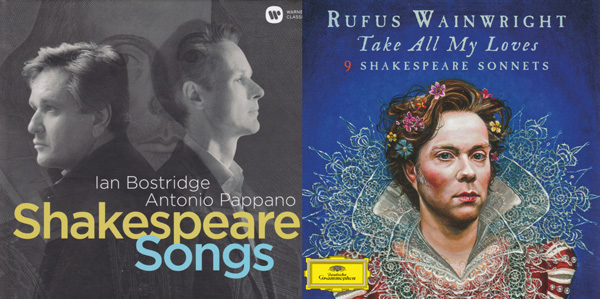
With 2016 almost behind us, there's just enough time to speak of two of the many recordings issued this year to commemorate the 400th anniversary of the death of William Shakespeare. Equally commendable, albeit radically different in the way they honor the Bard, are Shakespeare Songs (Warner Classics) from tenor Ian Bostridge and pianist Anthony Pappano (available in 24/96 from HDTracks), and Take All my Loves: 9 Shakespeare Sonnets (Deutsche Grammophon) from Rufus Wainwright and friends (available in 24/44.1 from HDTracks).
As well you might expect, Bostridge and Pappano's is the more traditional effort. Starting with Finzi's five-song Shakespeare cycle, Let Us Garlands Bring, which was written in the 20th century, it continues with songs by Byrd, Morley, Wilson, and Johnson, all written during Shakespeare's lifetime. Next come two well-known songs by the Germans Schubert and Haydn (the delightful "An Silvia"—To Sylvia—and the touching "She never told her love").
Returning to the 20th century, we visit the efforts of Quilter, Gurney, Warlock, Korngold, Poulenc, Britten, Tippett, and Stravinsky.
There are 29 tracks in all, with the earliest accompanied by lutenist Elizabeth Kenny, and the Stravinsky handled by flutist Adam Walker, clarinetist Michael Collins, and violist Lawrence Power. Readers who recognize these names will know that Warner went for quality in a production that also includes a hard-bound, multi-lingual booklet, complete with an erudite essay by Christopher R. Wilson and several fine illustrations.
Two decades after Bostridge shot to international prominence with his recording of Schubert's Die Schöne Müllerin, accompanied by Graham Johnson for the Hyperion Schubert series, his lovely tenor retains its youthful beauty and purity of emission. The lower tones sound rather conventionally masculine, but as soon as he begins to ascend—roughly 85% of all the notes he sings in this recital—the tone is wonderful. It is hard not to fall in love with the sound of Bostridge's voice, especially when, as in the opening selection, Finzi's "Come away, come away death," he sounds so fragile and innocent.
The intelligence, too, is there in spades. While I continue to find him too fussy with words, and at times too precious in his emoting, he shares with one of his mentors, the late Dietrich Fischer-Dieskau, the ability to slay you with his insights. Check out the "Hey, ding-a-ding dings" in Finzi's "It was a lover and his lass," and the equally spirited "heys" in Morley's setting of the same verse and Warlock's "Pretty Ring Time." That doesn't mean that Bostridge's "Pretty Ring Time" in any way supplants the fetching simplicity of soprano Julianne Baird's rendition, on an early Delos CD that was once standard fare at audio shows, or that I would treasure any less versions of some of these songs by soprano Elisabeth Schumann and mezzo-soprano Janet Baker.
For standouts on the Bostridge recording, try his rendition of Johnson's "Full fathom five," and the way that he smiles at grief in the aforementioned Haydn song. Equally recommended: Gurney's lovely "Under the Greenwood Tree"; the three extremely interesting Korngold songs; the delicious contrast between Poulenc and Britten's settings of "Fancie"; the dog barks in Tippett's "Come unto these yellow sands"; the fabulous rhythms in Stravinsky's late Three Songs from William Shakespeare; and the alterations in tone in the three contrasting verses of the beautiful final unaccompanied song, by Anonymous. Even if you don't like everything Bostridge does, you will no doubt be transported by the greatness of his textual insights and the beauty of his voice.
Rufus Wainwright is, of course, a very different animal. As nice as his voice may be, there's no question that its range and emotional compass are far more limited. But it's also clear that, in his own way, he ranges much farther afield than Bostridge and Pappano.
Take All my Loves is no flash-in-the-pan effort. Encouraged by his mother, Kate McGarrigle, to read Shakespeare's astoundingly subtle, sometimes confounding sonnets during his adolescence, he deepened his appreciation for Shakespeare's accomplishment when Robert Wilson and the Berliner Ensemble commissioned him to write music for an evening of the sonnets. At the same time as he was studying him, his mother was dying of cancer, he was falling in love with his partner, Jörn, and they were planning the conception of their daughter, Viva. What a rich time to immerse oneself in sonnets that, in their own way, are as rich in meaning as Beethoven's piano sonatas.
Wainwright may start off low-key, with a simple reading of Sonnet 43, "When Most I Wink," by Siân Phillips, but he soon goes all operatic with soprano Anna Prohaska's rendition of same. If softer rock is the preferred idiom for Sonnet 40, "Take All My Loves," far more raucous hard rock greets Sonnet 23, "Unperfect Actor." In both tracks, voices recede as the music takes over. Those voices, I might add, includes Martha Wainwright and Fiora Cutler's vocals on the latter track, and recitations by Marius de Vries and Helena Bonham Carter. Hold on to your seatbelts, space cadets, when I tell you that even William Shatner and Carrie Fisher make cameo appearances, reciting Sonnets 29, "When in Disgrace with Fortune and Men's Eyes," and 129, "Th'Expense of Spirit in a Waste of Shame," and that Sonnet 66 is sung in German by Christopher Nell, Jürgen Holtz, and Rufus Wainwright.
I'm neither convinced that Prohaska's soaring soprano, which begins to sound overly dramatic and heavy higher in the range, or Wainwright's rather conventional rock treatments do much to illuminate Shakespeare's many faceted meanings. But the disc is so much fun that I can't imagine you not giving it a listen. I may very well play one or more of those rock tracks at CES, when I join other members of the Stereophile team January 5–8 to cover that ever-shrinking, increasingly expensive but still important trade show.















