

Until about nine months ago, in the fall of 1970, FM radio station WFLN, Philadelphia, was just another one of that dying breed: the classical FM station. Like its counterparts in the few remaining classical-radio cities, it provides the major part of the high-fidelity listener's radio diet, and also like most similar classical stations, its fidelity was nothing to brag about.
This was not because of indifference or lack of funds for better equipment, but because WFLN had been following one of radio's traditions which happen to be detrimental to audio quality. They were "reaching."
Radio advertisers, like all advertisers, think in terms of audience. The larger the station's listenership, the more people will be reached by the advertiser's message and the more the station can charge for airing it. A classical-music station has a limited potential audience to begin with, simply because the vast majority of Americans, for various reasons, feel that listening to classical music is something one does for cultural enrichment rather than for enjoyment.
But the classical-station listener often has expensive tastes in the products he buys, and the people who sell such products find that they get a better return on their advertising dollars from a classical-music station than from one with a wider audience. But the station must still reach as much of its potential audience as possible, and this is best done (within their legal limit of transmitting power) by keeping the signal loud.
Unfortunately, classical music, unlike pops and background music, is quiet most of the time. Crescendos comprise but a small fraction of most classical works, and quiet passages don't have the "reach" that is needed to push the signal out to the fringes of reception. So, WFLN was doing what everyone else is doing; using peak clippers and volume compressors to hold the average signal level close to the permissable maximum and prevent the quiet parts from getting too quiet. Since all volume compressors have audible distortion, and dynamic range is an essential part of classical music anyway, the result was not one to gladden the audiophile's heart. The sound was tolerably clean most of the time, but every crescendo stirred up the mud in the limiting and compressing devices. And whenever a protracted quiet passage came along, the volume (and the background noise) would creep up, up, up until the next crescendo choked the sound back to normal.
Finally, someone at the station got fed up and "did something" to their compressors. There was no public announcement, no claim to "improved fidelity." One day, their signal quality was mediocre, the next day it was clean, transparent, and for all intents and purposes completely uncompressed.
Then the station's management sat back to wait for the anticipated listener reaction. And waited. And waited. And waited. For two weeks nothing happened. Then, within a couple of days, there were two calls to congratulate them for their new sound. WFLN program director Jim Keeler identified one caller as Eugene Coggins, of Paoli High Fidelity Consultants. The other was Ye Editor & Publisher of Stereophile.
Six weeks later, the grand total of calls commenting about the improved sound stood at five, despite the fact that we had phoned several critical-listener-type friends, urging them to listen to the new WFLN sound and register their approval if they liked it. They all said they liked it. Only one of them bothered to let the station know he' liked it.
This miserable display of human inertia was by no means unusual. Every two years, it accounts for the election of corrupt politicians all over the country, and more often than that, it is a source of discouragement for some FM station or recording company that improves its sound quality in the hope that someone will notice and appreciate.
It is a truism, and not a happy one for man's self-image, that people are much more likely to make their voices heard when they dislike something than when they like it. But when it comes to the quality of the program material made available for reproduction through our thousand-dollar hi-fi systems, it seems that hi-fi enthusiasts are incapable of getting off their fat asses even to register a protest, let alone a vote of approval.
Maybe we, as a group, just don't expect better sound from FM and recordings than we're getting now. But dammit, when it happens, the least we can do is give the responsible parties a pat on the back. Critical hi-fi listeners are a tiny minority of the general public as it is. If we remain steadfastly silent on matters of concern to us, we don't deserve any consideration by the people who decide what kind of fi we get to listen to.
Late Again!
Anyone comparing our cover date (below) with a calendar may be excused for wondering if we aren't a little behind schedule again. We are, mainly because Ye Editor took on a freelance job last summer that turned out to be three times as much work as he thought it would be. I apologize. We may be late again, some time in the future, but I can assure readers it won't be for the same reason. Once burned...—J. Gordon Holt
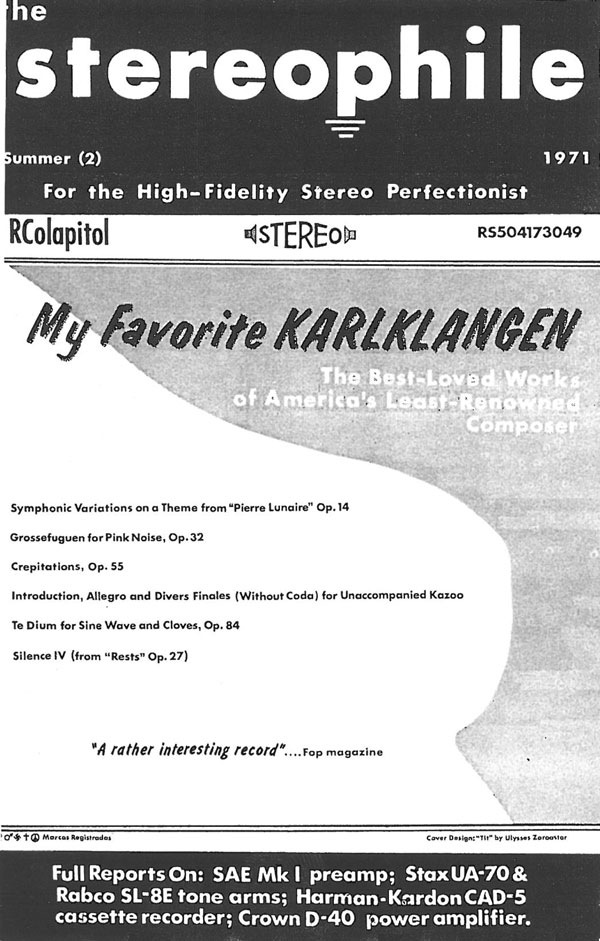
Anyone comparing our cover date (below) with a calendar may be excused for wondering if we aren't a little behind schedule again. We are, mainly because Ye Editor took on a freelance job last summer that turned out to be three times as much work as he thought it would be. I apologize. We may be late again, some time in the future, but I can assure readers it won't be for the same reason. Once burned...—J. Gordon Holt















