

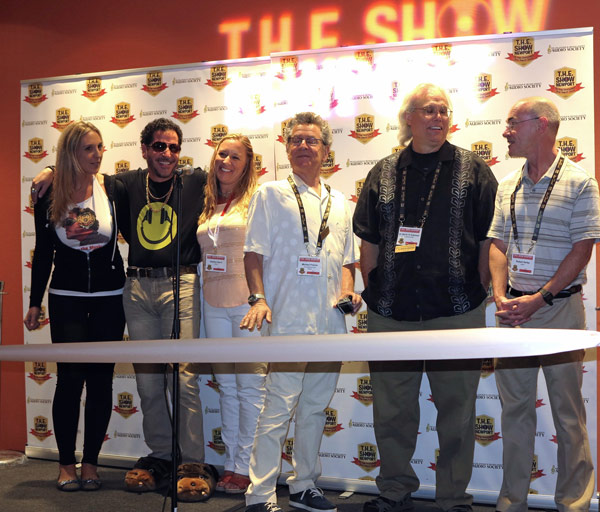
The ribbon had been cut and the trumpets sounded. THE Show Newport Beach, whose 2015 installment had moved a mile or two up the road into Irvine, was underway. Doing the honors at the ribbon-cutting ceremony were, from left to right, a gold chain-bedecked Steve Rochlin of Enjoy the Music, accompanied by his wife, Heather to his left, and an unidentified woman to his right; Michael Fremer of Stereophile and AnalogPlanet.com; David Robinson of Positive Feedback, Robert Harley of The Absolute Sound. Several folks were present on the stage later in the ceremony, including Carol and Dave Clark of Positive Feedback, Richard Beers of THE Show, and Bob Levi of THE Show/Los Angeles Orange County Audiophile Society. The big drama, besides the trumpets, was supplied by journalists jostling for a good shot.
 It might have been a workday, but you'd never know it from the line stretching out the door at the Hotel Irvine. It reportedly took two hours for the first throng of registrants to get their badges and make it through the door. At least pre-registrants had a head start, having encountered a much shorter line. Nonetheless, given the fact the show was spread over nine floors, it was possible to snare a seat in every room I visited.
 Up on the 5th Floor, Grammy-winning producer and recording engineer Cookie Marenco of Blue Coast Records was prepared to host three days of live performances while recording, mixing, and playing back on the spot. Among the artists poised to perform was the lovely Fiona Joy, the celebrated Blue Coast artist whose Winds of Samsara received the 2015 Grammy for Best New Age album.
[
Up on the 5th Floor, Grammy-winning producer and recording engineer Cookie Marenco of Blue Coast Records was prepared to host three days of live performances while recording, mixing, and playing back on the spot. Among the artists poised to perform was the lovely Fiona Joy, the celebrated Blue Coast artist whose Winds of Samsara received the 2015 Grammy for Best New Age album.
[ No less a personage than recording engineer Keith O. Johnson (right) joined Ric and Jan Mancuso at the busy Reference Recordings booth in THE Show's huge, T-Shaped marketplace. Vinyl lovers, too, were having a ball.
I got advance word of Reference Recordings' releases for the rest of the year: Rediscovering Moszkowski: Orchestral Works of Moritz Moszkowski, performed by the San Francisco Ballet Orchestra conducted by Martin West (October); Wine-Dark Sea: Symphony for Band by John Mackay and other works from the University of Texas Wind Ensemble, conducted by Jerry Junkin (November); and Of The Free: Marches, Anthems and Songs performed by the West Point Band, conducted by Lt. Col Jim Keene (November).
From the Fresh! from RR series, which is recorded in DSD by SoundMirror and released as a hybrid SACD that includes a HDCD-encoded CD layer: Mahler: Symphony No. 1 "Titan" performed by the Utah Symphony, conducted by Thierry Fischer (September); Beethoven: Symphonies 5 & 7, performed by the Pittsburgh Symphony Orchestra, conducted by Manfred Honeck (October); and Far In The Heavens: Choral Music of Stephen Paulus, world premieres of the last pieces Paulus wrote and recorded, just before his untimely death last year, with the True Concord Voices (formerly Tucson Chamber Artists (September 11, 2015). Holst's The Planets is due from the Kansas City Orchestra in 2016.
No less a personage than recording engineer Keith O. Johnson (right) joined Ric and Jan Mancuso at the busy Reference Recordings booth in THE Show's huge, T-Shaped marketplace. Vinyl lovers, too, were having a ball.
I got advance word of Reference Recordings' releases for the rest of the year: Rediscovering Moszkowski: Orchestral Works of Moritz Moszkowski, performed by the San Francisco Ballet Orchestra conducted by Martin West (October); Wine-Dark Sea: Symphony for Band by John Mackay and other works from the University of Texas Wind Ensemble, conducted by Jerry Junkin (November); and Of The Free: Marches, Anthems and Songs performed by the West Point Band, conducted by Lt. Col Jim Keene (November).
From the Fresh! from RR series, which is recorded in DSD by SoundMirror and released as a hybrid SACD that includes a HDCD-encoded CD layer: Mahler: Symphony No. 1 "Titan" performed by the Utah Symphony, conducted by Thierry Fischer (September); Beethoven: Symphonies 5 & 7, performed by the Pittsburgh Symphony Orchestra, conducted by Manfred Honeck (October); and Far In The Heavens: Choral Music of Stephen Paulus, world premieres of the last pieces Paulus wrote and recorded, just before his untimely death last year, with the True Concord Voices (formerly Tucson Chamber Artists (September 11, 2015). Holst's The Planets is due from the Kansas City Orchestra in 2016.
 Virtually every system on the lobby level of the Hotel Irvine qualified as cost-no-object, with some being more stratospherically priced than others. What immediately seized the attention of everyone who entered this extremely large room was the marvelously full range, convincingly colorful organ holding forth from Tineo J Horn loudspeakers ($35,000/pair in rare Tineo Brazilian hardwood finish). Allied with Ayon Titan SET Gen 4 monoblocks ($53,900/pair), Ayon Spheris III preamp ($34,000), Ayon CD-3sx CD player/DAC/streamer/DSD ($9850), BBS Audio aluminum racks ($5600), and unidentified cabling, this was a killer system that displayed impressive control on everything from thunderous, full-range organ to electric guitar. Both speakers and racks are available in multiple finishes.
 Dean Martin's Dream with Dean, a superb recent LP release from Acoustic Sounds, was graced by an absolutely gorgeous midrange on a world premiere pair of Evolution Acoustics MMTwo EXACT loudspeakers ($89,500/pair) with new outboard crossover (pictured alongside the loudspeaker). In a system assembled by The Audio Association of Anaheim, these beauties were joined by Evolution Acoustics cabling ($20,000); two new iterations of darTZeel products that are due to ship in June, the LHC-203 "DANalogue" streaming Ethernet DAC w/integrated amplifier ($15,000) and NHB-18NS reference preamplifier with integrated reference phonostage ($40,000); Wave Kinetics NVS reference direct-drive turntable plus accouterments ($47,400 total); Durand Kairos tonearm and tonearm cable ($8300); and Ortofon MC Anna MC cartridge ($9000).
If the midrange shone on Dean Martin's prime condition voice, the bass foundation on Zubin Mehta's performance of Mahler's Symphony 3 was equally impressive. With the only room treatment in the sonically daunting square space being draping, this system's beauty and control were outstanding. Given that the preamp was not broken-in, I can only imagine how good this system will sound by the final day. Hats off to Jonathan Tinn for pulling it all together.
Dean Martin's Dream with Dean, a superb recent LP release from Acoustic Sounds, was graced by an absolutely gorgeous midrange on a world premiere pair of Evolution Acoustics MMTwo EXACT loudspeakers ($89,500/pair) with new outboard crossover (pictured alongside the loudspeaker). In a system assembled by The Audio Association of Anaheim, these beauties were joined by Evolution Acoustics cabling ($20,000); two new iterations of darTZeel products that are due to ship in June, the LHC-203 "DANalogue" streaming Ethernet DAC w/integrated amplifier ($15,000) and NHB-18NS reference preamplifier with integrated reference phonostage ($40,000); Wave Kinetics NVS reference direct-drive turntable plus accouterments ($47,400 total); Durand Kairos tonearm and tonearm cable ($8300); and Ortofon MC Anna MC cartridge ($9000).
If the midrange shone on Dean Martin's prime condition voice, the bass foundation on Zubin Mehta's performance of Mahler's Symphony 3 was equally impressive. With the only room treatment in the sonically daunting square space being draping, this system's beauty and control were outstanding. Given that the preamp was not broken-in, I can only imagine how good this system will sound by the final day. Hats off to Jonathan Tinn for pulling it all together.
 The Bulgarian Thrax Lira loudspeakers ($20,000/pair) that were making their US premiere—I missed them in Munich—may have been small, but their high-frequency horn drivers and magnesium-diaphragm mid/bass drivers, housed in an all-aluminum ported enclosure, were capable of throwing an impressively large soundstage. The sound was warm and lovely on "Friend" from Pink Martini + The Von Trapps, and highs on Iván Fischer's version of Mahler Symphony 2, with the CD layer of the hybrid SACD upsampled to 32/384, were quite good. While the system couldn't nail the lowest bass line of the symphony, there was absolutely no distortion when the volume was turned way up. Furthermore, new bass modules are due for the speakers, which will surely address the low bass issue (which, of course, was compounded by the sheer size of the room).
Also heard: Thrax Dionysos linestage preamplifier ($21,500), Thrax Maximinus DAC ($33,000), Thrax Teres transformer-coupled hybrid amplifier ($30,000) that outputs 250Wpc into 8ohms and 350Wpc into 4ohms, Weiss Man301 Music Archive network player ($9083 or $12,262 with DAC), and Enklein David series cabling.
The Bulgarian Thrax Lira loudspeakers ($20,000/pair) that were making their US premiere—I missed them in Munich—may have been small, but their high-frequency horn drivers and magnesium-diaphragm mid/bass drivers, housed in an all-aluminum ported enclosure, were capable of throwing an impressively large soundstage. The sound was warm and lovely on "Friend" from Pink Martini + The Von Trapps, and highs on Iván Fischer's version of Mahler Symphony 2, with the CD layer of the hybrid SACD upsampled to 32/384, were quite good. While the system couldn't nail the lowest bass line of the symphony, there was absolutely no distortion when the volume was turned way up. Furthermore, new bass modules are due for the speakers, which will surely address the low bass issue (which, of course, was compounded by the sheer size of the room).
Also heard: Thrax Dionysos linestage preamplifier ($21,500), Thrax Maximinus DAC ($33,000), Thrax Teres transformer-coupled hybrid amplifier ($30,000) that outputs 250Wpc into 8ohms and 350Wpc into 4ohms, Weiss Man301 Music Archive network player ($9083 or $12,262 with DAC), and Enklein David series cabling.
 These photos begin to give you a sense of the enormous size of the Synergistic Research/Scott Walker Audio room. There was so much equipment here that it would take a half hour to type it all up. I believe we heard a Berkeley Alpha DAC Reference w/Alpha USB module ($17,895), Soulution 711 power amplifier ($65,000), Soulution 725 preamplifier w/phono stage ($60,000), Magico S5 loudspeakers ($32,400/pair), a large array of Synergistic Research Galileo and Atmosphere Level 4 cabling ($several hundred thousand), 10 Synergistic Research Tranquility Base XLs ($29,950 total), 2 SR Grounding Blocks and 24 SR High Definition Ground cables, a SR Black Box ($1995), and their Atmosphere, HFT, HFT 2.0, HFT X, and Acoustic ART systems.
By all accounts, this system should have sounded fantastic. In fact, I heard some of the same Synergistic Research products in the MBL room at AXPONA Chicago, and they helped contribute to one of the indubitably best sounds at the show. But for some reason, here, the sound on Elgar's Enigma Variations was very dark and strangely muffled, with no shine or life on top. Nor could the very different-sounding Metallica break loose. Yes, the image was far larger that one might expect, given the size of the room, but bass was boomy and ill-focused, as though it could not fully escape the speaker cabinets. I'm afraid the effect of the room's walls, whose acoustic paneling was designed to deaden sound, could not be entirely ameliorated.
These photos begin to give you a sense of the enormous size of the Synergistic Research/Scott Walker Audio room. There was so much equipment here that it would take a half hour to type it all up. I believe we heard a Berkeley Alpha DAC Reference w/Alpha USB module ($17,895), Soulution 711 power amplifier ($65,000), Soulution 725 preamplifier w/phono stage ($60,000), Magico S5 loudspeakers ($32,400/pair), a large array of Synergistic Research Galileo and Atmosphere Level 4 cabling ($several hundred thousand), 10 Synergistic Research Tranquility Base XLs ($29,950 total), 2 SR Grounding Blocks and 24 SR High Definition Ground cables, a SR Black Box ($1995), and their Atmosphere, HFT, HFT 2.0, HFT X, and Acoustic ART systems.
By all accounts, this system should have sounded fantastic. In fact, I heard some of the same Synergistic Research products in the MBL room at AXPONA Chicago, and they helped contribute to one of the indubitably best sounds at the show. But for some reason, here, the sound on Elgar's Enigma Variations was very dark and strangely muffled, with no shine or life on top. Nor could the very different-sounding Metallica break loose. Yes, the image was far larger that one might expect, given the size of the room, but bass was boomy and ill-focused, as though it could not fully escape the speaker cabinets. I'm afraid the effect of the room's walls, whose acoustic paneling was designed to deaden sound, could not be entirely ameliorated.
 In a smaller room with a far lower ceiling, superb full range sound poured forth from YG Acoustics Sonja 1.3 loudspeakers ($106,800/pair); Audionet's PAM G2 phonostage with EPX enhanced power supply ($20,200), PRE G2 preamp ($23,350), and MAX monoblocks ($61,000/pair); Kronos limited-edition Pro turntable ($38,000 with 12" Black Beauty tonearm ($8500); AirTight PC1 Supreme cartridge ($11,000); and Kubala-Sosna's Elation! cabling, world premiere Realization ($3500/1m) and Temptation ($600/1m) USB cables, and XPander ($4800). With the entire room treatment consisting of opening the heavy drapes a bit, the violin on Massenet's Meditation from Thaïs sounded absolutely gorgeous. Switching to jazz, a direct-to-disc LP of Charlie Byrd and ensemble depicted drums, gongs, bass, and guitar with absolute control and fabulous dynamics.
I am told this is the first time the Sonja 1.3 loudspeakers had been bi-amped in public. It certainly adds to the price, but it also worked wonders. Everything from the drum's decay to cymbals and trumpet was handled impeccably. On "Bluesville" from Count Basie's 88 Basin Street, the trumpet was depicted with a perfect combination of edge, with just enough warmth to leave me smiling. This system was a triumph.
In a smaller room with a far lower ceiling, superb full range sound poured forth from YG Acoustics Sonja 1.3 loudspeakers ($106,800/pair); Audionet's PAM G2 phonostage with EPX enhanced power supply ($20,200), PRE G2 preamp ($23,350), and MAX monoblocks ($61,000/pair); Kronos limited-edition Pro turntable ($38,000 with 12" Black Beauty tonearm ($8500); AirTight PC1 Supreme cartridge ($11,000); and Kubala-Sosna's Elation! cabling, world premiere Realization ($3500/1m) and Temptation ($600/1m) USB cables, and XPander ($4800). With the entire room treatment consisting of opening the heavy drapes a bit, the violin on Massenet's Meditation from Thaïs sounded absolutely gorgeous. Switching to jazz, a direct-to-disc LP of Charlie Byrd and ensemble depicted drums, gongs, bass, and guitar with absolute control and fabulous dynamics.
I am told this is the first time the Sonja 1.3 loudspeakers had been bi-amped in public. It certainly adds to the price, but it also worked wonders. Everything from the drum's decay to cymbals and trumpet was handled impeccably. On "Bluesville" from Count Basie's 88 Basin Street, the trumpet was depicted with a perfect combination of edge, with just enough warmth to leave me smiling. This system was a triumph.
 At the same time that Doug MacLeod was sounding just gorgeous on the LP version of "Exactly Like This," who should appear in the second row of the On a Higher Note room but his bass player, Denny Croy? Shown to the right of On a Higher Note's Philip O'Hanlon, whose taste in music is impeccable, Croy was still smiling from the beautiful timbres of guitar and bass that he heard. I didn't see his face when we heard The Tape Project's transfer of Reference Recordings' Malcolm Arnold Overtures, but my mouth was agape at a superbly realistic presentation whose fabulously wide soundstage, depth, air, and slightly warm timbres were nothing short of remarkable.
This was the finest presentation of the Vivid Giya G3 speakers ($40,000/pair) I've ever experienced. A thumbs up to a Luxman PD-171 turntable ($6400), SoundSmith moving-iron cartridge ($7500),new Luxman EQ-500 vacuum tube phono stage ($7990), Luxman DA-06 DAC ($4990), Luxman C900u control amp ($19,900), Luxman M-900u stereo amp ($19,900), SonoruS ATR10 open-reel ($17,500), Otari MT20 ½" open-reel playing Tape Project masters, Apple MacBook Air running Audirvana, and Eclipse TD520 subwoofer ($3600) and Sonorus proximity subwoofer controller ($9800) that I'm assured were used solely to smooth out rather than extend the bass, given that the Vivid Giya G3's bass is already quite extended.
At the same time that Doug MacLeod was sounding just gorgeous on the LP version of "Exactly Like This," who should appear in the second row of the On a Higher Note room but his bass player, Denny Croy? Shown to the right of On a Higher Note's Philip O'Hanlon, whose taste in music is impeccable, Croy was still smiling from the beautiful timbres of guitar and bass that he heard. I didn't see his face when we heard The Tape Project's transfer of Reference Recordings' Malcolm Arnold Overtures, but my mouth was agape at a superbly realistic presentation whose fabulously wide soundstage, depth, air, and slightly warm timbres were nothing short of remarkable.
This was the finest presentation of the Vivid Giya G3 speakers ($40,000/pair) I've ever experienced. A thumbs up to a Luxman PD-171 turntable ($6400), SoundSmith moving-iron cartridge ($7500),new Luxman EQ-500 vacuum tube phono stage ($7990), Luxman DA-06 DAC ($4990), Luxman C900u control amp ($19,900), Luxman M-900u stereo amp ($19,900), SonoruS ATR10 open-reel ($17,500), Otari MT20 ½" open-reel playing Tape Project masters, Apple MacBook Air running Audirvana, and Eclipse TD520 subwoofer ($3600) and Sonorus proximity subwoofer controller ($9800) that I'm assured were used solely to smooth out rather than extend the bass, given that the Vivid Giya G3's bass is already quite extended.
It might have been a workday, but you'd never know it from the line stretching out the door at the Hotel Irvine. It reportedly took two hours for the first throng of registrants to get their badges and make it through the door. At least pre-registrants had a head start, having encountered a much shorter line. Nonetheless, given the fact the show was spread over nine floors, it was possible to snare a seat in every room I visited.
Up on the 5th Floor, Grammy-winning producer and recording engineer Cookie Marenco of Blue Coast Records was prepared to host three days of live performances while recording, mixing, and playing back on the spot. Among the artists poised to perform was the lovely Fiona Joy, the celebrated Blue Coast artist whose Winds of Samsara received the 2015 Grammy for Best New Age album.
No less a personage than recording engineer Keith O. Johnson (right) joined Ric and Jan Mancuso at the busy Reference Recordings booth in THE Show's huge, T-Shaped marketplace. Vinyl lovers, too, were having a ball.
I got advance word of Reference Recordings' releases for the rest of the year: Rediscovering Moszkowski: Orchestral Works of Moritz Moszkowski, performed by the San Francisco Ballet Orchestra conducted by Martin West (October); Wine-Dark Sea: Symphony for Band by John Mackay and other works from the University of Texas Wind Ensemble, conducted by Jerry Junkin (November); and Of The Free: Marches, Anthems and Songs performed by the West Point Band, conducted by Lt. Col Jim Keene (November).
From the Fresh! from RR series, which is recorded in DSD by SoundMirror and released as a hybrid SACD that includes a HDCD-encoded CD layer: Mahler: Symphony No. 1 "Titan" performed by the Utah Symphony, conducted by Thierry Fischer (September); Beethoven: Symphonies 5 & 7, performed by the Pittsburgh Symphony Orchestra, conducted by Manfred Honeck (October); and Far In The Heavens: Choral Music of Stephen Paulus, world premieres of the last pieces Paulus wrote and recorded, just before his untimely death last year, with the True Concord Voices (formerly Tucson Chamber Artists (September 11, 2015). Holst's The Planets is due from the Kansas City Orchestra in 2016.
Virtually every system on the lobby level of the Hotel Irvine qualified as cost-no-object, with some being more stratospherically priced than others. What immediately seized the attention of everyone who entered this extremely large room was the marvelously full range, convincingly colorful organ holding forth from Tineo J Horn loudspeakers ($35,000/pair in rare Tineo Brazilian hardwood finish). Allied with Ayon Titan SET Gen 4 monoblocks ($53,900/pair), Ayon Spheris III preamp ($34,000), Ayon CD-3sx CD player/DAC/streamer/DSD ($9850), BBS Audio aluminum racks ($5600), and unidentified cabling, this was a killer system that displayed impressive control on everything from thunderous, full-range organ to electric guitar. Both speakers and racks are available in multiple finishes.
Dean Martin's Dream with Dean, a superb recent LP release from Acoustic Sounds, was graced by an absolutely gorgeous midrange on a world premiere pair of Evolution Acoustics MMTwo EXACT loudspeakers ($89,500/pair) with new outboard crossover (pictured alongside the loudspeaker). In a system assembled by The Audio Association of Anaheim, these beauties were joined by Evolution Acoustics cabling ($20,000); two new iterations of darTZeel products that are due to ship in June, the LHC-203 "DANalogue" streaming Ethernet DAC w/integrated amplifier ($15,000) and NHB-18NS reference preamplifier with integrated reference phonostage ($40,000); Wave Kinetics NVS reference direct-drive turntable plus accouterments ($47,400 total); Durand Kairos tonearm and tonearm cable ($8300); and Ortofon MC Anna MC cartridge ($9000).
If the midrange shone on Dean Martin's prime condition voice, the bass foundation on Zubin Mehta's performance of Mahler's Symphony 3 was equally impressive. With the only room treatment in the sonically daunting square space being draping, this system's beauty and control were outstanding. Given that the preamp was not broken-in, I can only imagine how good this system will sound by the final day. Hats off to Jonathan Tinn for pulling it all together.
The Bulgarian Thrax Lira loudspeakers ($20,000/pair) that were making their US premiere—I missed them in Munich—may have been small, but their high-frequency horn drivers and magnesium-diaphragm mid/bass drivers, housed in an all-aluminum ported enclosure, were capable of throwing an impressively large soundstage. The sound was warm and lovely on "Friend" from Pink Martini + The Von Trapps, and highs on Iván Fischer's version of Mahler Symphony 2, with the CD layer of the hybrid SACD upsampled to 32/384, were quite good. While the system couldn't nail the lowest bass line of the symphony, there was absolutely no distortion when the volume was turned way up. Furthermore, new bass modules are due for the speakers, which will surely address the low bass issue (which, of course, was compounded by the sheer size of the room).
Also heard: Thrax Dionysos linestage preamplifier ($21,500), Thrax Maximinus DAC ($33,000), Thrax Teres transformer-coupled hybrid amplifier ($30,000) that outputs 250Wpc into 8ohms and 350Wpc into 4ohms, Weiss Man301 Music Archive network player ($9083 or $12,262 with DAC), and Enklein David series cabling.
These photos begin to give you a sense of the enormous size of the Synergistic Research/Scott Walker Audio room. There was so much equipment here that it would take a half hour to type it all up. I believe we heard a Berkeley Alpha DAC Reference w/Alpha USB module ($17,895), Soulution 711 power amplifier ($65,000), Soulution 725 preamplifier w/phono stage ($60,000), Magico S5 loudspeakers ($32,400/pair), a large array of Synergistic Research Galileo and Atmosphere Level 4 cabling ($several hundred thousand), 10 Synergistic Research Tranquility Base XLs ($29,950 total), 2 SR Grounding Blocks and 24 SR High Definition Ground cables, a SR Black Box ($1995), and their Atmosphere, HFT, HFT 2.0, HFT X, and Acoustic ART systems.
In a smaller room with a far lower ceiling, superb full range sound poured forth from YG Acoustics Sonja 1.3 loudspeakers ($106,800/pair); Audionet's PAM G2 phonostage with EPX enhanced power supply ($20,200), PRE G2 preamp ($23,350), and MAX monoblocks ($61,000/pair); Kronos limited-edition Pro turntable ($38,000 with 12" Black Beauty tonearm ($8500); AirTight PC1 Supreme cartridge ($11,000); and Kubala-Sosna's Elation! cabling, world premiere Realization ($3500/1m) and Temptation ($600/1m) USB cables, and XPander ($4800). With the entire room treatment consisting of opening the heavy drapes a bit, the violin on Massenet's Meditation from Thaïs sounded absolutely gorgeous. Switching to jazz, a direct-to-disc LP of Charlie Byrd and ensemble depicted drums, gongs, bass, and guitar with absolute control and fabulous dynamics.
I am told this is the first time the Sonja 1.3 loudspeakers had been bi-amped in public. It certainly adds to the price, but it also worked wonders. Everything from the drum's decay to cymbals and trumpet was handled impeccably. On "Bluesville" from Count Basie's 88 Basin Street, the trumpet was depicted with a perfect combination of edge, with just enough warmth to leave me smiling. This system was a triumph.
At the same time that Doug MacLeod was sounding just gorgeous on the LP version of "Exactly Like This," who should appear in the second row of the On a Higher Note room but his bass player, Denny Croy? Shown to the right of On a Higher Note's Philip O'Hanlon, whose taste in music is impeccable, Croy was still smiling from the beautiful timbres of guitar and bass that he heard. I didn't see his face when we heard The Tape Project's transfer of Reference Recordings' Malcolm Arnold Overtures, but my mouth was agape at a superbly realistic presentation whose fabulously wide soundstage, depth, air, and slightly warm timbres were nothing short of remarkable.
This was the finest presentation of the Vivid Giya G3 speakers ($40,000/pair) I've ever experienced. A thumbs up to a Luxman PD-171 turntable ($6400), SoundSmith moving-iron cartridge ($7500),new Luxman EQ-500 vacuum tube phono stage ($7990), Luxman DA-06 DAC ($4990), Luxman C900u control amp ($19,900), Luxman M-900u stereo amp ($19,900), SonoruS ATR10 open-reel ($17,500), Otari MT20 ½" open-reel playing Tape Project masters, Apple MacBook Air running Audirvana, and Eclipse TD520 subwoofer ($3600) and Sonorus proximity subwoofer controller ($9800) that I'm assured were used solely to smooth out rather than extend the bass, given that the Vivid Giya G3's bass is already quite extended.














