

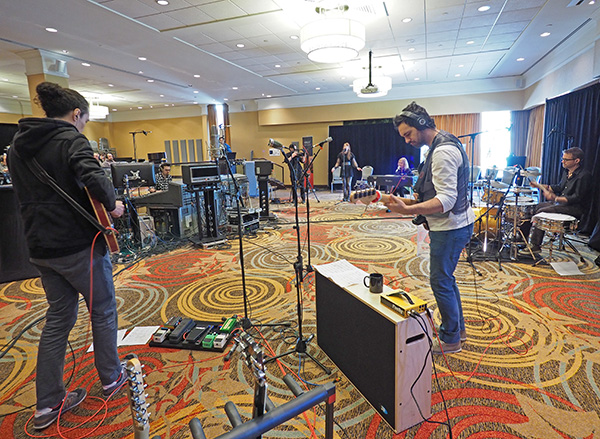
An event at SSI 2015 that, to the best of my knowledge, was unique for an audio show, involved the setup of an "on location" recording studio, and the making of actual recordings. No, not a "Garage Band" App, not a "home recording studio," but a real professional studio, involving some $300k's worth of equipment, and the services of professional recording engineers. The project, called La VibZ Studio, was initiated by Stephan Rich, musician and sound technician, and brought together for the SSI 2015 event vocalist/pianist Anne Bisson, the Give Band (featuring vocalist Caroline St-Louis and Stephan Ritch on the guitar), and Hans Wilwright. The attendees were provided with Sennheiser cordless headphones for listening to the playback.
 At the session I attended, the recording made was of the Give Band, with Anne Bisson on the keyboard. There were some initial setup glitches, but when these were sorted out, and they started playing, the atmosphere was, well, electric. It was loud, but somehow not too loud, just what the music required. What impressed me particularly was the fact that, despite the unfamiliar surroundings and the presence of observers, the performers seemed fully into the music. I guess that's what it means to be a professional.
 I had an unusual experience while taking the escalator down to the lower level, where most of the larger rooms were located. I heard what sounded like live music, featuring a jazz guitar. I knew that SSI 2015 had a number of live music events scheduled, and I assumed that this was one of them. I followed the sound to the open area behind the escalator—and was surprised to find that it was produced by speakers! The speaker company is called ClaeCast, which is also the name of the speaker, the only model from this company. It's a three-way design, with two woofers, two magnetic-planar midranges, and a ribbon tweeter. Heard at a closer listening distance, the speakers had a startling immediacy; this, combined with the acoustics of the space in which the speakers were placed, must have been responsible for the "live" impression. They were driven by tube electronics designed by Zdenko Zivkovic, well-known in Canadian audio circles, who also collaborated on the design of the speakers with Sam Rota.
Having just written this, I checked the Stereophile website, and saw Art Dudley's report on these speakers. Art wrote: "their loudspeakers . . . sounded snappy and believable—all the way from the downstairs entrance to the escalator!" What's the saying about great minds??
I had an unusual experience while taking the escalator down to the lower level, where most of the larger rooms were located. I heard what sounded like live music, featuring a jazz guitar. I knew that SSI 2015 had a number of live music events scheduled, and I assumed that this was one of them. I followed the sound to the open area behind the escalator—and was surprised to find that it was produced by speakers! The speaker company is called ClaeCast, which is also the name of the speaker, the only model from this company. It's a three-way design, with two woofers, two magnetic-planar midranges, and a ribbon tweeter. Heard at a closer listening distance, the speakers had a startling immediacy; this, combined with the acoustics of the space in which the speakers were placed, must have been responsible for the "live" impression. They were driven by tube electronics designed by Zdenko Zivkovic, well-known in Canadian audio circles, who also collaborated on the design of the speakers with Sam Rota.
Having just written this, I checked the Stereophile website, and saw Art Dudley's report on these speakers. Art wrote: "their loudspeakers . . . sounded snappy and believable—all the way from the downstairs entrance to the escalator!" What's the saying about great minds??
 Somewhere between DIY and finished loudspeakers are the ones from PureAudioProject, which they refer to being a Modular Open Baffle Design. The DIY aspect was made apparent to me when I asked about the price, and was told it depended on whether it was to include delivery. Different degrees of assembly are available; the finished Trio 15 TB demoed costing USD$3750/pair. The kit versions are said to involve "breeze-simple tool-less self assembly." The modular aspect comes into it by the availability of different midrange/tweeter modules. These are easy to swap, and allow you to get effectively a different speaker. For example, the module with Heil drivers costs USD$1200. They all use the open-baffle design, and the sound was suitably open and dynamic. The electronics were some highly-affordable ones, imported from China by Grant Audio.
 Turntables can be differentiated along a number of dimensions, but if what you're looking for is drop-dead-gorgeous looks, it's hard to beat the ones from Triangle Art. Just look at the picture: isn't this something that you would like to have in your listening/living room? This is the Triangle Art Signature, with Asiris tonearm (CAD$26,000). I'm sure it sounds good, too, but with appearance like this sound almost becomes secondary.
 SSI 2015 was rather short on the availability of LPs that attendees could buy; the best choice—and the lowest prices—were at Audio Sensibility, which also had a good selection of cables and other accessories at very reasonable prices.
 Those expecting to see only audio, and maybe video, equipment at SSI 2015 may have wondered what the model of the Montreal Olympic Stadium was doing in the area near the bottom of the escalator. Well, it turns out that a company named Delaney Technologies has a design for a retractable roof for the Montreal Olympic Stadium, and they're trying to persuade the municipal powers-that-be to go for this design. To this end, they had on display the model of the Stadium, complete with retractable roof, and they sponsored performances by Maison Corbeau, which I wrote about earlier. They also had on display a sound system designed for the Stadium, which is said to have been developed "by our team of physics and electronics scientists." There was no-one around that I could ask about this sound system, but, in any case, I have a feeling that it can play very loud.

At the session I attended, the recording made was of the Give Band, with Anne Bisson on the keyboard. There were some initial setup glitches, but when these were sorted out, and they started playing, the atmosphere was, well, electric. It was loud, but somehow not too loud, just what the music required. What impressed me particularly was the fact that, despite the unfamiliar surroundings and the presence of observers, the performers seemed fully into the music. I guess that's what it means to be a professional.
I had an unusual experience while taking the escalator down to the lower level, where most of the larger rooms were located. I heard what sounded like live music, featuring a jazz guitar. I knew that SSI 2015 had a number of live music events scheduled, and I assumed that this was one of them. I followed the sound to the open area behind the escalator—and was surprised to find that it was produced by speakers! The speaker company is called ClaeCast, which is also the name of the speaker, the only model from this company. It's a three-way design, with two woofers, two magnetic-planar midranges, and a ribbon tweeter. Heard at a closer listening distance, the speakers had a startling immediacy; this, combined with the acoustics of the space in which the speakers were placed, must have been responsible for the "live" impression. They were driven by tube electronics designed by Zdenko Zivkovic, well-known in Canadian audio circles, who also collaborated on the design of the speakers with Sam Rota.
Somewhere between DIY and finished loudspeakers are the ones from PureAudioProject, which they refer to being a Modular Open Baffle Design. The DIY aspect was made apparent to me when I asked about the price, and was told it depended on whether it was to include delivery. Different degrees of assembly are available; the finished Trio 15 TB demoed costing USD$3750/pair. The kit versions are said to involve "breeze-simple tool-less self assembly." The modular aspect comes into it by the availability of different midrange/tweeter modules. These are easy to swap, and allow you to get effectively a different speaker. For example, the module with Heil drivers costs USD$1200. They all use the open-baffle design, and the sound was suitably open and dynamic. The electronics were some highly-affordable ones, imported from China by Grant Audio.
Turntables can be differentiated along a number of dimensions, but if what you're looking for is drop-dead-gorgeous looks, it's hard to beat the ones from Triangle Art. Just look at the picture: isn't this something that you would like to have in your listening/living room? This is the Triangle Art Signature, with Asiris tonearm (CAD$26,000). I'm sure it sounds good, too, but with appearance like this sound almost becomes secondary.
SSI 2015 was rather short on the availability of LPs that attendees could buy; the best choice—and the lowest prices—were at Audio Sensibility, which also had a good selection of cables and other accessories at very reasonable prices.
Those expecting to see only audio, and maybe video, equipment at SSI 2015 may have wondered what the model of the Montreal Olympic Stadium was doing in the area near the bottom of the escalator. Well, it turns out that a company named Delaney Technologies has a design for a retractable roof for the Montreal Olympic Stadium, and they're trying to persuade the municipal powers-that-be to go for this design. To this end, they had on display the model of the Stadium, complete with retractable roof, and they sponsored performances by Maison Corbeau, which I wrote about earlier. They also had on display a sound system designed for the Stadium, which is said to have been developed "by our team of physics and electronics scientists." There was no-one around that I could ask about this sound system, but, in any case, I have a feeling that it can play very loud.















