"There are two kinds of music. Good music, and the other kind," Duke Ellington is famously supposed to have said. But that doesn't tell us how to recognize "good music," and it doesn't define good. Nor will this essay. Many have described the music of, say, Mozart or J.S. Bach with such phrases as the music of heaven or the mind of God or—especially Bach's music—that it embodies the basic structure of the universe/existence/reality. I've said such things myself. But if such analogies are to be made, I think they better suit Haydn. Any god I would think worthy of worship would not be pious, would have a strong sense of humor in addition to all of the other usual qualities of divinity, and Haydn's jokes and good humor are better and more dependable than Bach's (who had few) or Mozart's. But that is as much a prejudice as a preference; I'm sure you have your own.
I want to talk here of the difference between being deeply moved and being deeply delighted. Haydn engages my soul every time, but always the part of my soul that experiences delight—no dark brooding romantic passion, not even in the Sturm und Drang works. He sounds to me the ultimate Enlightenment composer. As I continue my third traversal of his 104-odd symphonies in the cycle recorded by Antal Doráti and the Philharmonia Hungarica, I consistently feel as I did when I stood in the rotunda of the Jefferson Memorial on a bright, brisk day in spring: musical thoughts wafting in and out like light and air moving through open colonnades of elegant form. Those architectures of marble and of sound strike me as ideal embodiments of and metaphors for the opened mind. Again, a purely personal response, but it is from Mozart's music that I often feel so oddly detached. In comparison to Haydn, Mozart's undeniable quality of awesome perfection seems self-regarding, even smug: a smooth, unmarred sphere, completely self-contained. It does not need me, and I find no way in to its cold, clear heart. I cannot gain a purchase on its polished surface, and so cannot move it, nor it move me.
But these days, I find that music almost never moves me in an emotionally deep or passionate way—not as it did in my teens or twenties or even my forties. For a long while, this ever-recovering romantic considered that a loss, but I no longer do. Now, regardless of the tone or ostensible "mood" of a piece I am listening to, my positive response, when I have one, is almost always one of delight: shallow, middling, deep, or profound, but always somewhere in the well of delight—even with so (apparently) anguished a work as the Adagio of Bruckner's Symphony 9. I just sit there and grin, marveling at how astonishing it is, that it makes the sense it does in the way it does—that it makes sense at all. I feel a fellow craftsman's joy in working his craft. I suspect that mine is a very simple soul.
In my freshman year in college, during my single semester as a Music History major in the fall of 1968, I often sat in my dorm room, listening through headphones to Mahler's Symphony 9 (Georg Solti's first recording, with the London Symphony), sometimes with score in hand. Once, as I listened to the final movement, I read D.T. Suzuki's classic An Introduction to Zen Buddhism, and realized that the music I was hearing embodied the state of mind Suzuki wrote of: awakenedness, satori, enlightenment, call it what you will. More than an intellectual realization, it was a genuine spiritual opening that I have never forgotten. A hole in reality seemed to have opened around me, and I fell into a vast, eternal now in which everything was perfect, precisely as it was, even as it eternally became something else. Others will have had similar experiences with other music, books, drugs, moments, but this was mine. At the time, a lot of this was going around. (A few months later, a friend insisted I listen to The Beatles (White Album). It was the first pop or rock album I had ever heard. For a long time after that, my listening life was very different from what it had been.)
It's one thing to have such a singular breakthrough experience, as I did at 17 with Suzuki and Mahler. It's another to want to repeat that experience over and over. It's actually not possible. It's like trying to open an already opened door, a doorway passed through long ago. Whatever it was that was broken through that first time can be broken through only once, and perhaps only at a certain time in life. After that, it can never again be as wholly new and unprecedented, even shocking, as it was that first time—and almost certainly it will not be triggered by what triggered it the first time. It's like the second beer of the evening: I never want a second beer; what I actually want is to repeat the experience of drinking that evening's first beer. But it's not possible: the first beer has already done its work.
Now, half a century later, when I listen again to Mahler's Ninth (still my favorite work of his, and the only one I ever want to hear again), after having heard it so many times, I come to it with ears and a sensibility of soul that have, to some degree, already been shaped or molded by Mahler's Ninth. The symphony has made in my psyche a complementary shape or impression of itself that is now permanently there to receive it, and into which it perfectly fits—because, to some degree, there it meets itself.
Perhaps this is easier to think about in terms of pop music. Throughout the late 1960s and into the '70s, many wondered who "the next Bob Dylan" or "the next Beatles" might turn out to be. After a while, this began to make as much sense to me as looking for lost keys only where the light is good. The very fact that those two pop cataclysms so profoundly affected everything and everyone who followed them was precisely what made it impossible for anyone ever to do it again, at least for a very long time. Those of us who hoped or wondered or wished for such breakthroughs to happen "again" posited a paradox: Living in a world, and having selves, shaped to considerable degrees by Dylan and the Beatles, we wondered what could grow from within those selves and that world that would utterly transcend them in some new and unexpected way. But nothing can. Breakthroughs of such magnitude will happen again—they always do—but by definition, they will never happen when or where, or in any form or genre, that they are expected to. That would be expected, even foreseeable, and such breakthroughs are, by definition, shockingly neither.
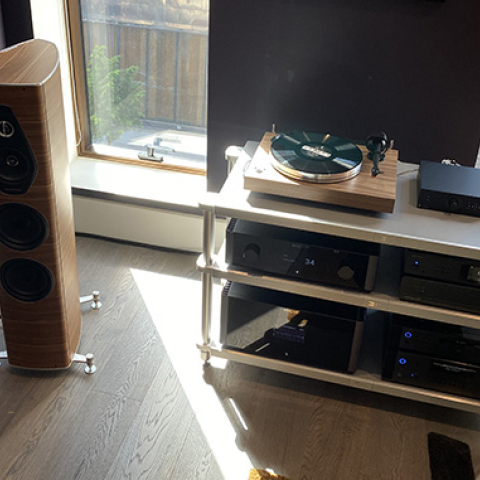
In audio as in music as in life: Do we spend ever more on audio gear, and on constant upgrades, in an attempt to re-enact a breakthrough first made while listening to a car radio or a primitive dorm-room system? If so, it's important to remember that it certainly wasn't the quality of the gear that made that breakthrough possible. It was something in the music, in ourselves, in the times. It couldn't have happened without the sound, and the quality of that sound was not important. I'm not saying that such breakthroughs can never happen again—they can. But none of us is now the same person he or she was then, and they won't happen because we're listening to better gear than we were last year. They'll happen because we've opened our hearts, and the heart cannot be forced open by the will. As Sergiù Celibidache said of conducting the music of Bruckner: "You don't do anything—you let it evolve." And when that is allowed to happen, it can make of life—and listening—a delight.—Richard Lehnert