

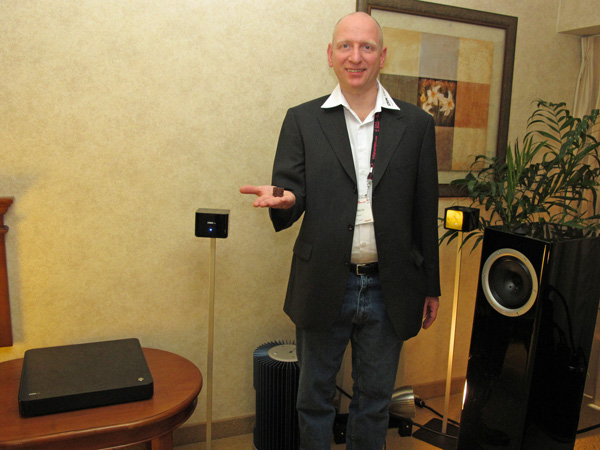
The Stein Music Harmonizers (approx. $1100 each; distributor Walter Swanborn of Fidelis AV is putting together package deals that include Stein’s Harmonizer accessories) are one of those mysterious sound-improving devices that are hard to explain to those who have not heard them. They certainly impressed Sam Tellig, who recently discussed them in his monthly Stereophile column.
They’ve also impressed me greatly. A set of four Stein Harmonizers has been residing in my reference system in Oakland for several months, bringing me much pleasure. To these ears, when set up correctly, they have a far from subtle effect on three-dimensionality, transparency, and realism. They take me one step closer to the real thing, making what comes out of my speakers sound less like hi-fi and more like music.
I was delighted to spend some time at T.H.E. Show with the Harmonizers’ designer, Holger Stein of Germany. Stein was showing the newest version of the Harmonizers, which were five years in the making.
The latest Harmonizers have a three-position switch on the rear. Those positions are (1) on with light, (2) on without light to preserve battery life for up to two years, and (3) off, to save energy when the system is not playing. Besides that, they function identically to their predecessor (which I have).
So how does the Stein Harmonizer work? Best to quote directly from Stein. Since, for him, English is a second language, I’ve given him an assist in the editing department.
”Some years ago, my wife used some rose quartz for decoration in our showroom. When we powered up the system, we had the impression that the sound had changed somewhat. It was not a big difference; it was something like moving a curtain into a somewhat different position. But it did make some change.
“We wondered what was causing this phenomenon. Then, while moving the quartz, we found it made a small change in the music. It was small, but detectable. So we asked ourselves how this can be.
“When examined closely, the atomic cores of rose quartz crystals have a very regular, ordered structure. Even the electrons around the atomic core are ordered. This uniform order is transferred to neighboring electrons, even affecting the structure of the air surround the crystals.
“Although there was not a huge difference, we wondered about the ultimate potential of these crystals to improve the quality of audio when used in an optimal manner. We thus spent years experimenting with the phenomenon, and invented complex techniques to improve and optimize audio performance. With these techniques, we were able to magnify the ‘normal’ effect of the quartz and ideally adopt it to what is needed for good audio.
“To get a slight impression of what the Harmonizers do, you can easily conduct your own experiments with rose quartz. In doing so, we believe you will hear its ability to make a subtle difference.
“The result of our experiments is a system that consists of two different types of
active components called Harmonizers (A and B) and some passive Magic
Diamonds and Magic Stones that magnify their effects.”
Also in the room, and pictured on the table on Stein’s right, was the Stein DE3 LP enhancer ($2800). The unit is said to radiate a special signal sequence that improves the sound of LPs. There’s also the DE2 unit for CDs ($698).
Stein has also developed equipment supports called Super Natural footers ($198/set of three). In the photo, one is resting in the palm of his hand. A set of three can support 200 kg, or more than 400 lbs.
Internally, the Super Natural footers contain three ceramic elements that provide fast resonance transfer. Their exterior is made of walnut to fine-tune components’ sound. Holes in the walnut on the sides and top also help control resonance. Finally, between the internal three ceramic elements and the walnut exterior is a vacuum-impregnated lacquered felt.















