

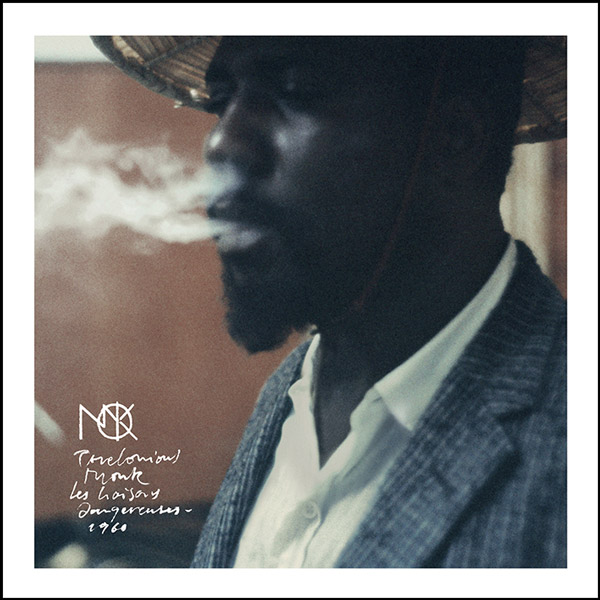
Et tu, Thelonious? We've come to expect new discoveries from the vaults, annually or more often, by Miles Davis, Charlie Parker, Bill Evans, and Sonny Rollins. But who knew there were hidden gems by the gnomic Monk—and from a professionally recorded studio session, no less!
In 1959, Monk was commissioned to compose and play the score for a Roger Vadim film, Les Liaisons Dangereuses. By the time of the recording date (at Nola Penthouse Studio in New York), he hadn't written anything new (it was a particularly hard time for Monk, as an essay in the album's extensive booklet describes). But after watching a print of the movie, he took several tunes from his catalog—"Rhythm-a-ning," "Crepuscule with Nellie," "Well You Needn't," "Pannonica," "Ba-Lue Bolivar Ba-Lues-Are," "Light Blue," and "By and By"—and set them to breezier paces or moodier cadences than usual.
This session has never been released to the public before; the tapes were thought lost for all these decades. Usually, when recovered sessions are heralded as "long lost," a quick listening reveals why. But the result in this case is a surprisingly terrific Monk album.
Monk isn't at his most technically dexterous (again, he was in an anguished state), but there's a fleet energy and a playful dissonance to his piano work that stirs its own brew of pleasure. And his band—Charlie Rouse and Barney Wilson on tenor saxophones, Sam Jones on bass, and Art Taylor on drums—is in top form. As a bonus, the final track, which lets us eavesdrop on Monk instructing Taylor how to play the drum part on "Light Blue," is a precious illustration of just how difficult Monk's music is—and how wondrous were (and are) the bands that can make it go.
The album, simply called Les Liaisons Dangereuses 1960, was released as a 3-LP box by Sam Records, mastered from the original analog tapes, and a 2-CD set by Saga. And both sound excellent.
Which version to buy? Well, you may have no choice: the LPs, which were put out for Record Day a few months ago, are pretty much sold out (though they're available for euros from Sam's website). Either way (and this may come as a shock), I prefer the CDs. The LPs are more spacious and airy, with warmer horns and a woodier bass. But the CDs sport more percussive and sparkly piano and drums. (I don't know why this should be so.) For many musicians, I'd go with the LP's strengths; but for Monk, I'd go for the percussiveness.
If you don't have Monk's albums from the 1950s on Riverside, or the ones from the 1960s on Columbia, get those first. And a tip on the Columbias: if you can't find 1st-pressing LPs, get Sony's 2003 CD reissues, remastered by Mark Wilder, as they not only include alternate takes but also restore the original versions of the tracks, which producer Teo Macero had cut, sometimes mangled, in the released versions, often slashing or eliminating Charlie Rouser's solos. (The underrated Underground is a particularly egregious example of Macero's butchering—and a particularly revelatory example of Wilder's restoring.) On some of the later albums, including Underground, Wilder's digital remastering sounds better than the originals too.
But if you're already well versed in matters Monk, Les Liaisons Dangereuses 1960 is well worth having. It's not the typical excavation from the closet. It's a work of art on its own.















