You know how it is when you hear a strange new word for the first time, and then, all of a sudden, you start hearing that strange new word everywhere? Where had that word been for the previous twenty-eight years of your life and why is it surrounding you now?
Truth is, that word had always been around, just waiting for you to discover it. Words are patient, and you just weren't ready for it until now. Timing is so very important, yes indeed. With that in mind, I suggest you start watching out for
hemidemisemiquavers. They're everywhere, I tell you.
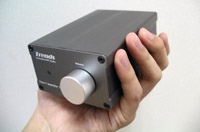
This weird trend works with audio components, too. Lately, ever since I mentioned my interest in putting together The Magnificent $1000 System, I keep running into one particular amplifier: The Trends, in fact, TA-10.
It's a hundred and forty-nine dollars and fits in the palm of your hand. Use it in a sentence three times, and it's practically yours for life.
The TA-10 uses Tripath's class-T Digital Power Processing technology. What does that mean? To tell you the truth, as I oft am wont, I know very little about class, especially as it pertains to amplifiers. Class-T is, if I've got this right, Tripath's class-D implementation. Ah, but such talk is meant to both confuse and illuminate. It's marketing. And marketing freaks us out. So what's it really all about?
D does not necessarily stand for digital. D might, however, stand for different. Class-D amps are efficient, that I know for sure. I mean, I've learned that class-D amps waste very little energy and run relatively cool. We like that. Wasting energy is stupid and bad, and giving off lots of heat can cause problems.
Unfortunately, the sound of class-D amplifiers has also often been described as cool. Too cool. Sam Tellig likes to joke that some class-D amps leave him feeling ICE cold. Tripath's Class-T technology, however, is said to offer class-D's efficiency, while providing a warm, clean sound. The Trends TA-10, like the popular
Sonic Impact Super T, uses Tripath's TA2024 chip.
A chip? Now I'm talking about a chip. My exploration of this topic, I'm giving myself the feeling, is not going in the proper sequence. The classification of amplifiers has something to do with the input signal and something to do with switching. Switching what? The more I think about it, the more questions I create. Can somebody help me out here? I'm sure John Atkinson can explain it to me tomorrow when he walks into my office and stands there, looking at me.
"I'm standing here," he'll eventually explain, "because my office is filled with work."
I'll smile and say, "Oh yeah, I know I should know this by now, but what the hell are you talking about when you say an amplifier is class-A or -B or -C or -D?"
"Hemidemisemiquavers," he'll say.
"What?"
Trends Audio has both a mission and a vision(s). The Mission:
Integrating new technologies with traditional wisdom and our innovative ideas to bring audiophiles and music lovers the outstanding Hi-Fi gears in affordable prices.
The Vision(s):
In the Hi-Fi field, some may like to play new technologies such as SACD, DVD-Audio, Blue-ray DVD, Home Theatre PC (HTPC), Class-D or Class-T amplifiers, etc. On the other side, some may like to play valve amplifiers, Class-A amplifiers and LP turntable. The worst is that it creates many unnecessary arguing between both sides in the cyberspace and other areas frequently.
We would like to breakdown the wall between the new technologies and traditional wisdom and integrating them to provide good Hi-Fi gear in affordable prices, of course, without the compromise of the sound quality. No matter what kind of technology, the one which can provide good sound in an optimized cost would be included in our consideration list.
Moreover, we hope our affordable Hi-Fi gears can attract more youngsters to join into the Hi-Fi field. Let more people be able to enjoy Hi-Fi quality gears and widen their music listening scopes.
Alright, so the language is a little screwy. So what? Our language is a little screwy, too. Hemidemisemiquaver? But I'll tell you this: I know all about that unnecessary arguing between both sides in the cyberspace and other areas frequently. And it really fricking sucks. It's an enormous waste of energy and gets me all hot under the collar. If Trends is against that, then I'm with Trends. And if Trends wants to attract more youngsters to join into the Hi-Fi field, then, again, I'm with Trends.
The Trends TA-10, at $149 and with such an honorable mission and vision, is, it seems to me, well worth looking into. Let more people be able to enjoy Hi-Fi quality gears and widen their music listening scopes!
Right on.