

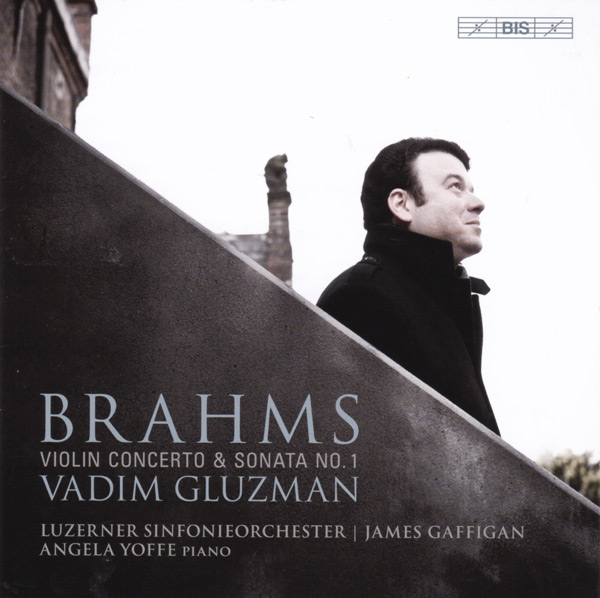
How many times can one write "beautiful" before the word loses all meaning? And yet, what else can I say when Brahms' sole violin concerto, as well as his first Violin Sonata, are so profoundly touching, and played so exquisitely by violinist Vadim Gluzman, the Lucerne Symphony Orchestra under James Gaffigan, and pianist Angela Yoffe?
Although Vadim Gluzman has yet to receive the same attention as some of his contemporaries, in no small part due to his embrace of a long-term contract with the BIS hi-rez record label rather than Universal Classics, Sony, or Warner, his schedule for the year shows him performing with a number of the great orchestras, and in the great halls. (In the USA, those orchestras include the Boston and San Francisco Symphony Orchestras.) Distinguished by the company he keeps, Gluzman's season includes trio recitals with two exceptional partners—pianist Yevgeny Sudbin (piano) and cellist Johannes Moser—as well as duos with his wife, Yoffe. But even if he was performing with second rate artists in provincial venues, a listen to Gluzman's most recent release of the music of Johannes Brahms shows him as a rightful member of that line of great Russian violinists which, on record, includes the very different Heifetz, Milstein, Stern, Kogan, and, of course, Oistrakh.
First, there is Gluzman's tone. Far less dark and shrouded than some lower in the range, it rises to sweet, silvery, but nonetheless full-bodied highs that sing in a clear, heart-touching manner. The distinct color of Gluzman's highs contrasts with the octaves below them, and is distinguished by a purity that speaks of an unfailing single-minded devotion to art. Captured in 24/96, and auditioned by me in stereo SACD format, they never sound sweet for sweetness's sake—the excellent Joshua Bell comes to mind here—but rather because they so completely convey what Brahms's writing wishes to express.
When, in the Violin Concerto's final movement, Brahms calls for his soloist to bite into and even slash through notes, Gluzman responds in kind. But when he is allowed to sing and soar lyrically, as the concerto's consummately beautiful middle movement Adagio invites him to do, he is an equal master. Few violinists sound as heartfelt in this extended sigh.
This is not to say that tempi in the concerto's first movement could not do with more lyrical indulgence. As I listen to Sir Neville Marriner conduct Hilary Hahn with the Academy of St. Martin in the Fields, and admire the way the two slowed down as she rose to the heights of the first theme, I wish that Gluzman and Gaffigan had done the same. There are, in fact, a number of places in this movement where I wish for more flexibility of tempo. Nonetheless, when I listen to Gluzman, I smile at how he opens his vibrato in wide embrace. That embrace only deepens in the final two movements, which strike me as perfect.
Brahms composed his Violin Sonata No.1 in 1878–1879, completing it right around the time that he invited the famed violinist, Joseph Joachim, to visit him on Lake Wörthersee in southern Austria so they could put finishing, pre-publication touches on the Concerto. The sonata's opening theme is incomparably lovely, and hard to get out of one's head. Its third movement derives from Brahms's song, "Regenlied" (Rain Song). Brahms wrote the song for pianist Clara Schumann (who was Robert Schumann's wife, and the woman Brahms was in love with) in 1873 after her violinist son, Felix—Brahms's godson—was diagnosed with incurable TB. While there is some darkness here, it is balanced by ample light and love.
The recording ends with a little dessert—the 5 or so minute scherzo from the F-A-E Sonata that Brahms, Schumann, and Albert Dietrich wrote for Joachim in 1853. After two minutes of animation, the scherzo once again dips into that shared heart from which so much of Brahms's music sings.
I've been wanting to review multiple Brahms recordings since beginning my stint as an online classical recording reviewer for Stereophile. Far too many have passed me by. More Brahms is coming soon, I promise. Until then, I hope you can find a way to hear this recording, preferably on a system that allows you to appreciate what Gluzman sounds like. At the risk of saying it again, his playing, and this music, are so, so beautiful.















