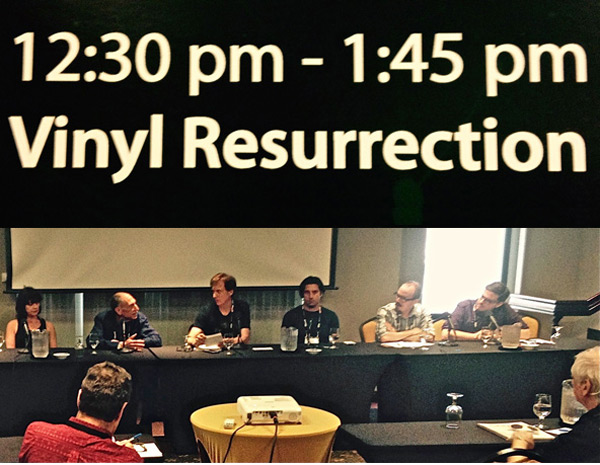
Left to right at the "Vinyl Resurrection" seminar: Nina Palmer (Ross Ellis Printing), Steve Sheldon (Rainbo Records), Michael Kurtz (Record Store Day), Bryan Burkert (The Sound Garden), Matthew Johnson (Fat Possum Records), and Mark Piro (Spark/Razor & Tie).
The New Music Seminar 2015 was a three-day (June 21,22, and 23) conference held in New York that invited music industry insiders to dialog on the current state and potential future of the music delivery business.
Right away I knew I wasn't at CES. The people here in the lobby of the Wyndham New Yorker Hotel were mostly young, thin, and fashionably dressed. More than half of them were female and everybody looked like pop stars or hipsters. Tom Silverman (Seminar Director and CEO Tommy Boy Entertainment) was wearing all black with a crimson shirt and a pork pie hat. I knew for sure I wasn't in Vegas when I picked up my press credentials and they introduced me to my own extremely attractive "personal guide" saying that "Kim" would escort me to any of the dozens of seminars and intensives being held that day. (Kim smiled and mentioned she would be happy to introduce me to Denis Leary when they presented the first three episodes of "Sex & Drugs & Rock & Roll" at 6pm.)
In his opening remarks, Tom Silverman painted a surprisingly sunny picture of the present and future of the "music sales business"—this, despite his own (inflation-adjusted) graph showing industry revenues at a lower point than they had been since 1966. I didn't hear much music at the New Music Seminar but I did hear a lot of spin doctor types interpreting avalanches of Power Point graphs and market research statistics in a way that made all the $300/head attendees feel like they were back in school learning something important. This was fascinating—so fascinating, that it was hard to decide where to be at any given time. I am certain anybody who attended even one or two seminars could not help but walk away with a clearer picture and better understanding of where the music industry has been, where it is now, and what the realistic prospects for the future might be. I know I did!
But guess what jumped out of the New Music Seminar schedule of events for this cub reporter? The "Vinyl Resurrection" seminar. While it doesn't look like CD sales will be rising anytime soon, it is surprising and true that
new vinyl sales have increased 50% during each of the last four years! All of the world's 200+ vinyl presses are currently working 24/7 and, according to panel member Steve Sheldon of Rainbo Records, "It would take at least new 50 vinyl presses pounding away 24/7 to catch up and meet the current demand."
Nina Palmer (National Sales Director, Ross Ellis Printing) explained, it is not just the demand for new "vinyls" which has caught everybody in the industry unprepared, it is the demand for premium packaging, too. She explained that a large part of the LP resurrection is fueled by the perceived value, physical beauty, and collectability of the packaging. She says the majority of new discs (black
and silver) are being sold with elaborate "Black Moses"-type fold-out jackets with high-quality printing. She pulled out a double gold-vinyl record in a blinding gold quadruple gatefold sleeve that shot beams of golden light across the room. Despairingly, Steve Sheldon chimed in, "And now
everybody wants colored vinyl—which takes longer and costs more to press!"
Panel conductor, Michael Kurtz (Founder, Record Store Day) explained that suddenly, 15% of all "hard" music sales are in the form of vinyl and that the demographic for these sales was not aging baby boomers. He said it was mostly people born during the digital age. Bryan Burkert (Owner, The Sound Garden record stores) smiled and explained, "Most of my vinyl customers are young, well-educated women." He explained that they were treating these beautifully packaged items not only as sources of listening pleasure but as cult status trophy items that are even better when purchased, signed by the artist, on their first day of release. He explained that when a group brings out the LP days or weeks later than the CD or download, "Total recording sales are usually lower." Clearly, vinyl was attracting music buyers' attention.
The Sound Garden owner also explained the absolute importance of selling these customers quality entry-level record playing systems. He said all of his stores feature Audio-Technica turntables and Audioengine powered speakers as $300 packages for vinyl newbies. Bryan stressed the importance of playback quality as the main factor in repeat vinyl sales. "We must keep these customers asking for more and better." He emphasized that: audiophile magazines and websites needed to guide the neophyte up the quality playback ladder. "We must not let Crosley kill the vinyl movement!"
I should point out now, that in an earlier intensive entitled, "Music Value" I heard Frank Luby (Present Tense) say that the value (in $$) of any music lies in, ". . . the method of delivery!" Luby said that free downloads hold "no real value" and suggested they are perceived as a property of "no worth" and that in today's music market, delivery systems like YouTube or Spotify hold no genuine "pricing power." Tom Silverman (who attended every seminar) added, "People are starting to see that they have to have a
subscription—it's becoming cool to have a music subscription and there's almost a status that comes with it now—it was an outlier until now."
In harmony, every member of the Vinyl Resurrection panel agreed; the beauty of this vinyl resurgence is that these new hand-crafted black disc releases possess
maximum pricing power. Mark Piro (Musical Curator/Head of Analog, Spark/Razor & Tie) mentioned
Chad Kassem and Acoustic Sounds, and joked, "This new vinyl market represents the first time music delivery products are
quality- rather than price-driven." He said the pricing power of vinyl was currently "unlimited." What Mark and Bryan Burkert also emphasized was that the retail side of the vinyl resurgence is being fueled by the "curatorial" aspect of bricks and mortar stores. People go to retail venues like Other Music or Sound Garden to find out what is hot. The main appeal of stores like these is: you know in advance that what you are seeing and buying is, pre-sorted, and musically hip & cool—just like you!