

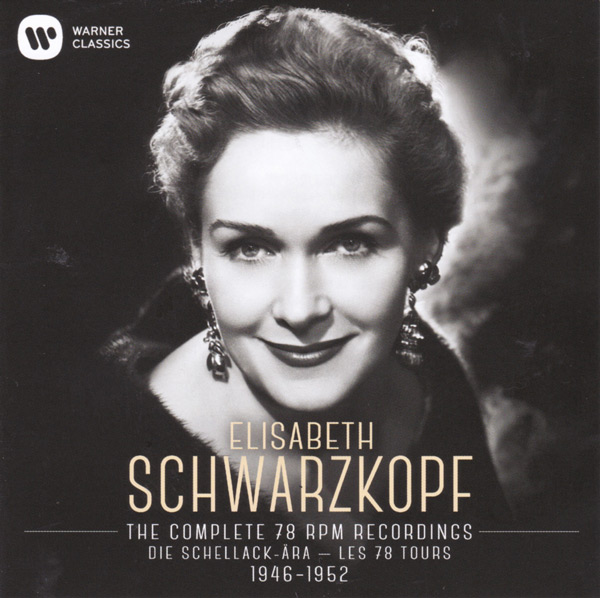
Warner's 5-CD box set, Elisabeth Schwarzkopf: The Complete 78 rpm Recordings 1946–1952 is a vocal lover's dream. Filled with recordings made when the soprano was between 30 and 37 years of age—she was born December 9, 1915—this bargain bonanza confirms that Schwarzkopf's oft-brilliant, sometimes outré interpretations of art song and opera were an essential part of her artistic personality from the get-go.
The brilliance of Schwarzkopf' instrument, and the magic of her sweet head tones, was already in place when the first of these recordings was made. In fact, listening to these new masterings, made by Andrew Walter at Abbey Road Studios, reveals that while the very top of Schwarzkopf's voice was more controlled and easily produced early on—savor the ease with which she voices the highs in Morley's "It was a lover and his lass" (1946)—her interpretive mastery only increased as her first bloom diminished.
The set is almost what it claims to be. While it contains all the commercial titles that the soprano recorded for EMI and its Columbia label between 1946 and 1952, it omits a goodly number of alternate takes and sides that she withheld from publication during those years. The advantage of its duplications with the same tracks in the more comprehensive 2-CD Testament set, Elisabeth Schwarzkopf: The Unpublished EMI Recordings 1946–1952, lies in Walter's superior masterings.
Which is not to say that the sound on many of these titles is great. Either the mono masters have deteriorated, or the sonics were sub-par to begin with. Variations between the sound of recordings made days apart are noticeable. Nonetheless, despite a bit of ringing around the voice, Walter's transfers do a better job of allowing the voice to rise out of the "groove" than other masterings I've heard.
Pros and Cons
Controversy over Schwarzkopf's oeuvre extends far beyond her wartime Nazi affiliations. Rarely content to sing a song "straight," she is the mistress of mannerism. Often her interpretations work, as when she brings honeyed smoothness and warmth to the andante in Mozart's early Exsultate, jubilate (Exult, rejoice, 1946), and to his song (lied), "Abendemfindung," (Evening feelings, 1952). Both recordings show why many of her Mozart interpretations reigned supreme during the 1950s and 1960s. Her styling and pacing may clash with what period practice scholarship now suggests as appropriate, but the legato, control and beauty are beyond reproach. Schwarzkopf re-recorded "Abendemfindung," again with Gerald Moore, two years later, stretching it out even further to allow for more relaxed breaths. She recorded it yet again with Walter Gieseking. The latter version is more "authentic" in its pacing but, to these ears, less emotionally expressive.
Diametrically opposed to such restraint is Schwarzkopf's famed, unbridled rendition of Bach's solo cantata, Jauctzet Gott in allen Landen, BWV51 (Praise God in all the land, 1948), whose opening aria sounds as if the entire German army is advancing on God's kingdom. Totally unhinged are her infamous "Gsätszli," (1951), which has inspired many a drag queen's wicked imitation; her incomparable Wolf "Mausfallensprüchlein" (A little mousetrap epigram,1952), in which she becomes the most possessed rodent on Planet Earth; and her intentionally, if easily summoned forth, hysterical Donna Elvira in Mozart's Don Giovanni, here represented by an early "In quali eccessi . . . Mi tradi quell'alma ingrata" (In what excesses . . . That ungrateful soul betrayed me, 1947), conducted by Krips.
As we listen to these recordings, and ponder the nature of the woman behind them, it helps to keep in mind that very early in her career, Schwarzkopf was occasionally forced to sing under the pseudonym of Maria Helfer. This was her punishment for having intentionally damaged some props after she was ordered to sing the small part of Ida rather than the lead of Adele in an October 1941 run of Fledermaus in Berlin. Under Schwarzkopf's beautiful countenance bubbled a fair share of anger, rage, and control freak desire, which surfaced in various ways in some of her interpretations, as well as in her teacher-pupil relations.
Some of the incontrovertible misses in the set confirm why Schwarzkopf quickly specialized in German song (lieder) and carefully chosen, "ideal fit" roles in operetta and the operas of Mozart and Strauss. To provide but one example of what she was wise to leave behind, her very slow rendition of Charpentier's sensual paean to love, "Depuis le jour" (Since the day, 1950), from the opera Louise, is positively weird, the energy and French pronunciation all wrong. You may be brave enough to fantasize what her Louise's night of lovemaking was like, but I'm not ready to go there. The mastering, too, is less than perfect, with suggestions of too many edits.
There is also a "Presentation of the Rose" duet from Strauss' Der Rosenkavalier (1947), conducted by Herbert von Karajan, in which Irmgard Seefried's direct, uncomplicated Octavian stands in sharp relief to Schwarzkopf's arch Sophie. One listen, and you will understand why she was far better suited to sing the Marchallin. But when Schwarzkopf's controlled hysteria hits the mark, as in an astounding rendition of Schubert's "Gretchen am Spinnrade" (Gretchen at the Spinning Wheel, 1948) that is even more desperate (and, at its ending, overdone) than her better-judged rendition with Edwin Fischer (1952), or when she throws even more voice at Strauss' "Hat gesagt bleibt's nicht dabei" (He has said, but it won't stop at that, 1951) than in her later, less operatically concluded version, one can only marvel at her magnificence.
A distinct highlight of the set are the 14 songs by Nikolai Medtner that recorded in 1950, with a 70-year old Medtner at the piano. Schwarzkopf may not have known the songs before the recording session, but the fact that the composer was at the piano, just a year before his death, makes these essential listening.
For those wishing to understand more about the art of song, contrast Schwarzkopf's superbly vocalized but unquestionably over the top "Schlechtes Wetter" (Lousy weather, 1951), as well as her "Where the bee sucks" (1947), with the infinitely more charming albeit vocally imperfect renditions by Elisabeth Schumann. The comparison throws into sharp relief the difference between art and artifice. Nonetheless, as these five CDs demonstrate, Schwarzkopf in her early years could provide both, and in oft-stunning voice.
Don't throw out your CD player just yet. Elisabeth Schwarzkopf: The Complete 78 rpm Recordings 1946–1952, especially at its bargain price of just over $13, is a must have.
Controversy over Schwarzkopf's oeuvre extends far beyond her wartime Nazi affiliations. Rarely content to sing a song "straight," she is the mistress of mannerism. Often her interpretations work, as when she brings honeyed smoothness and warmth to the andante in Mozart's early Exsultate, jubilate (Exult, rejoice, 1946), and to his song (lied), "Abendemfindung," (Evening feelings, 1952). Both recordings show why many of her Mozart interpretations reigned supreme during the 1950s and 1960s. Her styling and pacing may clash with what period practice scholarship now suggests as appropriate, but the legato, control and beauty are beyond reproach. Schwarzkopf re-recorded "Abendemfindung," again with Gerald Moore, two years later, stretching it out even further to allow for more relaxed breaths. She recorded it yet again with Walter Gieseking. The latter version is more "authentic" in its pacing but, to these ears, less emotionally expressive.















