

Photo: Jim Austin
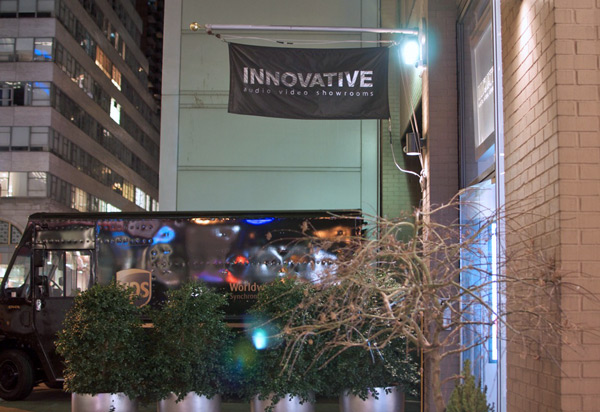
"'Happy' is our primary product," Elliot Fishkin, the proprietor of Innovative Audio, which is entering its 45th year of business, told visitors early Thursday evening, January 21. "We want you to be able to be connected to the music in profound ways." A small crowd was gathered in the lobby outside Innovative's newly renovated showrooms, in an expansive underground space on the east side of Manhattan, to hear amplifiers by VTL, cables by Transparent, and loudspeakers by Wilson Audio.
The evening's guests included Luke and Bea Manley of VTL, Transparent's Josh Clark, and a dozen or so music lovers ranging from young to not so young. One of them was Bernard Flom, who, 14 years ago, fell off the roof of his house and broke, he told the crowd, "almost every bone in my body. I spent 6 weeks in the hospital for multiple surgeries. The only thing that saved me was listening to music."

Photo: Jim Austin
After some introductory remarks by Fishkin (above), Luke Manley (below), Clark, and Scott Haggart, the store manager, visitors were invited to enjoy stereo systems at four price points, all featuring VTL amplification and all but one with Wilson Audio speakers, from the new Sabrinas through the formidable (655 lbs each) Alexandria XLFs.
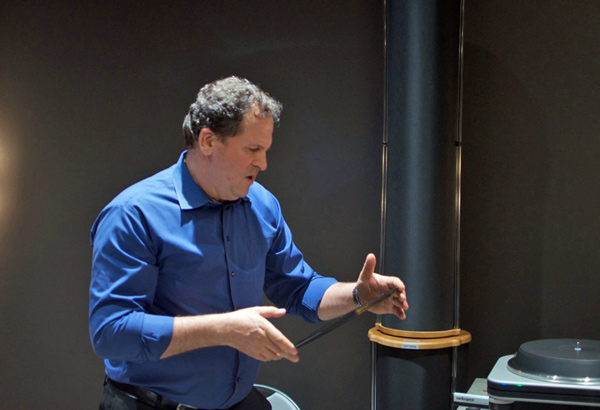
Photo: Jim Austin
First up for me was the "budget" system in Room 2—"budget" here is a relative term—with VTL's "Performance" series including their new TL-2.5i preamp ($3000 linestage-only) and ST-150 stereo amplifier. The source was a Linn LP12 turntable, cabling was Transparent's latest generation ("GEN5") MusicWave speaker cables, MusicLink interconnects, and PowerLink power cords, and the loudspeakers were Spendor D7s. Haggart started things off with a personal favorite, "Ritual Love Songs," by Jim Bartow, the musician, poet, and Harlem Renaissance historian who died in 2015. Bartow sang Duke Ellington's "Solitude." Soon, VTL's Bea Lam (below) arrived in the room bearing Record One from Lost on the River: The New Basement Tapes, with new music composed by current musicians to lyrics by Bob Dylan; Record Two of the 2-LP set was with Luke Manley in a different room. On the track Bea played, Rhiannon Giddens sang "Spanish Mary;" Why don't I own this?

Photo: Jim Austin
Apart from the music, the most interesting thing in Room 2 was, to me, the preamp—and in particular the optional, internal phono stage, which adds $2000 to the price and includes both an active MC section and a step-up transformer, allowing for optimal MC-cartridge matching. The phono stage can be retrofitted, not only to the 2.5i (which is just starting to ship) but also to the previous generation 2.5 preamp. By the end of the evening, that's just what attendee Erik Martin (below) was planning to do. For those seeking an affordable VTL stand-alone phono stage, it's coming soon.

Photo: Jim Austin
The next step up the price-and-quality ladder was in Room 5, but Transparent's Clark, an old acquaintance and former neighbor, was in the middle of a cable demo there, so I went straight to Room 4, which featured VTL's 6.5 Series II Signature preamp, VTL MB-450 Signature Series III monoblocks, and Wilson Alexia speakers. The source was a Meridian 813.3 DAC, and cabling was Transparent XL GEN5. This room gave me my first opportunity to hear MQA ("Master Quality Authenticated," the new technology from Bob Stuart of Meridian), via several classical works recorded by Wilson's Peter McGrath. These tracks sounded great, but I was unfamiliar with the recordings and the equipment, and there was no comparison with non-MQA files, so I'll have to suspend judgment on MQA.
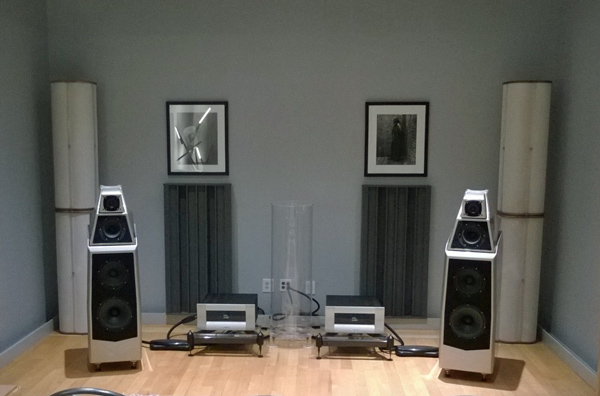
Photo: Luke Manley
The evening's highlight was, naturally enough, the reference system: VTL's TL-7.5 Series III Reference pre-amp and the company's S-400 Reference stereo amplifier driving Wilson Alexandria XLF loudspeakers. (Michael Fremer gets to listen to these speakers every day? Unfair!) Sources were both analog (Spiral Groove SG1.2 turntable and Centroid tonearm; Lyra Etna cartridge; VTL TP-6.5 Signature phono stage with MC step-up transformer) and digital (MSB Diamond V DAC; Meridian Sooloos zone player). I spent a lot of time in this room and heard a lot of good music, including a new discovery: Céline McLorin Salvant, the classically trained American jazz singer who won the first Thelonious Monk competition in 2010. Salvant was there in the room singing "Easy to Love" from her debut album; I intend to go find it as soon as we're dug out from this blizzard.
The reference system was stupendous with orchestral music, including, especially, a 24/96 PCM file of the first movement of Shostakovich 5 with the London Symphony Orchestra (on the LSO label). This is an unusual recording in that the conductor, Mstislav Rostropovich, set out to demonstrate that this symphony really isn't very good—that it is nothing more than "a Soviet artist's banal reply to dumb criticism." Rostropovich failed to make his case, in my opinion, but never mind that: The sound was stunning, with a colorful, nearly full-size orchestra arrayed left to right and on risers front to back. It was like having an elevated front-row orchestra seat but with no perfume or cell phones and better top-to-bottom balance than you'd get in a front-row seat. An ORG (originally Decca) reissue LP of Mendelssohn's "Scotch" Symphony, with Peter Maag conducting a much earlier version of the LSO, made an interesting contrast with the Shostakovich; it sounded similarly huge but much vaguer, with less precise imaging and far less natural texture.
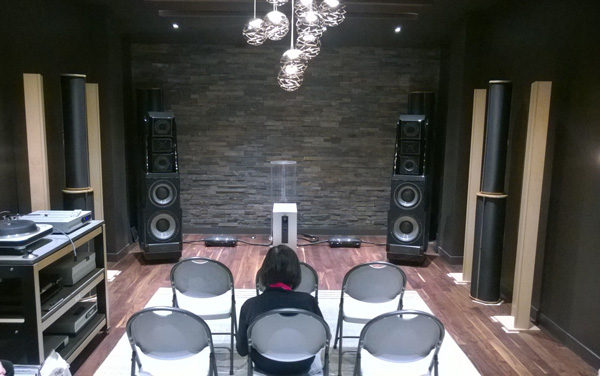
Photo: Luke Manley
It's hardly surprising that a system with 650 lb speakers and a 400W, 200 lb tube amp can do orchestras well, but this system was also capable of great delicacy—with Salvant's lovely, flexible, multi-octave voice, Rostropovich's solo cello (in an excerpt of the Bach suites), and in several short piano pieces and excerpts. This was probably the best-recorded piano sound I've ever heard. A dream system.

Photo: Innovative Audio















