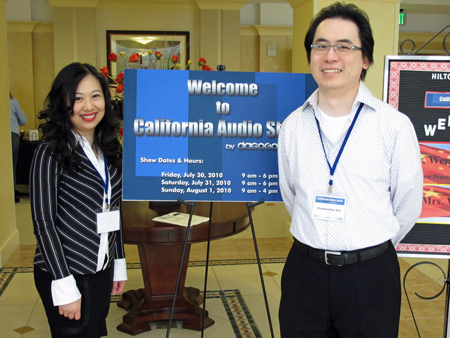
Constantine and Ann Soo deserve a huge thank you from the audiophile community. Responding to pleas from insistent dealers and distributors, who lamented the absence of an audiophile show from the San Francisco Bay Area, Constantine and dagogo.com took a huge risk.
In a little over four months, Constantine secured the relatively small-scaled Hilton Garden Court in Emeryville, and booked at least 34 exhibit rooms displaying well over 100 brands. He spent a bundle on advertising, getting major boosts from ads on stereophile.com, jazz station KCSM-FM, and also from our show preview. He also charged very little for admission—$15 for a three-day pass, discounted to $10 if purchased in advance—and offered free admission to members of the
Bay Area Audiophile Society.
No one knew what would happen. Lo and behold, judging from the coupons filled out for the daily Wadia iTransport 170 give-away, at least 500 attendees showed up on Friday, July 31, and a whopping 1010 on Saturday. Sunday's turnout was slower, as it always is at audio shows, but still impressive. The local dealers who sat this one out are probably kicking themselves.
Clearly Bay Area audiophiles, who have seen a decline in traditional storefront dealerships balanced in part by a host of newer in-home dealers, have been hungering for a chance to meet manufacturers and hear audio equipment in one easily accessible location. The California Audio Show may not have been ideally located for the carless, but it was perfect for those with wheels. And wheel them in it did.
The energy was very good in rooms and hallways. People were mostly quiet and respectful. Many brought along music on one medium or another, as well as an extensive knowledge of what they were listening for. Especially gratifying were the number of under-30 and under-40 visitors. Equally uplifting was the presence of women, either escorted by partners or flying solo. While older white men predominated, there was strong indication that the high-end is not destined for imminent oblivion. Especially not in the Bay Area, where so many Asian youth, educated by parents savvy in both music and technology, are thirsting for good sound, and so many venues offer top quality live music of all genres.
Not everything was perfect. Standard rooms were very small, with noisy air conditioning. Without it, things got very stuffy. Due to geometry and the materials used for the hotel's construction, bass problems were ubiquitous. The parking lot maxed out on Saturday, with parking costing $9/day. And one of the hotel's three elevators was out of commission.
I have received definite confirmation that the electrical problems I suspected were real. While PC readouts showed 115V, a number of us wondered why the sound was darker on the final day.
Several rooms reported brief power blackouts and brown outs. When you have tube equipment that requires an hour to warm up, and some solid-state gear that takes days, cutting the electricity for even a minute can greatly affect sound. As for running tube equipment at 110V rather than 117–120V, which happened to me in our East Oakland home until I made demands on my utility company, I know how low voltage sucks the life out of sound.
Here are some revealing report-backs from local dealers and distributors on this issue:
"The voltage was sagging big time, I suspect due to the fact the hotel was not quite prepared for the barrage of current draw from all the audio gear. Although we had good sound, I felt there was considerably less definition and air than when we had set up the same system in my shop set up in an almost identically-sized room."
"We noticed the sound to change during the course of the exhibits. Specifically, my phono section sounded thin and harsh at times, then returned to its full force without any change to the settings."
"I had problems with power outage in my room and figured out that always three rooms are connected to one 20A circuit breaker. If two exhibition rooms are on the same circuit and the exhibitor's wife turns on the hair dryer in the sleeping room in between,
bammm."
And, the most informative and telling:
"I dropped by the hotel a week early and asked if I could get into one of the rooms for a few minutes. I walked in said a few words and knew it was going to take everything I had to make one of those rooms listenable.
"There was a wicked slap-echo in both the upper frequencies and the lower midrange. Also, once I got sound going on Thursday morning, it became painfully clear that there was an awful bloat at about 80Hz, with a virtual null at about 50Hz . . . This explains why many systems sounded either bright, if they damped the bass problem (which usually is a broad-spectrum damping) and did not address the HF problems, or dark, if they managed to solve the upper frequencies but did not get the bass handled. With a practical dimension of 16
x12
x8 feet (all multiples of 4) the potential for acoustic disaster due to standing waves was pretty grave.
"I worked on the room for 12 straight hours. I discovered, for example, that the sound would change (quite drastically) during the day, according to humidity, air pressure and number (and position) of people in the room.
"The absolute best sound we had all weekend, which I found almost good, was on Sunday, midday, after taking the sub out of the room and replacing it with one of my little homemade (and very effective) bass traps. Suddenly the bass had snap and articulation at just about all frequencies except the 50Hz null. I had also discovered the day before that running the air conditioning dried out the air and made the room sound better (except that the air-conditioner noise messed it up. . .), so I alternated between AC and non-AC to keep things steadily good.
"Ironically, the slightly smaller sleeping rooms in between exhibit rooms—I set the system up the night before in one of them—were wonderfully alive and even-sounding. At one desperate point midway through Thursday, I considered swapping rooms, taking the bed out of the other and putting the system back in that smaller room.
"This is why shows are so tough, especially if you really care to get some life into the music. I must, because I really can't stand listening to a system that is not alive. But a lot of folks just try to get a show sound that is not offensive and are happy with that."
How these issues will be addressed in 2011 cannot be predicted. What is certain is that, just as with
Axpona 2010, everyone who attended the first California Audio Show came away the richer for the experience. It was a great show.