

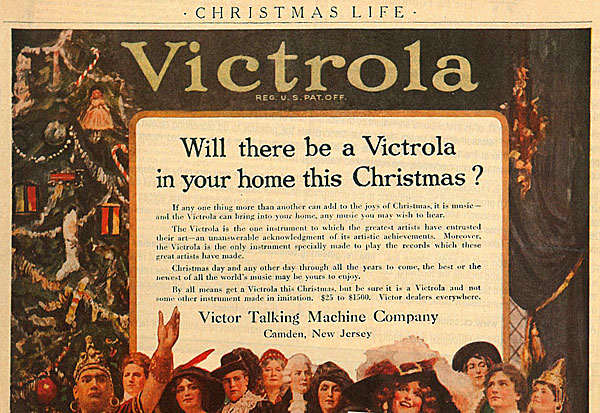
One of the benefits of belonging to the Institute of Electrical and Electronics Engineers (IEEE) is a subscription to their monthly magazine, IEEE Spectrum. Superbly written and edited, this journal keeps me up to date on emerging technology, and entertains me with things like reprints, on the final page, of vintage advertisements. Their January 2016 issue, for example, featured an ad from December 1920, promoting the Victor Talking Machine Company's Victrola: "By all means get a Victrola this Christmas, but be sure it is a Victrola and not some other instrument made in imitation. $25 to $1500. Victor dealers everywhere."
In 1920, "$25 to $1500" was the equivalent of $300 to $18,000 today—which is pretty much the range of what you need to pay to get a halfway-decent audio system or better. But what then caught my eye was the headline of the accompanying article, "When Caruso Was King," and a comment by its writer, Alexander B. Magoun: "As music formats have morphed from vinyl discs to cassettes to CDs and MP3s, the classical recording industry is nearly extinct."
Extinct? Not in 1920. As detailed in Roland Gelatt's superb 1965 book, The Fabulous Phonograph, the meteoric rise of both the record industry and the manufacturers who made the hardware on which to play records was tied to recordings of classical music. Not only was Enrico Caruso the Adele of his time, it was his 260-plus recordings on RCA Victor's Red Seal label that fueled the boom in "talking machines."
Extinct? Not when I was young. My evolution as an audiophile was fueled by recordings of classical music. When I was 11, my parents bought me the Reader's Digest Festival of Light Classical Music, a 12-LP collection of works ranging from Mozart's Eine kleine Nachtmusik to the overture to Wagner's opera Tannhäuser, all recorded by RCA's British A-Team of producer Chuck Gerhardt and engineer Kenneth Wilkinson. And when I started high school, we had a mandatory weekly lesson in "Music Appreciation," in which we were introduced to works like Sibelius's Finlandia, Mars and Jupiter from Holst's The Planets, and the Scherzo of Beethoven's Symphony 3, "Eroica," played on a mono system comprising a Leak "Sandwich" speaker driven by a Leak "Point One" tube amp.
The first classical LP I bought with my own money was of the 1959 modern-instruments performances, by Sir Yehudi Menuhin and the Bath Festival Orchestra, of Bach's Brandenburg Concertos 1–3, followed by Tchaikovsky's Symphony 4 from the London Symphony Orchestra conducted by Igor Markevitch. And when I started putting together my own audio system in the mid-1960s, the better the components I bought, the better these LPs sounded. As, of course, did the rock albums I bought—by Cream, Jimi Hendrix, the Byrds, the Beatles—to feed my burgeoning hi-fi habit.
Extinct? Perhaps. As I read the article in IEEE Spectrum, I had just finished preparing our 2016 special issue, 10 Years of Records to Die For: a collection of reviews of 500 albums that Stereophile's hardware and software reviewers could not bear the thought of leaving behind. Stereophile's founder, the late J. Gordon Holt, strongly felt that classical orchestral music was the only music worthy of being played through a true high-fidelity system. Yet just 14 pages of this "Collectors' Edition" are devoted to Classical Orchestral recordings, compared to 20 pages for Jazz. The largest category is Rock (including Pop, Alternative, and Country), at 48 pages—a statistic that I'm sure has JGH reaching for another celestial cigarette.
Extinct? Perhaps yes. According to Nielsen Soundscan, in the US in 2013, classical sales were just 2.8% of the total sales of CDs, cassettes, LPs, and downloads. This is less than half the figure I found for pre-CD 1983, when the amount of money spent in the US on classical records and tapes was 6% of the total, and undoubtedly rose through the rest of that decade as music lovers bought CDs to replace their classical LPs. But by the late 1990s, when Stereophile Inc. sold the Schwann Record Guides to Allegro, a record-distribution company, I was told by the purchaser that it was a rare classical CD that sold more than 1000 copies in its first year of release. And when you consider that schools no longer play classical music to their students and that classical radio stations are disappearing, it's difficult to see where new classical record buyers are going to come from.
Extinct? Perhaps not. Perhaps the statistics don't tell the whole truth. Audiophiles may pay large sums for classical recordings from the 1950s and '60s, when audio engineers didn't yet know enough to know how to ruin the quality of recorded sound—a subject close to JGH's heart. But I believe that we are living in a new Golden Age of classical recording triggered by the advent of high-resolution digital recording and powered by the advent of, first, the SACD medium, and now by high-resolution PCM and DSD downloads—all with sound quality that listeners of Caruso's era could only dream of.
And from their existing catalogs of classical CDs, record companies are offering complete collections at bargain prices. Last year, for example, I bought Decca Sound: The Analogue Years, a boxed set of 50 CDs, for $120—just $2.40 per disc. Similar collections are available from DG Archiv Produktion, DG, Philips, and L'Oiseau-Lyre, with prices per disc dropping to as little as $1.
There's life yet in the music that fueled the fabulous phonograph: If you release it, they will listen.—John Atkinson















