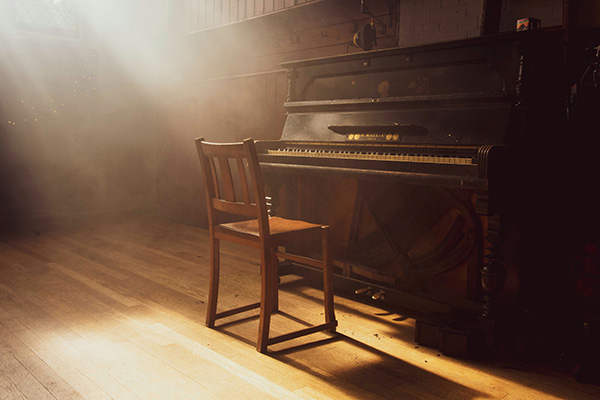
Photo: Paul Arkyon, Unsplash
There's a scene in the 2002 movie
The Pianist in which Adrien Brody's character, the Polish-Jewish pianist Władysław Szpilman, is hiding in the ruins of a Warsaw villa. The Nazi officer who discovers him asks what he did before the war. "I was a pianist," Szpilman stammers. The German points to a battered grand piano and orders him to play something. Szpilman hesitates, sits, lifts his trembling hands, and begins Chopin's
Ballade No.1 in G minor.
He plays because it's what's left; not to beg, not to resist, but to hold onto the one thing that still makes him himself. It isn't protest music or even defiance in the traditional sense. It's something deeper: an assertion of worth, humanity, beauty, all still alive in the rubble.
That scene wouldn't leave me alone this past year. The machinery of American democracy sputtered, and in the midst of it, the music I love—most of it nonpolitical—started to sound charged, alive, subversive, even when the lyrics aren't. It isn't just Kurt Weill or Gil Scott-Heron. Billie Eilish and Philip Glass now crackle with a sharper edge too.
I have also found new solace in world music. The devotional chants of Nusrat Fateh Ali Khan and the polyrhythms of Manu Katché move nimbly past the parochial, claustrophobic limits now being imposed on the Kennedy Center, public radio, and other institutions that ought to celebrate the breadth of human expression. When the culture contracts and once-open doors start closing, it feels good to listen to sounds that reject the small vision taking hold.
The pulse of the country is now dramatically different from anything I've experienced in 34 years on these shores. The national vocabulary has curdled into something cold and frightful. Disquieting phrases have crept into the discourse. "Enemy of the people." "Disloyal." "Vermin." Immigrants are accused of eating pets and "poisoning the blood of our country." I'm a migrant myself, but the calumny and cruelty in that language aren't meant for me and most other Europeans. It's aimed at people like my three Chinese-born daughters and darker-hued people. The language of strongmen and scapegoats has returned as if we've learned nothing at all.
This is the atmosphere in which I now listen to music. It has become a counterweight, an anchor. I linger in a melody, stay with a phrase, and let myself feel something without irony or armor.
That scene from
The Pianist haunts me because Szpilman is surrounded by absence, by the remnants of lives interrupted. I've long been drawn to photographs that capture the frozen moment, the instant between ordinary life and erasure.
Some of the pictures I keep coming back to show empty WWII-era rooms suspended in time. They can seem worse than scenes of carnage. I try to mentally inhabit the spaces left behind after families were rounded up and taken away—in Warsaw, Amsterdam, Vilnius. I don't know if I belong there, if I'm
allowed, but I go anyway. I visit parlors with coats still on hooks, children's drawings on a wall, used teacups. Clutter left after a rushed breakfast. No one came back that evening.
The pianos are always the worst. They often stand near a window and are draped in lace. I picture the hands that played the keys, the fingers that fumbled scales or found the shape of a tune by ear. Perhaps someone tried to impress a guest after dinner. People sat at those pianos and played Schubert's
Moments Musicaux, or Bach's
Prelude in C, or Gershwin's "The Man I Love." The performance brought comfort, or laughter, or pride. Music warmed those rooms. Then silence came and stayed too long. No one smashed those pianos. No one stripped them for wood, at least not right away. The violence was elsewhere. It's the
abandonment that calls out. A piano unplayed, orphaned, with no one left to listen.
I used to think such images held meaning only because they were sealed in the past—that the shock came from the contrast between the brutality that emptied those rooms and the tenderness that still clung to them. But that sense of distance has begun to slip. The past doesn't feel like the past. Something ugly is stirring again, too familiar to ignore.
Taking time to listen is a refusal to let the world be flattened into slogans and rage. Good music asks for attention, for empathy, for vulnerability. Those things aren't especially in fashion right now, but neither are they easy to crush.
Władysław Szpilman knew.
Music also steadies us and quiets anxiety. So we return to old favorites, follow new ones down rabbit holes, fall quiet when a song lands just right, honor giants whose names have faded but whose sounds never left the room.
We home in on a vocal, a cello line. A strange chord catches in our chest. We savor the moments that stop the noise, even briefly. They tether us to what's fading—decency, for one—and remind us never to let go.
Opinions expressed in My Back Pages
are not necessarily those of the magazine or its management.