

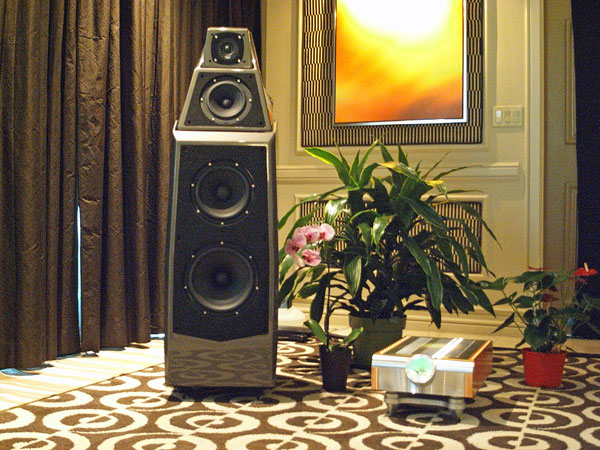
Over dinner one evening at the 2013 CES, I was being grilled by other magazine editors about my measurements of the Wilson Audio Specialties Alexandria XLF speaker that Michael Fremer reviewed in the January issue. In vain did I point to the XLF's superb in-room response; in vain did I emphasize that no one measurement fully describes a speaker's sound; in vain did I point out that the best way to integrate all the measurements was to listen to the thing. What I should have done was bid my peers to visit the dCS suite on one of the Mirage's penthouse floors where Wilson's Alexia loudspeaker ($48,500/pair), which incorporates much of the XLF's technology, was being demmed with Dan D'Agostino Momentum monoblocks and dCS's new Vivaldi digital system, wired up with Transparent Audio cables.
First Peter McGrath played me a live hi-rez recording of Mahler's Symphony 5, the one where the opening fanfare on solo trumpet is followed by an orchestral explosion. Then I played the hi-rez master of my 2008 recording of Cantus performing Eric Whitacre's "Lux Aurumque" (footnote 1). I wished my fellow editors had been there. Not only was the relationship between the sounds of the singers and musicians and the surrounding ambience of the recording venue breathtaking real, so was the relationship between the musicians and the music. I have played "Lux Aurumque" on dozens of systems—never have I heard it sound so real, so musically involving, as on this Wilson–D'Agostino–dCS–Transparent system. Wow! Just wow! As Peter said, "inargueably beautiful."
Footnote 1: You can hear an excerpt from this recording, although as a 256kbps MP3, at the foot of this page.
Footnote 1: You can hear an excerpt from this recording, although as a 256kbps MP3, at the foot of this page.















