

The Sonus Faber
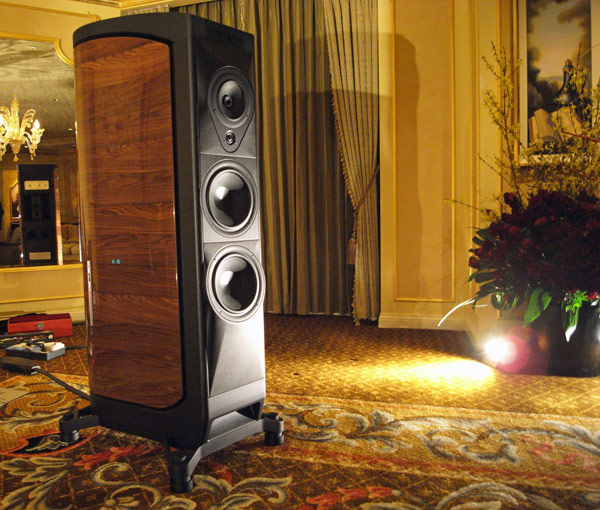
Previewed by Michael Fremer in the October 2010 issue of Stereophile (pp.1316), where he goes in depth into its technology, Sonus Faber's flagship loudspeaker, The Sonus Faber, will only be produced in a limited edition of 30 pairs. Apparently, all 30 pairs have been spoken for by distributors and dealers.
This is a big speakerit stands 67" tall and weighs 672 lbsand was being demmed in an appropriately large room with the large Audio Research Reference 610T tubed monoblocks. Or it would have been demmed, as on both my visits to the room, the electricity supply to the room had failed. (If you look closely, you can see the electrician's red toolbox to the left of my photo.)
A JJ Sighting

One of my more pleasant duties at this year’s CES was substituting for John Atkinson at a dinner for the press held by DTS. (JA had not arrived yet from New York.) What I was particularly looking forward toin addition to dinner at Nobu, one of Las Vegas’ best Japanese restaurantswas the opportunity to meet the legendary “JJ”: James Johnston (left), audio researcher, who has been called “the father of perceptual coding” for his work while at Bell Labs on MP3 and MP4. JJ is Chief Scientist at DTS, and also a Forum contributor at stereophile.com, occasionally jousting with those who make claims about sound reproduction that he feels have no scientific basis.
The pre-dinner presentation dealt with the latest surround sound format from DTS: Neo X 11.1, which uses 11 channels. Yes, folks, that’s 11 speakers, 11 channels of amplification, plus a powered subwoofer. There is not definite word on exactly when software and consumer hardware for this format will be available, and DTS admits that an 11.1 channel system is not something the average consumer will likely aspire to. However, a point made by JJ was that even if DTS 11.1 does not reach broad consumer acceptance, the research on 11.1 will lead to a better implementation of surround sound with 5.1 or 7.1 systems. He made an allusion to some work that he’s doing nowwhich he could not discussthat promises sonic virtual reality with a lot fewer than 11 channels.
I did get to meet and chat with JJ, and found him to be very genialnot at all like the doesn’t-suffer-fools-gladly persona that’s sometimes in his Forum postings.
Absolute Fidelity Interfaces
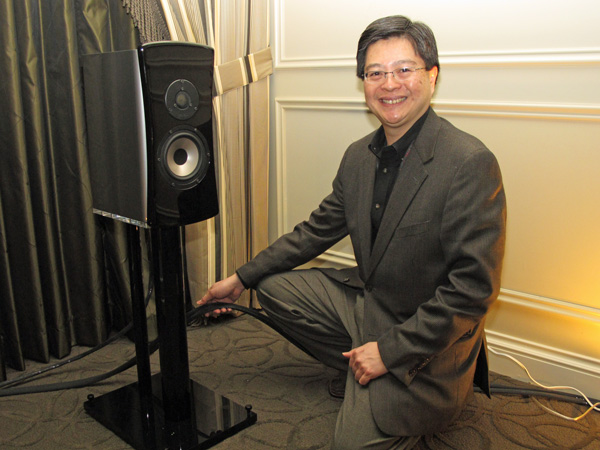
Gary Koh of speaker manufacturer Genesis was happy to show off the new Absolute Fidelity Interface cables. Being sure to note that the product does not use the Genesis name, because it has been designed to be used with all loudspeaker brands, it has been give its own dedicated Absolute Fidelity website.
“To me, a cable should not function as a component; it should be an interface between two components,” said Koh. “Since every component is different, and draws power differently, I’ve designed different cables to interface between different components.”
The Absolute Fidelity Interface line currently includes the Loudspeaker Interface ($3000/2m pair); Turntable Power interface, Amplifier Power interface, and Component Power interface (each $1800/1m pair); and Component Interface (for use between source components, $1800/0.6m pair).
Koh explained that, a few years back, when he could not find a cable sufficiently transparent to do full justice to his Genesis 1.2 loudspeaker, he began rolling his own. Steve McCormack and a few other designers he works with were so impressed with the cable that they urged him to market it.
“I didn’t really launch them,” Koh said with a smile. “They just started selling. You can call this the official launch.”
Acapella Revises the High Violoncello II
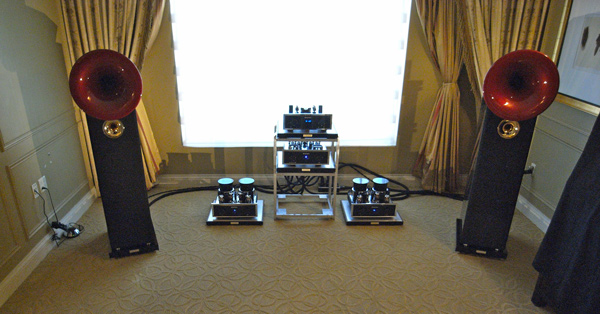
A highlight of my reviewing year in 2010 was living with and writing about the Acapella High Violoncello II speaker from Germany ($80,000/pair). With its horn-loaded, ionic tweeter and horn-loaded midrange unit, this speaker offered both high sensitivity and some of the most satisfyingly musical sound I have experienced in my room.
Current production has been modified a little compared with the much-traveled samples I auditioned for my review. (They were the same pair I had auditioned at the 2010 CES, Axpona and RMAF Shows.) The drive-unit complement, cabinet, and crossover are all the same, but there is now a greater range of level adjustment for the ionic tweeter and isobaric-loaded woofers. But the sound of the latest version at CES. driven by Einstein electronics, sounded just as I remembered: dynamic, transparent, neutrally balanced, and not a trace of horn colorations.
AcousticPlan DriveMaster Transport and DacMaster DAC
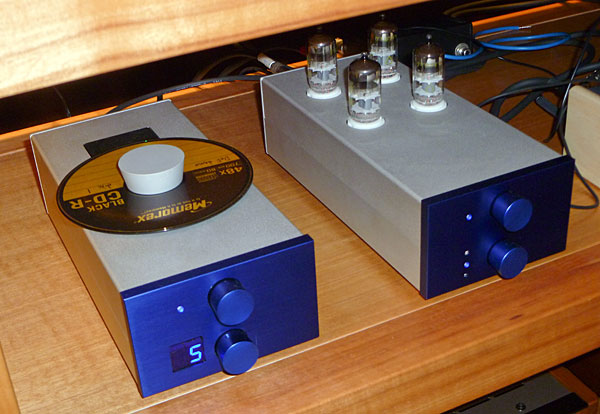
Tone Imports' Jonathan Halpern was on hand to demonstrate the new AcousticPlan DriveMaster transport and DacMaster DAC which retail for $4,200 each and were designed and built by Claus Jaeckle. There is also an optional power supply upgrade for $2,000 that will run two units.
These are small but superbly crafted units, and obviously use a novel approach to spinning a disc. The DAC features SPDIF BNC, I2S, and USB inputs.
Amphion Turns Down the Volume, Turns Up the Emotion
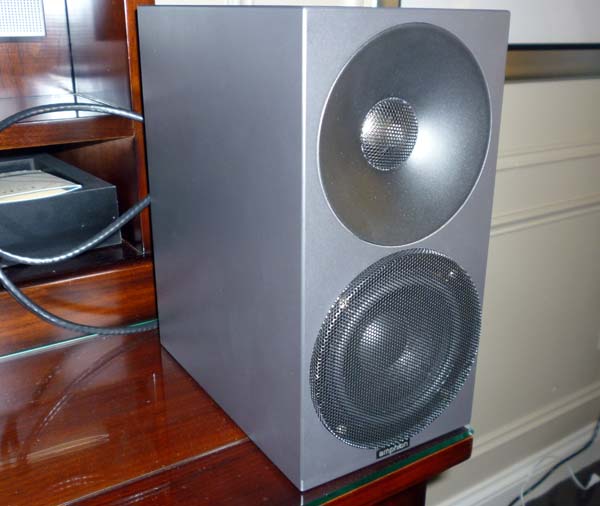
When I walk into the room, Amphion’s Anssi Hyvönen is demonstrating a small, attractive system made of Audio Analogue electronics and Amphion loudspeakers. He talks about the calming nature of music, and then he does something unexpected: He turns the volume down...
Amplification from Vitus
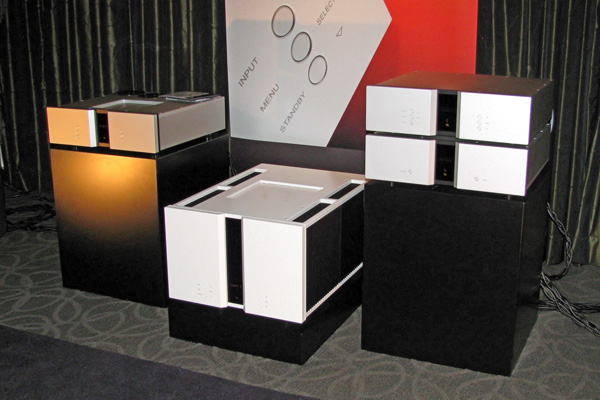
I met designer Hans-Ole Vitus in his room at the Venetian, where he was showing his new stereo amplifier, the Vitus SS 101 (pictured in the middle, $40,000). The SS101 puts out 50Wpc in class-A and 100Wpc in class-A/B. It also has a volume control, making it a single-source integrated amplifier that can be operated by remote control. The system really sounded great and Hans-Ole was a delightful chap.
Antique Sound Lab AQ 1001/1003 Mk.II DT
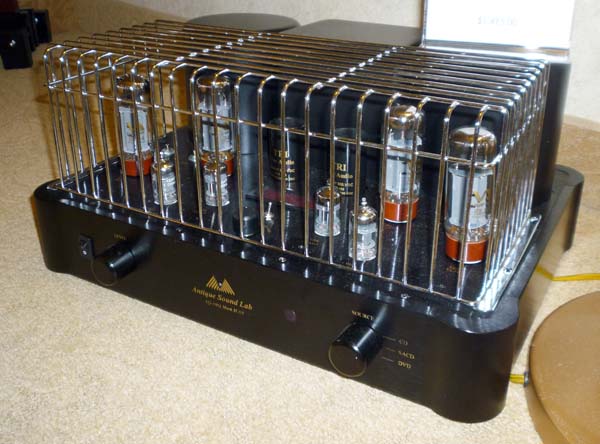
The Antique Sound Lab AQ 1003 Mk.II DT integrated amplifier ($1495) is optimized for EL34 tubes and provides 30Wpc. Though the basic design has been in production for over 15 years, the MK.II DT version has been updated with an attractive extruded-aluminum chassis and improved winding technique for the transformers. These same improvements can now also be found in ASL’s 50Wpc AQ 1001 Mk.II DT ($1995), which, according to Divergent Technologies’ Tash Goka, represents the company’s “best value for money.”
April Music ADAM iPod Dock
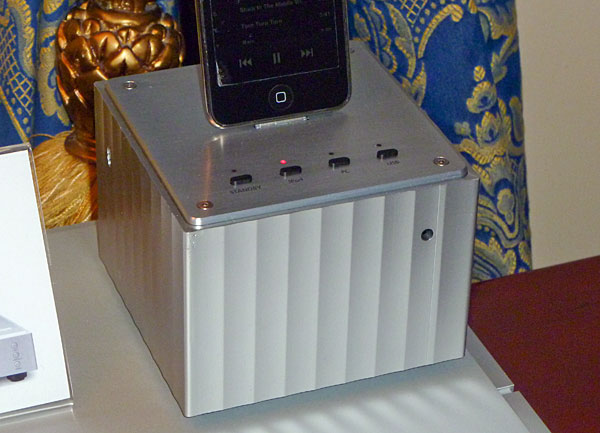
April Music had their new ADAM iPod doc on hand which also sports a USB input and SPDIF output for connecting to the DAC of your choice. The ADAM will retail for $499.
Arcam rDAC and rDACkw
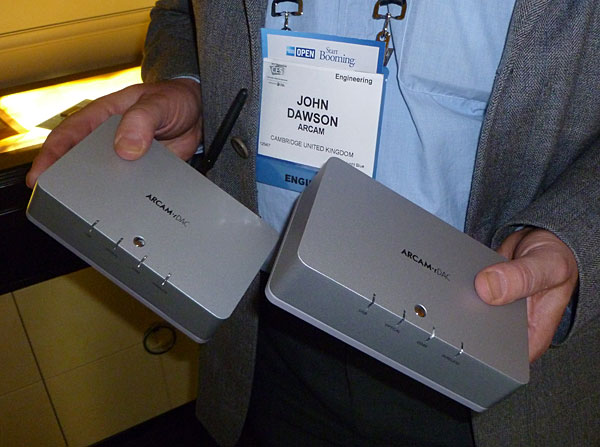
Arcam's John Dawson is seen holding the company's latest cost effective DACs. Featuring asynchronous USB technology licensed from dCS, the rDAC retails for $479 while the rDACkw (on the left) employs Kleer wireless transmitter technology and retails for $599.
Both DACs include one optical and one coax SPDIF connector in addition to USB. For the wireless option, the company has two dongles that connect to the source: the rWave for USB connections and the rWand for iPods. They cost $50 each if purchased with the DAC, $99 each purchased seperately.