Reference

Sort By:  Post Date TitlePublish Date

Colloms on Cables

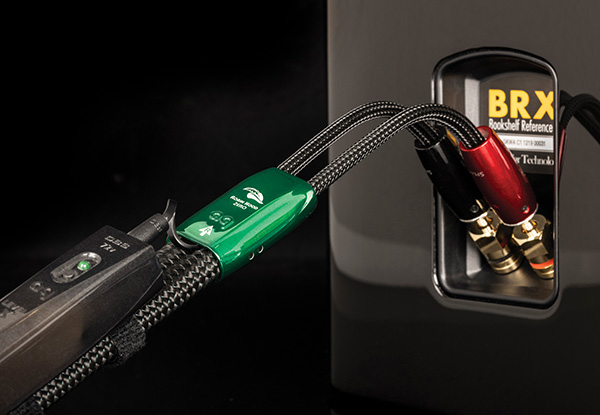
Underpinning a discussion about the merits of potentially costly specialist audio cables is an obvious question: Why do we need them? Doesn't almost all wire conduct audio signals with negligible distortion and very little loss of power? Specialist hi-fi cables seem expensive for what you get. Especially at the upper end, they seem like a worse value than electronics and loudspeakers. Depreciation is greater, too: Cables are almost a consumable.

But if you wish to finesse the quality endeavor of classic separates-based hi-fi systems, you cannot do without them. Fundamentally, it is not the efficient transfer of audio power that's the issue; that is the easy bit. Rather, it is a matter of optimizing the transmission of the more subtle information that describes recorded acoustic, instrumental detail, the performers, and, not least, dynamics and rhythm: Are your feet tapping unconsciously in time to the performance?
Loudspeaker Specifications: What Matters?

In a recent answer to a reader's letter, I somewhat bluntly stated that Stereophile's reviewers use "hi-fi" adjectives to describe loudspeaker sound because even good loudspeakers are too far removed from sounding "real" to be compared directly with live music. Upon reflection, this may have sounded too dismissive, so I will elaborate a little in this short essay.

NWAA Labs: Measurement Beyond The Atomic Level

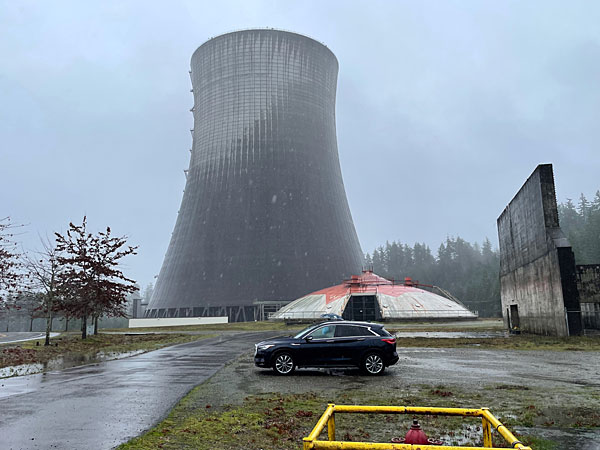
The setting is surreal. As you drive into the Satsop Business Park in rural Elma, Washington (pop. 3500, max), eyes immediately fixate on the looming 481'-tall cooling towers of an abandoned nuclear facility. Remnants of the largest nuclear power plant construction project in the United States, the site was mothballed in 1983, in part due to concerns triggered by reports of what had happened at Pennsylvania's Three Mile Island four years earlier.

Spectral X-Contamination: Problems in Op-Amp Chips

In high-end circles, the sonic repute of integrated-circuit op-amps (from "operational amplifier") is, at best, checkered. Of course, the expertise with which they are used and the parts they're used with can make all the difference. For example, my DIY preamplifier design, "AMP-02," published in Hi-Fi News & Record Review in 1989–90, and my earlier (1983–84) AMP-01 (footnote 1), I used the better IC op-amps of the time throughout. Both units were thought to outperform cost-no-object commercial units of the time that employed discrete transistors and even tubes, and only indicate what's possible.

What a Difference a Wire Makes

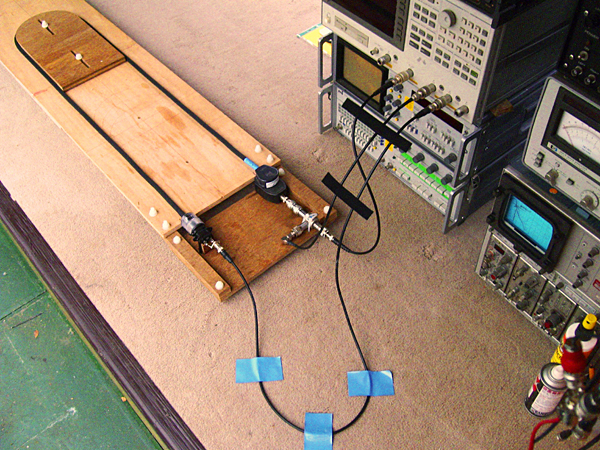
Testing the RF transmission of Kimber Kable, up to 3GHz, at Ben Duncan Research Labs, in 2008. The resulting proof of RF rejection was published on-line by Russ Andrews Accessories in England. (Photo: Naomi Swain).

Editor's Preface: In an article in the October 1995 issue of Stereophile, Professor Malcolm Omar Hawksford used Maxwell's Equations to develop a mathematical model describing the behavior of cables at audio frequencies. Among the predictions of this model were that for good conductors there exists an optimum size of wire for audio signal transmission, and that for a wire larger than this size an energy storage mechanism would exist. In his article Malcolm described a simple experiment, the results of which appeared to confirm his hypothesis.

Then serendipity struck. English engineer Ben Duncan, whose writings have occasionally appeared in Stereophile, sent me an article he had written for the pro-audio magazine Studio Sound. The results of a series of cable measurements he had performed seemed to confirm the Hawksford Hypothesis. We offer them here for your delight and delectation.—John Atkinson

Book Review: Designing Audio Power Amplifiers

Designing Audio Power Amplifiers, Second Edition, by Bob Cordell, Routledge/Focal Press, 2019. 776pp. $160.00, hard cover; $97.95, paperback.

I first met Bob Cordell at clinics he gave at the last audio show Stereophile organized, Home Entertainment 2007, in Manhattan. At those clinics, Bob shared his views on why amplifier measurements are not always good at predicting differences in sound quality. So when I was scheduled to host a seminar—"Amplifiers: Do Measurements Matter?"—at this year's now-canceled AXPONA, Cordell was on the short list of designers I felt would offer valuable insight.

The Uncertainty Principle

Have you ever suspected that the component you bought after diligent research is somehow not "typical"? That its sound seems to bear little resemblance to the descriptions in the reviews you read? Sure, you listened to the unit before purchase, but the one you took out of the box at home—was that the same unit? And if you suspect your new unit's sonic quality is below par, just how do you or your dealer go about proving it?

JA on Loudspeaker Measurements

Author's Note: Although I started accompanying Stereophile's loudspeaker reviews with measurements soon after I joined the magazine in 1986, it wasn't until 1989, when we acquired an Audio Precision System One electronics analyzer and the then-new MLSSA speaker measurement system from DRA Labs, that I developed the standardized data presentation that is still featured in our reviews more than three decades later. In this article from October 1991, I summarize the results from the first two years of using MLSSA to test 69 loudspeakers.—John Atkinson

Harmonic Convergence: the Effect of Component Tweaking

Power amplifiers fascinate me. In the past 15 years I've helped design and build over a dozen advanced models, with output powers ranging from 50 to 2500W, for a number of the UK's professional equipment manufacturers. To learn from others' ideas and mistakes, I've also repaired, measured, used, and reviewed hundreds of makes of amplifier. My experiences have led me to regard the power amplifier as one of the messiest, most imperfect pieces of electronic equipment in the record/replay path.

Subjective Loudspeaker Testing

One of the most firmly-established audio platitudes is the one which says "The specs don't tell the whole story." One reason for this, of course, is the fact that most manufacturers, preferring to sell their products on the basis of emotional appeals in ads rather than on hard, cold performance claims, do not attempt to make their specs tell the whole story.
Advertisement
Advertisement
Advertisement