Historical

Sort By:  Post Date TitlePublish Date

Krell Power: A Visit to the Laboratory of Doctor Morbius

The only one who knows this ounce of words is just a token
Is he who has a tongue to tell, but must remain unspoken.
—Moondog, 1968

The Lockheed 1011 sits dormant on the ground at Chicago's O'Hare airport. "We have a little light bulb problem here" drawls the pilot in the approved Right Stuff manner. "We don't know if it's the bulb or what, we'll let you know."

2020 Jitter Measurements

Even as digital/analog processors were becoming a hot product category in the early 1990s, audiophiles were also learning that timing uncertainties in the AES/EBU and S/PDIF serial datastreams—jitter—would compromise any improvement in sound quality offered by these DACs. Some companies therefore introduced products to reduce or eliminate jitter—in the November 1994 issue of Stereophile, Robert Harley reviewed three such products: the Audio Alchemy DTI Pro, the Digital Domain VSP, and the Sonic Frontiers UltrajitterBug. I still have Stereophile's review samples of the UltraJitterBug and VSP, along with two contemporary DACs: a PS Audio UltraLink and a Parts Connection Assemblage DAC-1.

As our reviews of these products were published before Paul Miller's and the late Julian Dunn's development of the "J-Test" diagnostic signal, I performed J-Test jitter measurements to bring that 1994 review into the 21st Century. You can see what I found here.

Farewell to the Paper Cone

Ever since the first electrical loudspeaker—a glorified headphone with a horn on it—was outmoded by the balanced-armature cone speaker, paper has been the standard diaphragm material for speakers reproducing low frequencies. The Rice-Kellogg moving-coil transducer replaced the balanced-armature driving system in 1925, but the paper cone remained. And although many improvements have since been made, were no more major changes in loudspeaker design for over 30 years!

Stereophile: A Personal Odyssey

John Atkinson (left) and Richard Lehnert (right) in RL's house in May 2011, the day before RL moved from Santa Fe, New Mexico, to Ashland, Oregon. (Photo: Susannah Tyrrell)

I first became aware of the existence of Stereophile sometime in spring 1985, while working as a typesetter in Santa Fe, New Mexico. (Remember typesetting?) From far down the hall behind me I heard a big, high-pitched laugh. I turned to see my present boss guiding toward my dark typesetting cell my future boss: a very tall, balding, round-faced man with a huge grin who shambled along in loose chinos and a Hawaiian shirt in full sail.

The Pros & Cons of Electrostatic Loudspeakers

The main inherent advantage of the full-range electrostatic loud speaker system is that it allows a single diaphragm to embody the conflicting attributes needed for optimal performance at both extremes of the audio range. Its thin-membrane diaphragm can be made exceedingly light, for superb transient response and extended HF response, yet it can be about as large in area as desired, for extended LF response.

The Nonstick Embrace Of Home Theater

Editor's Note: 24 years ago, in January 1995, we published the first issue of Stereophile Guide to Home Theater, a sister publication intended to appeal to the the growing number of home-theater enthusiasts. Stereophile's founder, the late J. Gordon Holt, had gotten early into the idea of accompanying movies with high-quality sound, and when I first visited his New Mexico home in January 1986, his system included an Advent NTSC-format video projector.

The 1965 New York Audio Show

Note: As our coverage of the 2016 New York Audio Show has just been posted, I thought it would be interesting to post our report from the 1965 show, in particular to see which brands are still around 50 years later.—John Atkinson

The 1965 New York hi-fi show was, to these observers, most notable for the marked increase in the number of exhibits which featured good—ie, classical—music for demonstration purposes. In the past, only about a half dozen of the exhibitors played any thing of musical worth, the rest of them evidently figuring they could make more noise with wild brass-and-percussion "demo" records.

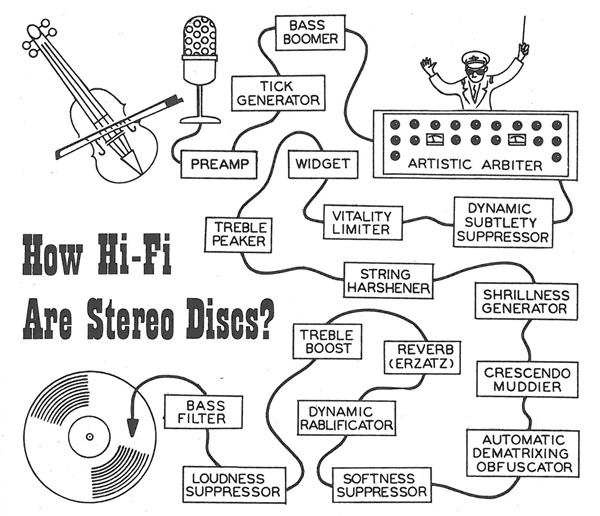
How Hi-Fi are Stereo Discs?

Editor's Note from 1992: This seminal J. Gordon Holt essay on how the art of recording natural sound became compromised in favor of unmusical artificiality for good commercial reasons was originally published in August 1964, in Vol.1 No.8. Though most people these days listen to classical music from CDs, not LPs, in the intervening decades, recording technology has not changed for the better as much as one might have hoped. Nevertheless, the days of wretched multimiking excess described by Gordon are past, and it's rare to find the music treated with the lack of respect typical of a mid-'60s Columbia session. Although some of the smaller companies—Reference Recordings, Delos, Chesky, Mapleshade, Dorian, and Sheffield Lab in the US; Meridian, Nimbus, and Hyperion in the UK—consistently use honest, minimal miking, it is not unknown for the majors in the '90s to do likewise. And the use of time delay for spot microphones, pioneered by Denon in the mid-'80s, means that instruments that might tend to become obscured at orchestral climaxes can now be brought up in level without unnaturally time-smearing the sound. I still find it sad, however, that it is rare to hear the sheer dynamic range of a live ensemble successfully captured on a commercial recording.—John Atkinson

Ralph—The Real Dog

Ralph died last week (September 11, 1991), his great and faithful heart stopped in the aftermath of an affliction not too uncommon for older, larger dogs—a gastric torsion. He was approximately 12 years old.

Advertisement
Advertisement
Advertisement