How good will downloadable audio have to become before you're interested in buying it?
So far, the audio quality of downloadable music has been almost as good as AM radio. How far does it have to go before you'll want to pay for a download?


So far, the audio quality of downloadable music has been almost as good as AM radio. How far does it have to go before you'll want to pay for a download?
The global market for music could reach $42.8 billion within five years—more than $7.5 billion higher than the present level, according to a recent study by <A HREF="http://www.pwcglobal.com/">PriceWaterhouseCoopers</A> and <A HREF="http://www.wilkofskygruen.com/">Wilkofsky Gruen Associates</A>. In the about-to-be-released study, <I>The Global Entertainment & Media Outlook: 2000–2004</I>, the firms make their prediction based on buying patterns and other economic factors in several regions of the world.
Audio manufacturers who know what's good for them avoid stepping on the toes of <A HREF="http://www.bose.com/">Bose, Inc.</A> The Framingham, Massachusetts–based corporation is renowned for it ruthless marketing and zealous protection of its patents.
E<I>ditor's Note: This is Part Three of a six-part series from reader Hervé Delétraz of Switzerland, who is chronicling the development of his DIY (do-it-yourself) audio amplifier. Part One is <A HREF="http://www.stereophile.com/news/10825/">here</A>, and Part Two is <A HREF="http://www.stereophile.com/news/10832/">here</A>.</I>
Jonathan Scull writes that "with its latest series of FPB (Full Power Balanced) amplifiers, Krell is taking careful aim at the <I>seam</I> between classic high-power two-channel systems and quality multichannel installations where sound is yet paramount. Nevertheless, Krell founder Dan D'Agostino was adamant: Krell's Class A components were designed for music playback. 'I'm a purist, like you, Jonathan!' he told me." In his review of the <A HREF="http://www.stereophile.com//amplificationreviews/266/">Krell Full Power Balanced 350mc monoblock amplifier</A>, Scull determines whether or not Krell has struck its musical target.
The enduring audiophile dilemma about whether to optimize a home-entertainment system for music or movies may no longer be relevant, thanks to new disc players from <A HREF="http://www.sony.com/sel/">Sony Corporation</A> and <A HREF="http://www.philips.com/">Philips Electronics NV</A>. The machines were introduced at <A HREF="http://www.cedia.org/expo/">CEDIA Expo 2000</A>, the annual home-theater and custom-installation trade show held in Indianapolis.
H<B>ome Entertainment 2001</B> (formerly The HI-FI Show) is heading back to the heart of New York for the first time in five years. Described as "a unique hands-on event where attendees will see and hear the newest and the best in home audio and home theater," HE 2001 will take place May 11–13 at the Hilton New York.
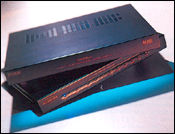
<B>Prelude</B> <BR> I fell in love with the original Link DAC, as was obvious from <A HREF="http://www.stereophile.com//digitalsourcereviews/234/">my review</A> in the January 1999 <I>Stereophile</I>. I said that "the Link redefines entry into high-quality digital sound," as it provided excellent sound and 24-bit/96kHz conversion for the remarkably low price of $349. It is as firmly ensconced in Class C of "Recommended Components" as it is in my weekend system, where it tames the digital signals from my DMX receiver and my trusty old Pioneer PD-7100 CD player.
You've decided to add a new piece of equipment to your system. Now begins the process of figuring out which make and model you want. How do you test products to make sure you get the right stuff?