Audacious Audio

Sort By:  Post Date TitlePublish Date

TAD Compact Reference CR1 loudspeaker

High-end audio is in some ways a dynastic beast, though without as many "begats." One of the world's most successful loudspeaker manufacturers in the years following World War II was the Wharfedale company, from Yorkshire in the North of England. Wharfedale was founded by Gilbert Briggs in 1932, who in the 1950s handed over the reins of Technical Director to fellow Yorkshireman Raymond Cooke. Cooke left Wharfedale in 1961 to found KEF Electronics Ltd., where he subsequently appointed Goodmans designer Laurie Fincham as Chief Engineer in 1968. Fincham led a team of young engineers, including Mike Gough, who eventually joined B&W, and Yorkshire-born Andrew Jones, who became KEF's Chief Engineer in 1989, before Fincham was lured to Harman's Infinity division, in Northridge, California, in 1993. Jones followed Fincham across the Atlantic, where he worked on Infinity's Prelude, Overture, and Reference Series speakers, before joining Pioneer in 1997. The Japanese company had established a state-of-the-art speaker-design facility in Southern California, and Jones was invited to lead the design team.


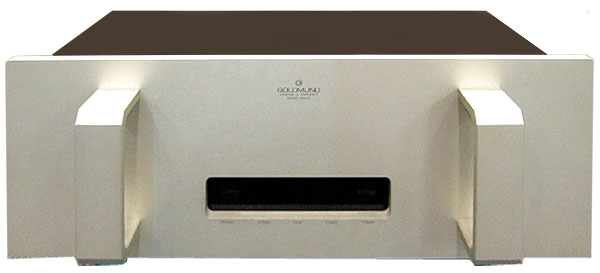
Goldmund Mimesis 8 power amplifier

To judge from the $6400 Mimesis 8, Goldmund walks its own way when it comes to power amplifier design. High-end solid-state amplifiers from US companies like Krell, Mark Levinson, Threshold, and the Jeff Rowland Design Group marry massive power supplies to large numbers of output devices (these often heavily biased to run in class-A), built on chassis of such nonmagnetic materials as aluminum. By contrast, the Mimesis 8 has a magnetic (steel) chassis, and uses a relatively modest power supply, that for each channel based on two main 4700µF reservoir capacitors. The 8 offers just two pairs per channel of complementary output MOSFETs (Hitachi K134/J49). These carry a modest bias current of around 80mA total.

Musical Fidelity AMS100 power amplifier

"That's just silly on so many counts, Antony."

I was talking last winter to Musical Fidelity's Antony Michaelson, who had been enthusing about his forthcoming stereo amplifier, the AMS100. It would be physically enormous—almost a yard deep—and commensurately heavy at 220 lbs. Despite its bulk, its maximum rated output would be just 100Wpc into 8 ohms. It would also be expensive, at $19,999. And to cock a snoot at environmentalists and their concerns, the AMS100's output stage would be biased into class-A up to its rated 8 ohm power, meaning that, even when not playing music, it will draw around 10 amps from a typical US wall supply of 120V. This also means that it will run very hot, making the amplifier impracticable for summer use in homes without central air-conditioning. Like mine.

Voxativ Ampeggio loudspeaker

It wasn't so much a vow as a prediction: After selling my last pair of Ticonal-magnet drivers and the homemade horns I'd carted around to three different houses, I supposed I would never again have a Lowther loudspeaker in my humble house.

That remains literally true: The 7" full-range drivers to which I'm listening today are from a German company called Voxativ; the horn-loaded cabinets from which they play were also designed by Voxativ, and are made in Germany by the Wilhelm Schimmel piano company. And, with all due respect to Lowther, the 75-year-old English loudspeaker firm that launched a thousand DIY fantasies—not to mention a thousand very lively wavefronts—the Voxativ drivers and horns take the Lowther concept further than anyone else of whom I'm aware.

VTL MB-1250 Wotan monoblock amplifier

Most reviewers look for a "hook" or angle of some kind when it comes time to write a review. After all, how many ways are there to get excited about audio equipment? Kathleen and I like to focus on the human side of the High End. So it was with some amusement that I watched the obstacles swirl around what I thought would be a fairly straightforward review of the Vacuum Tube Logic MB-1250 Wotan monoblock power amplifier. My thought was to return from single-ended to push-pull with a bang! I'll say...

It all began at the January 1996 WCES, where I found my shorts positively welded to the listening chair during a memorable musical blast at VTL. Luke Manley and his extreme audiophile wife Bea had a good thing going and they knew it. People were talking. "Did you hear those monster two-storey VTLs on the Alón Vs?"

Ypsilon PST-100 Mk.II line preamplifier

Though essentially a two-man operation based in Athens, Greece, Ypsilon Electronics has been, since 1995, turning ears and eyes throughout the audiophile world with purist, hand-crafted electronics whose sound seems to defy characterization. Even under audio-show conditions in difficult hotel rooms, and often driving unfamiliar loudspeakers, the sound of Ypsilon electronics seems to evaporate in ways that few products manage, leaving behind less residue and more music.

VTL MB-450 Series III Signature monoblock power amplifier

The VTL MB-450 series began life in the late 1980s as the Deluxe 300, a pair of which I once owned. Over the years the basic design has been improved and modified, in the forms of the MB-450 (1996) and the MB-450 Series II (which I reviewed in January 2008). The tube complement remains the same: eight 6550s in the push-pull output stage, a 12AT7 input tube, and a 12BH7 driver. Into a 5 ohm load, the MB-450 III is claimed to produce 425W in tetrode mode or 225W in triode, from 20Hz to 20kHz.

Audio Note Jinro integrated amplifier

It's asked all the time, wherever audiophiles gather to grumble: "Everybody knows about Ferrari, Rolex, and Leica. But why hasn't anyone heard of . . ."

The last word is up for grabs: Wilson? Levinson? Linn? Maybe. But for me, whenever I'm in pissing-and-moaning mode, the choice is easy: Why hasn't the average consumer heard of the Audio Note Ongaku?

Advertisement
Advertisement
Advertisement